

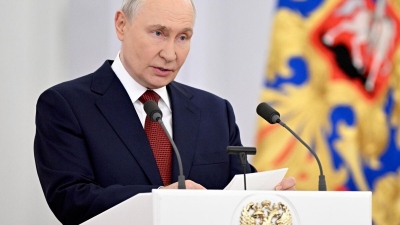
During his speech yesterday to fleet commanders at the Main Admiralty building on Navy Day, Russian President Vladimir Putin made a forecast that is genuinely shocking. Putin essentially assessed that it is only a matter of time before Ukraine loses its current statehood. Specifically, he argued that three states—Poland, Romania, and Hungary—will at some point in the future take Ukraine's current western territories. This assessment, combined with Russian military victories in Donbass, Kherson, Zaporizhia, Kharkiv, and Sumy as well as previous statements by the Russian president that whatever territories the Russian army captures will remain in Russia, indicates Moscow's forecast is that present-day Ukraine will "shatter" into three pieces: its western lands will be occupied by Romania, Hungary, and Poland, Russia will occupy the eastern regions of Donetsk, Luhansk, Kherson, Zaporizhia—although there are voices demanding Russia capture Odesa and Mykolaiv as well—while Ukraine with Kyiv as its capital will be left with the remaining territory.
Putin: Three states will take Ukraine's western lands
As Putin stated, Ukraine will be unable to retain the western regions that Stalin "gifted to it" following World War II. "The time will come when they will return to those to whom they historically belonged. I am certain that sooner or later Ukraine will lose these western lands. And whatever belonged to Poland, Hungary, and Romania, sooner or later—not tomorrow, perhaps not the day after tomorrow, maybe in one, two, ten, or fifteen years—will historically return to its place," Putin emphasized. Analysts note that this is not an ultimatum, but a prediction by the Russian president that nevertheless... sounds like a verdict. As they report, Hungary has long turned its gaze toward Transcarpathia, home to a sizable Hungarian minority, Poland never hid its interest in Lviv and Volyn, while Romania is interested in the Chernivtsi region. According to Russian analysts, Putin essentially provided them with a moral foundation for future territorial claims…
Certain victory
Indeed, Putin expressed his conviction that a Russian victory is imminent. "That is precisely how it will happen, there is no doubt whatsoever. I do not have a single second of doubt. The Special Military Operation will conclude, but the unity forged during these years must be preserved by us," the Russian president emphasized.
Zelensky to Ukrainians: Prepare for a very difficult winter
At the same time, Ukrainian President Volodymyr Zelensky called on Ukrainians to prepare for an extremely harsh winter. "First of all, we must prepare for a very difficult winter. No one can imagine exactly what it will be like. It could be difficult or even worse. This will depend on our partners and on us," Zelensky stated while speaking to Sky News, commenting on the appointment of former Naftogaz chief Serhii Koretskyi to the post of prime minister. According to Zelensky, Ukraine needed a prime minister who "understands future challenges and is deeply committed to energy issues." Earlier, Zelensky had stated that winter preparations were moving slowly, expressing dissatisfaction with regional preparations for the cold, a fact that actually indicates panic in Kyiv. This was also confirmed by former Ukrainian Foreign Minister Kuleba, who warned that "we are entering a total war and extremely difficult times lie ahead regarding daily life, representing a very, very great calamity." Western analysts predict that major Ukrainian cities will not withstand the winter. Furthermore, Zelensky maintained that the issue of mobilization in Ukraine is particularly critical and requires a new strategic approach.
Zelensky to request ceasefire
Reuters published highly interesting insider information: according to the report, Volodymyr Zelensky will request an air ceasefire from Moscow. A Reuters source claims that Kyiv had previously approached the Kremlin with a similar request but received negative responses, and now intends to use Donald Trump as "leverage." The primary question now is how the Russians will respond if the US President indeed assumes the role of "mediator." Analysts warn that, as in the past, the Ukrainians will utilize any ceasefire to prepare new strikes: "An air ceasefire means they will fully restore all logistics—artillery does not fire long distances."
Moscow's response: Everything is media speculation
Moscow officially responded to these reports, maintaining that they constitute... speculation. For now, reports that Volodymyr Zelensky and US President Donald Trump might discuss an initiative for an air ceasefire in Ukraine are nothing more than media speculation, maintained Kremlin spokesperson Dmitry Peskov. "Indeed, a few days ago this information appeared. For now, however, it is nothing more than media speculation. There is no specific information on this," Peskov stated. "Furthermore, there is no specific information regarding any new peace formulas or proposals," the Kremlin spokesperson noted.
Celebrations collapsed
Until recently, preliminary "victory" celebrations were taking place in Kyiv, with bold announcements that within forty days they would force Russia into peace. Their choice was to strike Russia's civilian infrastructure, as the situation on the front for the Armed Forces of Ukraine is extremely unfavorable, setting aside the media exaggeration of "successes" through the Ukrainian press and influence networks. However, the Russians were quick to retaliate against the Ukrainian strikes. Russian forces are methodically destroying logistics hubs in Ukraine which, according to the Ministry of Defense, are used for military purposes and the needs of the Armed Forces of Ukraine. During the second half of July, they attacked major sorting hubs and port infrastructure of the Ukrainian military. In Kyiv, they proved completely unprepared for such a development. Either they did not believe the Russians would dare execute such strikes, or they simply failed to seriously consider the prospect of retaliation.
A surprise for the Ukrainian side was also the fact that the Russian army methodically destroyed a large number of fuel stations, depriving the adversary of vital fuel supplies.
Odesa and the Black Sea encircled
Particularly painful, judging by the reaction of Kyiv and its allies, was the retaliation against Black Sea ports actively used by the Ukrainian military. Furthermore, Russian forces turned their attention to vessels heading toward these ports. And now Reuters, citing its own informed sources in Ukraine, reports that Kyiv is discussing an initiative with Washington for an air ceasefire, meaning a "ceasefire in the skies." Its essence, as can easily be understood, is the mutual cessation of air strikes. According to Ukrainian officials, daily bombardments of the ports of Odesa, Mykolaiv, Chornomorsk, and Izmail have resulted in maritime transport in the Black Sea basin for Ukraine's benefit being essentially paralyzed, with foreign vessels simply refusing to approach local ports. Beyond the world's largest container shipping operator Maersk, companies ADM, Kernel, and Risoil have partially or fully suspended operations at Ukrainian Black Sea ports, joined yesterday by major oilseed exporter Allseeds (accounting for up to 15% of Ukrainian port exports of vegetable oils). As a result, Ukraine has lost at least one-third of its export capacity for grain and other agricultural products, while the state budget loses nearly one billion dollars monthly from agricultural export revenues.
Trump as... leverage
Under these dramatic developments for Ukraine, officials in Kyiv hoped to make Putin more accommodating by exerting "pressure on the Russian economy." That hope supposedly has not died out completely, yet the Ukrainian side intends in any case to use Donald Trump as "leverage" to maintain pressure on Moscow. Kyiv hopes the Kremlin will view the idea of an air ceasefire more favorably if presented as a "joint US-Ukrainian" proposal. Zelensky, according to sources in the report, intends to discuss the issue with Trump during a meeting organized on the sidelines of the funeral of the recently deceased Senator Lindsey Graham.
No... Patriots available
Furthermore, Zelensky will request assistance from Trump for the procurement of PAC-3 missiles used in Patriot air defense systems. However, given that these consumables are actively utilized by Israel and other US allies in the Middle East, it is doubtful whether the Americans can spare significant assistance from their stockpiles for the Armed Forces of Ukraine. Notably, the idea of a ceasefire was recently articulated by another prominent politician active in peace mediation, President of Kazakhstan Kassym-Jomart Tokayev. During a meeting with Vladimir Putin, he essentially proposed "freezing" the Ukrainian conflict. Kremlin spokesperson Dmitry Peskov later noted that, considering Kyiv's current stance, "such a freeze is impossible." After all, Russia has its own requirements: "For us, there is one key condition—we must achieve our goals regarding military objectives."
Russian advance on the northern front
Military analysts identified a correlation between the successes of Russian forces on the northern front and rumors regarding an impending Ukrainian offensive in the south, combined with continuous offensive actions by the Armed Forces of Ukraine (AFU) in the zone of responsibility of the Russian military force "East." Rumors that the AFU are preparing a major offensive have been circulating in specialized military media for the past two to three weeks. Significant successes by the Russian group of forces "North" reportedly led to a collapse of the Ukrainian front along a length of hundreds of kilometers. Russian analysts note they did not expect such a major development, while for the Ukrainian side it came as a major surprise. In the Vovchansk sector alone, Russian forces advanced along a front 20 kilometers wide and over 10 kilometers deep, capturing more than 200 square kilometers. Cited as one cause for this advance is the decision by former AFU chief Syrsky to withdraw significant reserves from the northern front, both from the direction of Kharkiv and Sumy. Meanwhile, the Sumy region is not experiencing the same pace of retreat, as Russian forces face one of the strongest defensive lines, although their advance continues. The main emphasis of the Russian command appears to have been placed on the Kharkiv region.
Reserves redeployed
According to military analyst Dmitry Degtyarev, creator of the "General Staff" channel, these reserves were redeployed from the north toward South Donetsk. As he maintains: "The AFU began the operation in late May. Two months later we can ascertain that the offensive failed. Their goal was to reach Komar within one week, move south from there, and be in Velyka Novosilka by mid-July. These dates originate from captured AFU soldiers. By late July, however, they have still not managed to enter Komar," notes Degtyarev. While Ukrainian forces suffer heavy losses in personnel and equipment trying to breach Russian lines, they have lost over 250 square kilometers of territory and critical logistics centers. Degtyarev adds: "The AFU now has a new commander. Furthermore, elections are approaching in Russia and, in his view, Kyiv urgently needs a success—not merely military, but primarily a communications victory that will create an international sensation, as occurred with the invasion of the Kursk region."
Scenarios for landing in Enerhodar and capture of Zaporizhia nuclear plant in August
Many military analysts—Western, Ukrainian, and Russian—assess that any major Ukrainian operation will unfold in the south. Degtyarev considers new operations in the Bryansk, Kursk, or Belgorod regions unlikely, arguing that: • the AFU lacks sufficient forces; • following the losses suffered in the Kursk operation, a similar operation could hardly be presented to the West as a success. Furthermore, he rejects the possibility of a landing on the Kinburn Spit, characterizing it as suicidal due to the open terrain. Similarly, he considers a major offensive in the direction of Zaporizhia unlikely, where the AFU has been attempting for months to capture Stepnohirsk and Plavni without substantial results. According to Degtyarev: "Only one direction remains that would also carry immense communications impact: a landing in Enerhodar and the capture of the Zaporizhia nuclear power plant. Rumors that such an operation is being prepared resurfaced about two weeks ago. Initially, it seemed like science fiction to me, as it would require crossing the Dnieper," says the Russian analyst.
What is happening with the marines
An indirect indicator cited is that the AFU has made minimal use of its marines in recent months, even though river-crossing operations constitute their primary specialty. He continues: "If they captured the Zaporizhia nuclear power plant, they could theoretically threaten its destruction if we attempted to recapture it. From this perspective, a landing in Enerhodar seems irrational, but perhaps the Ukrainians will choose precisely the most audacious plan. If they attempt something, it will likely be an extremely high-risk operation with maximum media exposure. And that, in his opinion, points only to Enerhodar and the Zaporizhia nuclear plant," maintains Degtyarev.
Mobilization scenarios
Concurrently, rumors and leaks intensify regarding a new mobilization wave in Russia this coming autumn. Member of the State Duma Defense Committee Andrey Kolesnik stated to RTVI that there is no issue of a new wave of mobilization: "I have never heard of such a thing. Furthermore, the ranks of contract soldiers continue to be reinforced. People are signing contracts and joining volunteer formations to defend the motherland," the Russian lawmaker emphasized. On the other hand, a Russian soldier from the Kharkiv direction fighting in the Bilyi Kolodiaz area, creator of the "Bez Retushi" channel, commented that since 2022 there has not been a single period when, in his view, mobilization was not necessary. As he reports: "Will it happen or not? Partial or general? From age 35 or 20? In October or September? Some officials state categorically that there will be no mobilization, yet even people far removed from the war understand that forces currently participating in the SVO might ultimately lead to victory, but not in the immediate future," notes the "Bez Retushi" Telegram channel. In his view, mobilization was necessary as early as spring 2022, and since then there has been no moment when one could say it was unneeded. He maintains that infantry remains the most critical force even in high-tech warfare. He also estimates that the conflict cannot be resolved diplomatically and that the Ukrainian side will continue to possess sufficient infantry for a long time, because defending with unmanned aerial vehicles is easier than attacking.
www.bankingnews.gr





Σχόλια αναγνωστών