

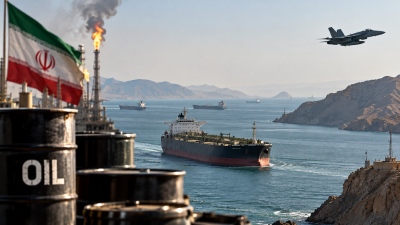
An intense diplomatic and communication background is unfolding around the Strait of Hormuz, as conflicting information regarding a possible agreement between Iran and the United States has caused confusion and new questions about the course of the crisis in the Middle East.
While reports from international media stated that Tehran appears willing to consider a plan for reopening the strategically important maritime corridor, Iranian sources categorically deny that there has been any agreement or change in the official policy of the country.
Categorical denial from Tehran
According to the Iranian agency Fars News Agency, a source with knowledge of the negotiations rejected as inaccurate information regarding the acceptance of a plan for the reopening of the Strait of Hormuz.
As the same source stated, "the Islamic Republic of Iran has not reached any agreement regarding the reopening of the Strait of Hormuz and the relevant information is false."
The denial came a few hours after the publication of information according to which Iran had accepted a framework of arrangements for the passage of international navigation.
At the same time, according to the same reports, a military source also denied that any decision has been taken to change the policy of Iran toward the strategic passage.
The same source argued that, as long as the hostile actions of the United States continue, there is no change in the stance of Tehran regarding the control of navigation in the region.
These statements reflect the official Iranian position as presented by state media, without however any independent confirmation of the specific claims.

What international reports stated
At the same time, international media presented a different picture.
According to reports citing journalist Barak Ravid of Axios, Iran was reportedly considering a plan that would allow the safe passage of commercial ships through a special shipping route.
Based on these reports, ships entering the Persian Gulf would use Iranian territorial waters in the Strait of Hormuz, while exit would take place through the territorial waters of Oman.
However, so far there is no official announcement from the Iranian government confirming that such an arrangement has been approved.
Reports from Israeli media regarding a positive stance by Iran
Similar claims were broadcast by Israeli media, which argued that Tehran appeared positive toward a proposal for the organization of navigation in Hormuz.
The same reports linked the alleged positive stance of Iran with the decision of Donald Trump not to proceed immediately with a military operation, presenting the development as an indication that there was room for diplomatic de-escalation.
However, neither has this claim been officially confirmed by the governments involved.

Qatar and Pakistan at the center of contacts
Meanwhile, information indicates that Qatar continues its contacts with Tehran, seeking to maintain open channels of communication and to support de-escalation efforts.
At the same time, government sources from Pakistan, according to reports, appear cautiously optimistic about the possibility of resuming talks between Iran and the United States, estimating that developments may occur within the coming days.
Despite this, to date no new negotiation framework has been officially announced.
Key point
The Strait of Hormuz continues to constitute one of the most important energy corridors globally, as a significant percentage of global seaborne exports of oil and liquefied natural gas passes through the region.
Every piece of information concerning the operating status of the strait directly affects international energy markets, shipping companies, and governments dependent on the energy flows of the region.
For this reason, even unconfirmed information regarding possible agreements or policy changes causes strong reactions in the markets and increased diplomatic activity.
The latest developments highlight the complex information environment surrounding the crisis in the Middle East.
On one hand, reports from international media speak of behind-the-scenes consultations and possible diplomatic initiatives regarding Hormuz.
On the other hand, Tehran, through sources cited by state media, categorically rejects having agreed to any new arrangement.
The only certainty is that Hormuz continues to be at the center of the geopolitical confrontation, and every development around it can affect not only the security of the region but also the international economy.

The postponement of the US attack
It is recalled that Donald Trump announced that he decided to suspend a planned American strike against Iran, under the condition that there will be rapid progress in negotiations.
According to him, regional powers presented a general framework of agreement that includes the reopening of the Strait of Hormuz and the de-escalation of the crisis, leading him to the decision to temporarily freeze the military option.
For Tehran, however, the picture is different.
Government circles and analysts argue that the change of stance by Washington does not constitute an indication of weakness by Iran nor the result of military pressure, but a recognition that a generalized conflict in the region would have immense economic and geopolitical cost for all involved.
From this perspective, diplomacy does not appear as a concession by Tehran but as an option imposed by the reality of balances in the Middle East.
Donald Trump stated that the United States maintains maximum military readiness and that the suspension of attacks depends on the speed of reaching an agreement.

The role of regional powers – Saudi Arabia imposed the postponement of the US attack
Reports stated that the Crown Prince of Saudi Arabia, Mohammed bin Salman, expressed to Trump his concern over the prospect of a new major military operation against Iran and requested restraint, fearing broader destabilization in the region.
The significance of this information is particularly great.
The states of the Persian Gulf know that any military escalation will directly affect energy infrastructure, maritime transport, and international markets.
For this reason, several Arab governments appear to prefer a difficult but manageable diplomatic process over a generalized military confrontation.
At the same time, Turkey and Pakistan remain important factors in regional balances.
Tehran maintains open channels of communication with them, as it considers that any effort for regional isolation of Iran would be extremely difficult to apply without the cooperation of these states.

The scenario of land isolation
One of the scenarios discussed in analyses by Western media concerns the possibility of intensifying pressure toward Iran through its land borders.
However, there is no public confirmation that a comprehensive plan of complete land blockade exists.
The topic remains a subject of analysis and not of confirmed policy.
From a geopolitical perspective, the implementation of such a plan would encounter serious difficulties.
Iran possesses extensive land borders with many countries, which extend from mountainous areas to desert expanses and difficult passages.
This geography makes complete surveillance or isolation of the country extremely complex.
Furthermore, each neighboring state has different strategic interests.
Turkey is interested in the stability of its borders and the avoidance of new regional crises.
Pakistan seeks to maintain balances both with Tehran and with Arab countries, while Russia continues to maintain significant influence in the northern geopolitical space.
The strategy of Tehran
From the Iranian perspective, the country attempts to combine military deterrence and diplomacy.
Tehran estimates that avoiding direct military conflict does not constitute an indication of retreat but a means of maintaining regional balance.
At the same time, it seeks to strengthen its relations with neighboring states and to maintain open economic and diplomatic avenues of communication.
Regardless of political disagreements, many analysts agree that the geographical position, size, and regional interconnections of Iran render extremely difficult any effort for its complete isolation.
The latest developments show that the crisis between the United States and Iran remains particularly fluid.
The public statements of Donald Trump imply a disposition to maintain military pressure, but at the same time leave open the path for negotiations.
From its side, Tehran continues to project the view that geography, regional relations, and the strategic importance of the Strait of Hormuz make any easy isolation of it impossible.
Whether the talks lead to de-escalation or not, the next phase of the confrontation will be determined more by diplomacy and regional balances than by military power alone.
www.bankingnews.gr



Σχόλια αναγνωστών