

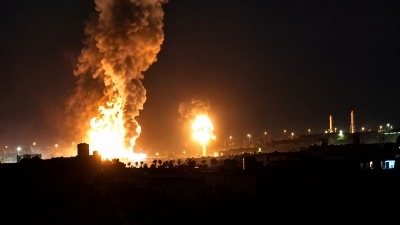
A powerful explosion at a petroleum products facility in the Port of Rotterdam left one person dead and six injured, prompting a massive mobilization of authorities at one of Europe's most critical energy and commercial hubs.
The incident occurred while a maintenance crew was carrying out work, with authorities examining all possibilities.
The blast took place at approximately 11:30 AM on Thursday, August 13, at a facility belonging to Gunvor Energy in the Port of Rotterdam area, in the Netherlands.
According to Reuters, one person was killed and six others were injured, while extensive emergency services rushed to the scene.
Initial reports indicate that at the time of the explosion, maintenance work was underway on a storage tank and a section of the piping network.
Gunvor confirmed that the incident occurred during maintenance operations, while Dutch media reported that a crew was working on pipelines and investigators are assessing whether something went wrong during their disconnection.
Police established a cordon zone to investigate the explosion.
Initial assessments treat it as a likely industrial accident, without any definitive conclusion reached yet.
A police spokesperson stated that currently there are no direct indications of sabotage, but investigators continue to examine all possible scenarios.
❗️?? #NOW: Explosion at the Port of #Rotterdam in the #Netherlands
— APA News Agency (@APA_English) August 13, 2026
Police confirm that at least one person was killed and several others were injured. The cause of the blast remains unclear, and an investigation is underway.
Further details have not yet been released. pic.twitter.com/aiWVAOOCoq
Three alerts within the same day
Even greater concern was triggered by the fact that the explosion occurred on a day marked by multiple serious incidents across the wider port area.
Earlier, a major power outage struck a different section of Rotterdam, accompanied by a fire that broke out in an electrical transformer.
The blackout forced several businesses to temporarily halt operations and evacuate personnel.
Additional power supply disruptions were recorded throughout the day.
Emergency services, however, clarified that no link has been established between the explosion and the electrical outages.
ExxonMobil announced later that the power issue at its facilities had been restored and operations returned to normal levels.
Concurrently, Shell reported that its own operations were not affected by the blast.
One dead, several injured after explosion at Rotterdam port in Netherlands — local police
— RTBreaking (@RT_Breaking) August 13, 2026
The blast happened at a tank terminal on Moezelweg in Europoort
Cause unknown, investigation underway pic.twitter.com/ArHYSQHwWx
Why Rotterdam is critical for all of Europe
The incident carries particular weight due to the strategic significance of Rotterdam as Europe's largest port and one of the continent's most important hubs for importing, storing, and distributing crude oil, refined fuels, and natural gas.
Major infrastructure belonging to energy conglomerates such as Shell, BP, ExxonMobil, Vitol, and Gunvor operates in the area.
LNG terminals were not directly impacted by the explosion, according to a port authority spokesperson.
Nevertheless, any major and prolonged disruption to Rotterdam's energy facilities would be closely monitored by European markets, given its role as a linchpin of northwestern Europe's energy supply.
The occurrence of an explosion, a transformer fire, and serious grid failures within a span of hours does not prove a common cause.
It underscores, however, how vulnerable the operations of a massive industrial and energy complex can become when distinct critical infrastructure nodes face simultaneous failures.
For now, the central question remains: what exactly triggered the deadly blast at Gunvor?
Until investigations conclude, Dutch authorities are avoiding rushed conclusions.
Yet in a port through which a vital share of Europe's commercial and energy flows transit, even an isolated accident is enough to sound alarms well beyond Rotterdam's borders.
An explosion occurred Thursday at a site operated by Gunvor Group in the Dutch port of Rotterdam, resulting in a fatality, according to local authorities https://t.co/u8oTFMmXSU
— Bloomberg (@business) August 13, 2026
Strategic significance of Rotterdam for NATO
The Port of Rotterdam is not merely Europe's largest commercial and energy gateway.
It has simultaneously acquired growing importance for NATO military mobility and the transit of troops, vehicles, and military materiel toward the European hinterland.
NATO itself has designated Rotterdam a critical point of entry for allied forces and hardware in the event of conflict within Alliance territory.
In May 2026, the Secretary General of NATO publicly highlighted that the port represents an «indispensable point of entry» for military forces and assets bound for Europe under wartime conditions.
This military function is expanding further.
The Dutch Ministry of Defense has advanced plans for dedicated loading and offloading capabilities for military hardware in the Maasvlakte 2 area, alongside rail connections enabling military cargo to transit toward other European nations via rail, road networks, and inland waterways.
Dutch authorities officially acknowledge that movements of personnel and military materiel belonging to NATO member states routinely cross the country under Host Nation Support frameworks.
The administration of the Port of Rotterdam also notes that the harbor serves as a hub for storing and transiting strategic cargo and maintains infrastructure essential for military mobility, making it vital not only for the Netherlands but also for broader European defense and NATO logistics.
This adds significant weight to any major incident within Rotterdam's facilities.
BREAKING: One person killed and six injured after explosion at Dutch port.
— Sky News (@SkyNews) August 13, 2026
Read more ⬇️https://t.co/jy1v9rPkat
Explosion at munitions production facility in Italy
A staggering large-scale explosion occurred at a medium and large-caliber munitions production facility near Rome.
Specifically, a major blast took place at the former Sammel Difesa plant, owned by KNDS Ammo Italy, a subsidiary of the Franco-German defense group KNDS, according to Italian news agency ANSA.
Multiple firefighting crews operated on site, though containment of the blaze proved challenging.
Initial reports indicate no injuries resulted from the incident.
Firefighters worked to prevent the flames from spreading to adjacent facilities.
Notably, the exact cause of the fire remains unclear.
Rescue personnel estimate that the incident originated in the gunpowder pressing unit.
Amid record-breaking summer heat, fire hazards remain elevated.
According to Sky TG-24, the KNDS group is among the primary suppliers of artillery and ammunition supporting European military aid to Ukraine.
The KNDS Ammo Italy plant specializes in manufacturing munitions for European ground defense, including manned and unmanned systems, according to the company's official site.

How the KNDS Italia plant connects to the war in Ukraine
The link between the KNDS plant and the war in Ukraine was highlighted in a report by SouthFront.
Specifically, KNDS Ammo Italy, the ammunition arm of Franco-German defense contractor KNDS, expanded its production capacity across several facilities, including the site in Colleferro, following the start of Russian military operations in Ukraine.
www.bankingnews.grA large explosion tore through the KNDS Ammo Italy munitions plant in Colleferro, south of Rome. The blast started in the powder pressing department and was heard for kilometers. pic.twitter.com/35kZ1XiPsw
— Open Source Intel (@Osint613) August 13, 2026







Σχόλια αναγνωστών