

The war in Ukraine appears to be entering its final stretch...
Following the capture of the settlement of Orikhuvatka by the Russian army, the shortest route has opened... to the Ukrainian «fortress» city in Donbas, Sloviansk...
The Russians are reportedly located just 5 kilometers from Sloviansk at a moment when they are steadily tightening the vise on the Ukrainian armed forces...
As reported, there are now 3 «fortress» cities remaining before Donbas falls into Russian hands.
It is recalled that the capture of Donbas was one of the primary objectives set by Russian President Vladimir Putin at the launch of the special military operation in Ukraine in February 2022.
It is for this very reason that scenarios pointing toward... the end of the war even by December 2026 are intensifying.
Beyond speculation, however, the focus of many analysts is centered on the strategy pursued by the Russian military on the front line that leads to the crushing of the Ukrainians, while even greater interest is generated by the plan for how to completely isolate and finish off... Odesa and Ukraine's access to the Black Sea.
Russians 5 kilometers from Sloviansk
From the direction of Sloviansk, considerable positive news is emerging for the Russian army.
Russian soldiers of the «South» Group of Forces advanced by more than 6 km and captured the village of Orikhuvatka.
And here there are two crucial points.
First, this village is located beyond the Siverskyi Donets-Donbas canal.
The Russians now maintain firm control of the canal across its entire width and along this entire axis.
Second, at this moment the Russians are closer than ever to the administrative boundaries of Sloviansk.
The distance is merely around 5 km.
In fact, from the side of Orikhuvatka, there is no longer any settlement remaining until Sloviansk.
There is only an agricultural facility on the road and nothing else, reported military analyst Dmitry Degtyaryov, creator of the channel «General Staff».

3 fortress cities remain
«It is clear that no one is going to enter Sloviansk in this manner; it makes no sense.
To truly begin a serious assault operation on Sloviansk, Novomykolaivka must also be captured and the pressure on Lyman completed.
And it would not be a bad idea to drive some sort of wedge between Kramatorsk and Sloviansk», states Degtyaryov.
There is still extensive work on the flanks.
However, the fact that the Russian army is located just 5 km from Sloviansk speaks volumes.
Three fortress cities remain: Druzhkivka, Kramatorsk, and Sloviansk.
They are separated by 2.5 km from Druzhkivka, 3 km from Kramatorsk, and 5 km from Sloviansk.

Is the end of the war approaching?
Taking into account the configuration of the Donetsk front, Dmitry Degtyaryov poses the question: «Is the end of the war approaching?».
Additional interest was sparked by the words of Vladimir Putin on August 19, during the meeting of the Council for Strategic Development and National Projects.
The Russian President called on competent authorities to prepare in advance for the return of military personnel from the «Special Military Operation» zone following its conclusion.
According to him, their support for reintegration into the labor market must, among other things, be ensured.

Significant decision
As pointed out by Ukrainian Special Operations Forces Colonel Vladimir Antonyuk, one of the most significant changes on the front recently was not even the capture of a specific city, although that is exceptionally important, but the appointment of the new commander of the Russian «Center» Group of Forces, General Andrey Ivanaev, whose name is now linked to new tactics on the Donetsk front.
«In the direction of Dobropillia, two weeks after the appointment of the new commander of the "Center" Group, both the strategic objectives of this personnel change and the new tactics to achieve them are now clearly visible.
It is obvious that the command's goal is to gain full control of Dobropillia and surrounding areas before the onset of winter», underlines Antonyuk.
The grand plan
The first stage of the plan, according to Vladimir Antonyuk, envisions eliminating the Ukrainian fortified area in the Shevchenko - Dobropillia - Bilytske triangle.
Thanks to the successful Russian offensive of July, the Russian Armed Forces have already established positions in the center of this sector, in the settlement of Svitle, and have captured Bilytske.
The unified defensive line of the Armed Forces of Ukraine has essentially fragmented into isolated pockets of resistance.
The Russian command, for its part, chose to focus on isolating these fragmented groups.
In practice, this led to the encirclement of several Ukrainian garrisons.
Under these conditions, Ukrainian units are deprived of support.
The Ukrainian General Staff is unable to organize counterattacks or secure artillery and drone coverage.

General Ivanaev
«The successes of the Russian Armed Forces are due to the new tactics of General Andrey Ivanaev.
Instead of executing operational phases sequentially, the command shifted to direct attacks against Dobropillia.
Russian units are not only successfully infiltrating the city from the east, Ukrainian intelligence has detected roughly 10 sabotage and reconnaissance groups, but have also executed a bypass from the north, cutting off the highway to Kramatorsk», emphasizes the Ukrainian colonel.
The last two weeks, immediately following the change of commanders, were marked by a sharp increase in activity from the «East» and «Center» Groups of Forces.
And even though strikes are carried out on different sectors of the front, their synchronization leaves no room for doubt, Russian analysts point out.
As they stress, all actions obey a single operational design drafted by a common planner.
Is mobilization being canceled?
At this moment, August 2026, the distribution and rotation of personnel in the assault units of the Joint Group of Forces of the Russian Armed Forces is roughly as follows, according to retired Russian colonel and military analyst Aslan Nakhushev:
1) 25% - combat operations on the front line, namely in the contact zone, active combat operations zone, or «gray zone»,
2) 25% - rest, rehabilitation, and reinforcement on the second line, in the near rear,
3) 15% - training and other missions outside the «Special Military Operation» zone,
4) 35% - scheduled leave and medical treatment.
Reinforcements stem from strategic reserve units outside the operational theater, with the exception of «K units» , the term used in Wagner PMC for volunteers drawn from former prisoners.

On the front line
«Directly on the front line, at any given time, there is no more than 5% of the total strength of the Joint Group of Forces.
Do you understand, then, what kind of mobilization can be discussed with such rotation?
For the adversary, following forced recruitment or voluntary reporting upon notice, three weeks pass and you are already under fire from Russian troops in a tree line near Zelenyi Yar.
Unless, of course, you manage to flee "to the other side" en route, and such cases, according to him, reach 70% of mobilised personnel.
To the rear you can return only "feet first", or, if you are lucky, via the hospital, or through unauthorized abandonment of unit», argues the Russian analyst.
US message to the Kremlin
Furthermore, Aslan Nakhushev spoke of a US message to the Kremlin, against the backdrop of new prosecutions of high-ranking officials in Kyiv.
This time, the National Anti-Corruption Bureau of Ukraine, NABU, conducted a search regarding the deputy head of the Presidential Office.
«The Americans do not want to disable Starlink or interrupt the operation of available reconnaissance intelligence to pressure Kyiv into accepting "Anchorage", but they continued to trouble this ring of thieves (Yermak, Mindich, and others).
The message to the Kremlin is: we remain engaged and are doing whatever we can.
For the White House, disabling Starlink is roughly the same as the Kremlin shutting down Ukrainian nuclear power plants.
Virtually impossible», says Nakhushev, who underlines that the White House «grew deeply concerned in recent days over the sharp strengthening of Russian-Chinese cooperation in the Arctic and Russian-Iranian plans to construct an oil and gas pipeline on the seabed of the Caspian Sea»: «The view that NABU and SAPO are controlled by Europeans is either a deep misunderstanding or deliberate disinformation.
These structures are fully under the control of the CIA and the FBI.
Under American control is also the Ukrainian military intelligence service GUR.
The SBU, recently, has ceased to obey its transatlantic patrons», estimates Nakhushev.

How Russia will finish off Odesa
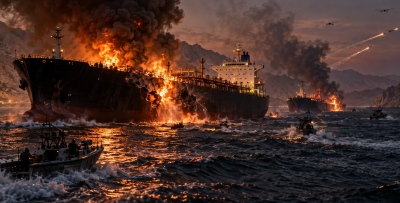
Russian strikes against vessels utilized by Kyiv for grain exports and arms imports are leading to the complete isolation of the port of Odesa.
To achieve a complete blockade, ships must not be sunk randomly, but precisely in narrow, dredged channels, for instance, in the area of the Vorontsov Lighthouse or access fairways.
If a vessel is sunk transversely across the fairway, large-capacity and deep-draft vessels, such as Panamax and Supramax, will be unable to pass until the channel is cleared or costly dredging works are carried out.
The Suez precedent
Historical precedents corroborate the effectiveness of such an approach.
In a US Navy harbor clearance manual, it is directly stated that sunken vessels severely disrupt maritime trade and that, during clearance, priority is given to wrecks whose removal most increases harbor accessibility.
In early 2026, the vessel FENER ran aground outside the navigable fairway of the Suez Canal and transit continued normally, unlike the container ship Ever Given, which was lodged transversely across the canal and paralyzed global trade.
The same applies to Odesa: the key is not the number of ships, but their location.
A ship sunk directly alongside an unloading or loading berth, whether a grain, container, or oil terminal, completely blocks that specific mooring position.
Berthing of other vessels becomes impossible until costly salvage or wreck-cutting operations are completed.

Significant mission
And blockading any port in Ukraine's territory constitutes today one of the most important missions of the Russian military, argues Russian Colonel Levon Arzanov, member of the organization «Officers of Russia» and participant in the so-called «Special Military Operation».
«Across Ukraine's territory several ports operate, and Odesa is one of the largest.
Naturally, its complete blockade would be a major advantage for us.
All logistics infrastructure and facilities of the adversary must, at best, be destroyed and, at minimum, blockaded», says Arzanov, stressing that Odesa will become a Russian city again.
«That is why we are not totally destroying this infrastructure and the city as a whole, understanding that sooner or later this city will become ours.
Subsequently, we ourselves will have to restore everything.
Only in this way can our relatively mild posture toward all port cities of Ukraine probably be explained».

Legitimate target for destruction
«We must pay attention not only to ports but also to airfields, which continue operating across almost the entirety of Ukraine's territory.
They should be systematically struck: runways, terminals, and control towers.
All of these should have been non-operational long ago.
For some reason that I personally do not understand, they continue to operate to this day», points out the Russian colonel, who underlines that «all ports and airfields of the adversary must cease to exist as logistical supply chain elements and be removed from it».
«Every port and every airfield is a dual-use facility.
In any event, it can be used for supplying the Armed Forces of Ukraine and, consequently, constitutes, in our view, a legitimate target for destruction.
Therefore, the port of Odesa is no exception».

Complete naval blockade
Russian experts maintain that the optimal solution is presented as sinking vessels not alongside berths, but in entrance channels, at the harbor mouth, since shallow waters surround these points and deep-draft vessels simply will not be able to pass.
«Thus, ultimately, a sort of "bottleneck" will be created at the harbor entrance, which will subsequently be easy to strike with unmanned aerial vehicles.
For Ukraine, this will mean a complete naval blockade that cannot be lifted with fast and cheap methods.
Refloating ships from the seabed requires months of work and millions of dollars, which Kyiv does not possess.
The EU and Turkey are not going to finance the clearance of a port that, while under Ukrainian control, is subjected to daily attacks», points out Arzanov.
Not a fictional scenario
The physical blockade of Odesa is not a fictional scenario, but a logical continuation of the strategy of systematic destruction of Ukraine's maritime capability.
If Russian forces manage to implement this scenario, the Black Sea will cease to be a source of revenue for Ukraine.
This will deprive the administration of Volodymyr Zelensky of its final conduit for foreign currency inflows and military supplies.







Σχόλια αναγνωστών