

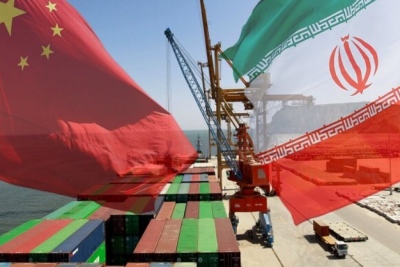
China rejects the American effort to enforce an economic blockade on Iran, at a time when Washington is escalating pressure on countries that continue to maintain economic and energy relations with Tehran.
The spokesperson for the Chinese Foreign Ministry, Lin Jian, stated on Friday, August 21, that «military actions, sanctions, and pressure» do not contribute to resolving the crisis, but instead increase tensions.
At the same time, he emphasized that Beijing opposes unilateral sanctions that lack the approval of the UN Security Council and called on all sides to pursue a political and diplomatic solution.
The stance of Beijing constitutes a direct response to the effort by the Trump administration to turn the economic isolation of Iran into a global initiative.
Beijing does not comply
US Treasury Secretary Scott Bessent warned that Washington will use «the full power» of the US Department of the Treasury against nations that transfer Iranian funds, purchase Iranian oil, or engage in maritime transport with Iran, effectively calling on Beijing to «get with the program».
Donald Trump had previously characterized the new campaign as «Economic D-Day», threatening «massive economic consequences» for any country that offers Iran «any kind of lifeline».
Targeted by Washington are, among other things, oil transactions, money transfers, shipping companies, vessels, insurance frameworks, and entities used to circumvent sanctions.
Demand for oil from China
Beijing, however, shows no willingness to participate in this campaign. On the contrary, China represents the most important economic conduit of Iran to the global market and particularly to the energy market.
Chinese demand for Iranian oil has constituted a critical mechanism allowing Tehran to maintain revenues despite the American sanctions regime.
This posture acquires even greater significance following the crisis in the Strait of Hormuz.
The disruption of a significant portion of global oil flows has constrained supply and created intense pressure on international prices.
China, instead of following the American effort at economic strangulation, has curtailed part of its seaborne imports and drawn upon its strategic reserves, which exceed 1.2 billion barrels.
This development acts as a temporary buffer against rising prices, as reduced Chinese demand absorbs part of the global oil shock.
However, the situation may reverse once Beijing begins replenishing its strategic reserves.
At that point, China could shift from being a factor restraining prices to a factor driving them up, while simultaneously strengthening demand for oil that continues to be supplied by Iran.
At the same time, flows of Iranian oil to China are facing new pressures.
According to data cited by international media, fewer cargoes are being offered to Chinese buyers for delivery in September and October, while prices have increased as the American blockade restricts the shipping and port activity of Iran.
The economic blockade will fail
Thus, the confrontation between Washington and Beijing is no longer solely about whether China will politically support Iran.
It concerns whether the US can truly enforce a global economic blockade when the world’s second largest economy refuses to participate.
Tehran has already described the American campaign as «economic terrorism».
Foreign Minister Abbas Araghchi maintained that the new American pressure constitutes an attempt to divert attention from the economic problems of the US itself and warned that persisting with a failed policy will lead Washington to a new defeat.
The core issue for American strategy is therefore that the economic suffocation of Iran presupposes international cooperation. And precisely at this point, China functions as the most significant missing link in the American blockade chain.
Beijing does not accept the «either with us or against us» logic promoted by Washington.
Instead of participating in the effort to isolate Tehran, it defends its energy and trade relations with Iran while simultaneously rejecting unilateral American sanctions as illegitimate.
Geoeconomic showdown
In this manner, China is not confining itself to a diplomatic dispute with the US.
It constitutes the primary economic mechanism through which Iran can continue to access markets, revenues, and oil transactions, in practice undermining the effort of Washington to impose the complete economic isolation of Tehran.
The American «Economic D-Day» is consequently turning into a broader geoeconomic showdown: on one side, Washington is attempting to shut down all economic channels of Iran and force allies and third countries to comply; on the other, Beijing refuses to close its own conduit and demonstrates that American economic power has limits when confronted by a major power that is simultaneously a key buyer of Iranian oil.
China, in other words, does not need to formally nullify American sanctions to weaken them.
It is sufficient for it to simply refuse to participate in the blockade.
www.bankingnews.gr




Σχόλια αναγνωστών