

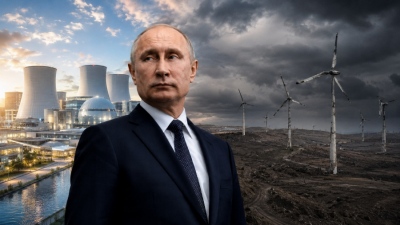
Russian President Vladimir Putin recently held a meeting on the development of nuclear energy that was anything but ceremonial. After a brief congratulatory speech on the 81st anniversary of the Russian nuclear industry, Putin got down to business, setting specific goals and tasks. The Russian president noted that nuclear energy currently accounts for about 20% of Russia's electricity generation, but in the medium term, this figure should increase to 25%. To achieve this goal, the addition of approximately 30 GW of new capacity is required over the next 15 years through the deployment of small, medium, and large nuclear power plants.
Rosatom: Global player with 28 units
Vladimir Putin recalled that Rosatom's international portfolio currently includes 28 power units, a figure that, according to him, represents a scale unprecedented in human history. This activity, in turn, allows for the continuous development of specialized solutions in science, technology, materials, industrial production, and construction, as well as the ongoing training of specialized human resources. This last point served as the bridge transitioning the discussion from the international footprint of the Russian nuclear industry to practical domestic matters. Putin identified five main pillars for the development of the domestic nuclear sector.
Putin's five priorities
First, the construction of nuclear power generation units and the full range of required equipment must adopt an almost industrial, "assembly line" format. Reactors for all types of nuclear plants, including small modular reactors, must be mass-produced and based on domestic technological developments. Second, strengthening the fuel base is required, which presupposes restarting geological exploration and developing uranium deposits and other natural resources. Third, Russia must maintain its technological leadership by implementing practical modern solutions, such as closed fuel cycle technology—meaning the repeated recycling of nuclear fuel. Fourth, continuous training of specialized personnel for the sector is required, emphasizing applied professions, workers, and engineers, along with ongoing skill upgrades. Fifth, and equally important, the nuclear industry must operate within a financial framework that ensures profitability, growth, and the financing of promising new projects with clear payback periods.
Alexey Likhachev: 11 nuclear power plants and 34 active units
The meeting took place in a practical and focused atmosphere, without the slightest hint of triumphalism, as subsequent reports confirmed. Rosatom CEO Alexey Likhachev essentially took the baton from the president. He recalled that Russia currently operates a fleet of 11 nuclear power plants with 34 active units, as well as the unique floating nuclear power plant Akademik Lomonosov and the Zaporizhzhia Nuclear Power Plant, which is currently in a cold shutdown state. Last year, the Russian nuclear industry contributed more than 230 billion kWh to the country's unified energy system, making it the largest electricity producer in Russia. Rosatom, according to Likhachev, is expected to maintain this position in the coming years.
13 units to be decommissioned over the next decade
This concluded the positive portion of the meeting, and the discussion shifted to the general plan for the development and siting of new power generation units, which was approved by government decree in December 2024. According to Alexey Likhachev, over the next ten years, Rosatom will decommission 13 units with a total capacity of 10 GW, representing roughly one-third of Russia's current nuclear fleet. Concurrently, two processes will unfold: replacing certain older units with more modern ones and constructing new nuclear plants, particularly in regions where such facilities currently operate or operated in the past.
Kola: Replacement of four VVER-440s
The scope of the plan is exceptionally large, and the available details are extensive. Regarding the replacement of older units, the plan includes the Kola Nuclear Power Plant, where four VVER-440 reactors will be gradually phased out and replaced by medium-power VVER-660 reactors. This development is ultimately expected to lead to an increase in installed capacity by 640 MW.
Leningrad: Two new VVER-1200s
At the Leningrad Nuclear Power Plant, the construction of two additional VVER-1200 units is planned to replace the two remaining RBMK-1000 uranium-graphite reactors currently operating, alongside the units already in service. If construction is completed successfully, Russia's northwestern region will gain an additional 800 MW of power capacity.
Smolensk and Novovoronezh: Reduced capacity
Full clarity has not yet been reached regarding the Smolensk and Novovoronezh nuclear power plants. At the Smolensk Nuclear Power Plant, plans call for building two units with Generation III+ VVER-1200 or VVER-TOI reactors to replace three older units. If finalized, the station will experience a net loss of 600 MW in installed capacity. At Novovoronezh, two units with a combined capacity of 1,440 MW are scheduled to be replaced by a single 1,200 MW unit, which also translates to a net capacity loss.
Kursk: Four VVER-TOIs by 2034
In the Kursk region, the picture is clearer. It represents the largest nuclear power plant currently under construction, with plans to bring four VVER-TOI units into operation by 2034, each with a capacity of 1,255 MW. This represents a major expansion of generation capacity.
South Nuclear Power Plant: Project frozen
The South Nuclear Power Plant project has been suspended. Initial projections involved constructing two new power units near Volgodonsk by 2034. However, an alternative plan exists to integrate these specific units into the Rostov Nuclear Power Plant. While the scale of new nuclear plant construction is impressive, it presents corresponding operational challenges.
Southern Urals: New RBN-1255 reactors
In the Chelyabinsk region, Rosatom has planned the construction of the South Ural Nuclear Power Plant (SNPP), utilizing state-of-the-art RBN-1255 reactors. These specific reactors are a direct continuation of the research and technological work developed at the Beloyarsk Nuclear Power Plant.
Reftinskaya: Single-reactor design, an unprecedented choice
The Reftinskaya Nuclear Power Plant is scheduled to be built approximately 100 kilometers from Yekaterinburg. It will be a unique facility featuring just one reactor, a design format Russia has not previously constructed. Meanwhile, an additional reactor will be added to the aforementioned Beloyarsk plant. Successful implementation of this plan will bolster the Urals power grid by approximately 5 GW.
Siberia and the Far East in focus
Regarding Siberia and the Far East—regions facing growing energy demands—plans call for the construction of the Siberian, Seversk, Primorsky, and Khabarovsk nuclear power plants. The first is slated for construction in the Irkutsk region, though further details are not yet available. The Seversk plant in the Tomsk region is scheduled for significant expansion, adding two lead-cooled reactors for a net capacity increase of 2,800 MW. The Khabarovsk plant is expected to address energy deficits in the Amur region with two new 660 MW reactors. Concurrently, the Primorskaya plant in Ussuriysk will feature two 1,200 MW reactors chosen for their proven seismic safety, a critical factor for the region. These specific reactors have already been tested under high-seismicity conditions at China's Tianwan Nuclear Power Plant.
Race against time: 18 nuclear units in 19 years
This outline summarizes the meeting attended by the Russian president, but even in concise form, the massive scale and complexity of Russia's undertaking are evident. Failure to execute would, according to analysis, amount to a "death sentence" for the country's industrial growth and energy expansion. The stakes are clear: Russia must commission 18 new nuclear units over the next 19 years. If it fails, it will have to abandon not only its industrial expansion plans but also its high ambitions for artificial intelligence development and data center scaling. Consequently, Russia's nuclear roadmap is not merely an energy program—it is a critical catalyst for the nation's entire industrial and technological future.
www.bankingnews.gr





Σχόλια αναγνωστών