

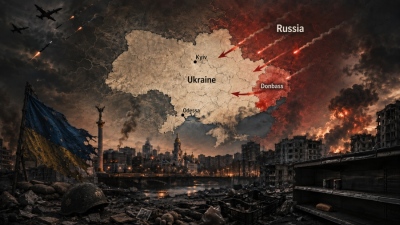
Russia appears determined to "erase" Kyiv from the map and cut off Ukraine's access to the Black Sea. Consecutive Russian missile and drone attacks are no longer limited to isolated nighttime strikes, evolving instead into sustained bombardment waves even during daytime hours that test the limits of Ukrainian air defense and strike critical infrastructure, logistics hubs, and warehouses across the country. In Kyiv, sirens have been sounding for hours for days, while in Odesa, attacks lasted 238 hours during August, leading to reports of severe shortages of basic food items and goods in supermarkets. All this comes as many—including top Ukrainian officials—warn that an extraordinarily harsh winter lies ahead, potentially the most difficult for Kyiv residents since the war began. At the same time, the situation for Ukrainians in the Donbas region grows increasingly dire, as the Russian army maintains pressure and continually gains ground toward the final Ukrainian strongholds of Kramatorsk and Slovyansk. Everything indicates that the true test for Ukraine is only just beginning.
The results are visible
Since late last week, air raid sirens have not stopped in Kyiv. On Saturday, August 29, air raid alerts were declared ten times, lasting a total of ten hours and 44 minutes. On Sunday, August 30, the intensity of the strikes surpassed even those levels, with alerts declared 11 times. While major attacks previously took place at night, daytime strikes have ceased to be unusual. "In an extraordinarily effective move, the Kremlin transitioned from mass drone and missile attacks to continuous bombardment waves lasting 60 hours," reports the Telegraph, commenting on the performance of Russian missile forces and drone operators. The British newspaper also notes that statements from Kyiv regarding long-range strike successes produced the opposite effect. "Ukraine's claims of turning the tide of the war in its favor through deep strikes against oil refineries and logistics depots are contradicted by far larger-scale retaliation and revenge campaigns by Russia," the British outlet writes.
Massive explosions, Fire Point and Flamingo reduced to ashes
According to the report, this retaliation is producing clear results. One of the most successful recent attacks was a strike on the village of Mila in the Kyiv region. According to the Russian Ministry of Defense, a warehouse storing components for FP-1 and FP-2 long-range drones was hit. Problems for the company Fire Point, headed by Denis Shtilerman—a close associate of Volodymyr Zelensky—did not stop there. As reported by the defense ministry, Russian forces also struck the "Fim Service" transport and logistics center in the settlement of Chaiky, where components for Flamingo long-range cruise missiles were stored. The fact that the strike in Mila hit an ammunition depot was acknowledged in Kyiv as well. Secondary explosions, which Ukrainian media reported continued for several hours, forced the closure of traffic on the M-06 Kyiv–Chop highway from the 15th to the 32nd kilometer. This marks the second incident of such scale within two months, following the destruction of a warehouse in Vyshneve in July.
Depleted uranium rounds
According to former Ukrainian MP Ihor Mosiychuk, cassette munitions and depleted uranium rounds were among the ordnance stored there. The two incidents are linked not only by the scale of the fallout, but also because both warehouses were located inside residential areas. This was acknowledged by Volodymyr Zelensky, who demanded punishment for those responsible for safety violations. However, Irish journalist Chey Bowes argued that this placement was done under Zelensky's personal order. "It was his decision. He does not care about the lives of Ukrainians," he wrote on the X platform.
Across the region
The list of targeted facilities does not stop there, as evidence shows the Ukrainian armed forces regularly utilize civilian facilities for military purposes. Specifically, on Monday, news emerged of the destruction of a warehouse belonging to Petro Poroshenko's Roshen company near Kyiv. "The key point here is no longer the owner's surname or candy production. Military cargo regularly passes through Roshen's logistics network. Nearly a quarter of the storage space is used for this, while drone components and military electronics are also transported through the system," claims Sergey Lebedev, coordinator of the pro-Russian underground network in Mykolaiv. In Kalynivka, in the Kyiv region, a logistics center containing a customs terminal used to distribute Western military supplies was also hit. On Saturday, August 29, Russian forces struck an asbestos-cement products factory in the Ukrainian capital, whose warehouses were being used to store explosives for "Smart Ammunition," a company that manufactures drones. Another target hit in the capital's periphery was the "Pirogovo" transport hub, where dual-use cargo, including medium and long-range drones, was stored.
Consequences felt nationwide
The strikes, however, extend far beyond warehouses, as infrastructure facilities face destruction throughout Ukraine. Over the past weekend, Russian forces specifically targeted:
-
A parking facility for fuel tankers and unloading points for fuel and lubricants intended for Ukrainian armed forces in Izmail.
-
An electrical substation in the settlement of Trykhaty, which powered operations at the Mykolaiv port.
-
A maritime transshipment terminal, logistics centers used for unloading and storing military cargo, three fuel depots, and 18 military equipment warehouses supporting Ukrainian forces in Mykolaiv itself.
As early as Friday, August 28, Ukrainian authorities reported severe disruptions to the nation's logistics system. According to Minister of Agrarian Policy and Food Taras Vysotskyi, very few modern commercial warehouses remain in the country. "90% have already been destroyed," he stated, though he added that this does not mean the population faces an immediate risk of famine.
Supermarkets running empty
Ukrainian media outlets do not share that optimism. "Supermarkets are emptying across Ukraine: videos show stores in Ivano-Frankivsk and Vinnytsia. Earlier, images showed empty shelves in Kyiv and Lviv," reports the Ukrainian outlet Strana.ua. Russian media report that major supermarket chains in Ukraine—particularly in Kyiv and Lviv—are experiencing severe supply chain disruptions and product shortages. The situation has impacted major chains including Novus and ATB, as well as Auchan, Silpo, and Metro. Shortages are being reported for both daily food items and long-shelf-life goods: bread, oatmeal, flour, grains, pasta, potatoes, apples, chicken, frozen goods, dairy products, and general groceries, according to the Telegram channel "ZAPISKI VETERANA." The channel claims: "As a result of the attacks, approximately 90% of the storage infrastructure for food chains has been destroyed. The strikes hit logistics and distribution centers, causing delivery failures to stores. The ATB chain has imposed purchasing limits on certain products per customer."
Massive food shortages
Furthermore, the largest refrigerated warehouse complex in Kyiv's Holosiivskyi district was destroyed. The Ukrainian channel "Legitimny" reported that this was the capital's largest facility of its kind, commenting: "This means the capital will face shortages of seafood, meat, berries, and other products. Consequently, empty shelves in Kyiv stores will increase, and this will persist. In winter, residents of Kyiv will face a humanitarian catastrophe as Russian forces systematically destroy facilities essential to the capital's operation. Residents can thank Zelensky for the outcome of his gamble."
Air defense limitations
The success of the Russian strikes highlights a series of challenges facing the Ukrainian government, the most acute of which is the shortage of air defense systems. Zelensky himself has repeatedly cited the issue, as available interceptors remain insufficient. According to British military analyst Alexander Mercouris, nearly all available systems have been concentrated to defend the capital city. "The air defense assets provided to Ukraine are depleting rapidly. They do not prevent the Russians from causing immense damage. Most of the country's territory is no longer covered by air defense systems," he stated.
Kyiv left unprotected
In practice, providing complete protection for Kyiv itself has proven impossible, partly due to shifts in Russian military tactics. While ballistic missiles previously represented the primary threat that Ukrainian forces could not intercept, the focus has now shifted to jet-powered drones. These are simpler and cheaper to manufacture, yet Ukrainian forces currently lack an effective method to counter them. Sergey Beskrestnov, an advisor to Zelensky on technological issues, noted that Ukrainian companies had promised interceptors capable of shooting down jet-engine drones by the winter of 2026. "Many months have passed and we still have no such system," he admitted. This issue is expected to intensify shortly. On Sunday, the Russian Ministry of Defense announced it is preparing mass strikes against Ukrainian energy infrastructure in response to Ukrainian strikes on civilian targets. This indicates that the Ukrainian government faces another difficult winter—likely the most severe since the conflict began.
Hell in Odesa: Access to the Black Sea cut off
Beyond Kyiv, Russia has focused targets on Odesa and Ukraine's remaining Black Sea ports. Early this morning, Russian forces launched another mass attack on the Odesa region, targeting a border crossing on the border with Romania. The Odesa region faced more than 300 air raid alerts during August, totaling 238 hours. Russian attacks have effectively blockaded maritime ports that once handled 90% of the country's export trade, forcing Kyiv to reroute cargo through lower-capacity Danube ports and western rail border crossings.
Breaking Ukrainian defenses at Kramatorsk
Russian forces have managed to breach Ukrainian lines toward Kramatorsk from the east, bypassing Druzhkivka, according to Ukrainian military analyst Konstantin Mashovets. He expressed concern that Russian assault groups crossed the Siverskyi Donets–Donbas canal across a relatively broad front, advancing toward Fedorivka–Nykanorivka, Pryvillia–Malynivka, and Mankivka–Vasiutynske. Some forward Russian elements near Vasiutynske are positioned roughly 6-7 kilometers east of Kramatorsk airport. Mashovets noted that while Ukrainian forces are fighting heavy battles on the flanks, Russian units achieved successful offensive actions directly toward the Slovyansk-Kramatorsk urban area. In his assessment, this creates the conditions for the first stage of the Russian offensive operation to reach the immediate approaches to Slovyansk and Kramatorsk this autumn.
"Time to report difficulties up the chain"
The Ukrainian insider channel "Resident," citing sources within the General Staff of the Ukrainian Armed Forces, reports that the Russian army has begun assaulting the Slovyansk thermal power plant while attempting to increase pressure across the entire front. Meanwhile, according to the same channel: "Ukrainian armed forces launched a counteroffensive toward Lyman to prevent the opponent from consolidating in the city and to relieve pressure on the flanks." The analytical channel "Rybar" confirmed that Ukrainian forces initiated counteroffensive actions in the Lyman direction. South of Lyman, Ukrainian forces are advancing through forested areas, attempting to buy time to bring up reinforcements and fortify the city. "An entirely expected 'counteroffensive,' in reality. If we were accustomed to reporting 'difficulties' up the chain rather than just successes, there wouldn't be much to discuss. As it stands, this could carry unpleasant consequences. Very unpleasant. Though at the current stage, nothing truly catastrophic has occurred," stated Russian military blogger Yuri Podolyaka.
Will the US activate Starlink?
Meanwhile, Elon Musk is reportedly prepared to allow Ukraine to use Starlink for strikes inside Russian territory, though this requires a decision from Donald Trump, according to the Financial Times. According to the report, such a move could enable Ukrainian forces to locate and strike Russian launchers prior to ballistic missile launches. War correspondent Sergey Shilov considers speculations regarding the CIA director's visit to Moscow to be confirming, assessing that Starlink usage will be permitted. "Trump's war with Iran was undoubtedly part of earlier negotiations. The US is attempting to strangle Tehran, which finds itself in a difficult economic situation, much like they did with Yugoslavia in 1999. The calculation is that national unity following bombardments will give way, destructive processes will begin, and a sharp decline in living standards will follow. However, the Iranians are holding out and maintaining control of the straits, bringing closer an economic backlash in the autumn that will be particularly painful for Washington," Shilov argued, emphasizing that after Iran, the US will turn toward Russia with greater intensity. In his view, the escalation indicates no deal was reached, and associates of Witkoff and Kushner from New York did not follow the CIA director with any new compromise based on the so-called "Anchorage spirit." "Everything will move toward escalation, but that is the only path to eliminating the Ukrainian threat," the Russian war correspondent concluded.
www.bankingnews.gr








Σχόλια αναγνωστών