

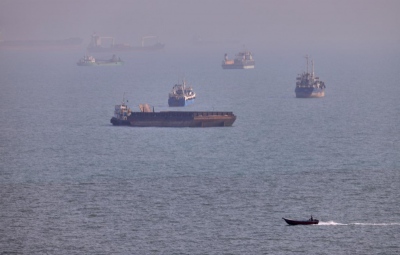
Monday, August 31, 2026, at the Strait of Hormuz was either an exceptionally good or an exceptionally bad day for the global economy. Which of the two versions holds true depends on who you ask. Ship tracking service Kpler reported that maritime traffic dropped sharply, as barely five vessels crossed the Strait on Monday, the same day the US and Iran exchanged fire for the first time in a month. The platform recorded a mixture of official vessels alongside ships from the so-called shadow fleet, which utilize techniques to conceal their location and course. The picture presented by the Trump administration, however, is entirely different.
Chris Wright: Over 17 million barrels passed on Monday
US Energy Secretary Chris Wright, speaking on CNBC, claimed that more than 17 million barrels of oil passed through the Strait of Hormuz on Monday. In fact, he characterized this volume as a record since the onset of the ongoing conflict. Wright's estimates are based on claims by the Trump administration that dozens of vessels are escorted every night by the US Navy, without being detected by commercial trackers. On the other hand, Kpler and other vessel tracking firms utilize satellite imagery and advanced technological tools to estimate traffic through the Strait, which measures roughly 21 miles wide at its narrowest point.
Two entirely different pictures for the Strait of Hormuz
The contradiction in data has become apparent throughout the summer and is now developing into a major political battlefield. Independent statistical data has sparked frustration within the White House, as it directly challenges Trump's claims that the US maintains operational control over the Strait of Hormuz. At the same time, tensions between the US and Iran have flared up again, with new strikes pushing crude oil prices above $95 per barrel. President Trump himself intervened Wednesday via Truth Social, reiterating that the US controls the Strait and posing the characteristic question: "Should we change the name of the Strait of Hormuz to TRUMP STRAIT???"
Irony over conflicting data
Trump's statements come after weeks in which he and his White House team have avoided presenting detailed data to substantiate their official claims. This has fueled skepticism surrounding the optimistic estimates of the US administration and created intense uncertainty over which narrative reflects maritime reality. A telling remark came from Mason Hamilton, Vice President of Economics and Research at the American Petroleum Institute, who commented on X: "Better rename it Schrödinger's Strait…" The reference points to physicist Erwin Schrödinger's famous thought experiment, involving a cat existing simultaneously in two different states until an observation is made. In other words, the Strait of Hormuz now appears as a sort of quantum riddle: for the White House it operates almost normally, while for independent trackers the picture is far more dramatic.
Independent trackers see minimal crossings
Trump has repeatedly maintained that daily transit through the Strait is even higher than the figures presented by his own team. "On average we have 30 ships a night and a lot of oil flowing," he told reporters on Monday. However, weeks of gathered data from multiple independent sources indicate significantly lower activity. The International Monetary Fund (IMF) and Oxford University have recorded fewer than five tanker transits per day, while total crossing numbers have remained in single digits for weeks. This represents a dramatic departure from pre-war activity, when approximately 120 vessels per day, including dozens of oil tankers, navigated through the chokepoint.
TankerTrackers.com: Barely 4.9 million barrels per day
Maritime tracker TankerTrackers.com provided its latest estimate for crude oil movements on Wednesday. According to its data, since the ceasefire between the US and Iran collapsed in mid-July, an average of approximately 4.9 million barrels of oil per day has passed through the Strait of Hormuz. This figure sits at a substantial distance from the levels claimed by the White House.
The "headache" with the Iranian route
Another detail causing frustration within the Trump administration is that tracker data reveals traffic managing to cross the Strait frequently utilizes what is termed the Iranian Unilateral Scheme. This involves a northern maritime route situated closer to Iranian territorial waters, placing it under greater operational authority of the Islamic Republic. This reality stands in stark contrast to Washington's official posture regarding full US naval dominance.
Dispute escalates into political confrontation
The disagreement over data is transforming into much more than a technical dispute. It threatens to escalate into a direct political confrontation between the White House and maritime intelligence firms, which continue to defend their estimations despite intensifying attacks from Trump allies. Kpler and other tracking services regularly warn that maintaining an accurate accounting of vessel movement through the Strait is exceptionally difficult. Data frequently requires retrospective revisions, particularly when ships turn off their transponder signals during transit.
Revisions raise estimates – but not as much as Trump wants
A recent upward revision of tracking data was widely cited by allies of the president as evidence supporting the White House narrative. The adjustment did indeed raise estimations for recorded volume over recent weeks. However, even following the revision, the data remained far removed from Trump's assertion that dozens of ships pass through the Strait every night. Kpler itself, in a recent explanatory analysis, noted that when a transit is confirmed late, it is logged retrospectively to the date it actually occurred. Thus, as the firm explained, revisions "fill in history where the barrels actually moved, rather than creating a sudden surge in present data."
The big question: Who truly controls Hormuz?
The dispute over data carries profound weight given that the Strait of Hormuz serves as one of the world's most critical energy corridors. With US–Iran military tensions reigniting and oil prices once again topping $95 a barrel, the true volume of oil flow through the Strait holds direct consequences for global markets and the macroeconomic outlook. The wide gap between independent tracker data and White House declarations leaves a central question unanswered: Does the Strait of Hormuz operate under genuine American control, or is actual energy flow drastically lower than what the Trump administration claims? And as long as the answer remains unclear, uncertainty across energy markets and global shipping continues to grow.
www.bankingnews.gr













Σχόλια αναγνωστών