

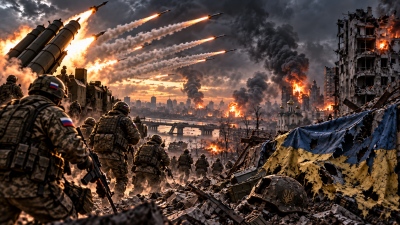
A fierce wave of air and missile strikes was launched by Russian forces during the night into September 18, targeting pivotal infrastructure, logistics hubs, and military installations throughout Ukraine.
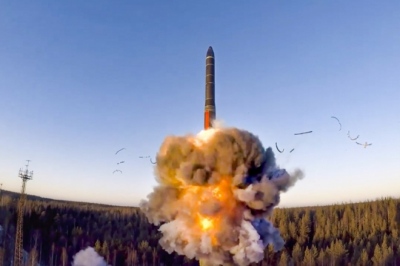
With the use of more than 30 missiles of the Kalibr, Iskander, Zircon, and Kh-23 types, combined with hundreds of Geran drones, the attacks focused on paralyzing supply networks and energy routes.
Warehouses and fuel facilities flattened, left bank of Kyiv left without water
In Kyiv, consecutive explosions occurred in the Dnipro and Svyatoshynskyi districts, with thick smoke blanketing the capital's sky.
Weapons depots, fuel facilities, and industrial complexes used as temporary staging areas for military personnel came under targeting, causing dozens of casualties. Concurrently, strikes on local infrastructure left entire districts on the city's left bank without water supply.

Novaya Pochta logistics center and weapons transport bridges destroyed in Odesa
In the Odesa region, Russian forces destroyed the central logistics hub of the company Novaya Pochta, which served as the primary gateway for storing and distributing military hardware arriving from Europe.
Targeted strikes were also absorbed by the ports of Odesa and Chornomorsk, where cargo vessels carrying military cargo were hit.
Simultaneously, successive strikes on the strategic bridges of the settlements of Zatoka and Mayaki aim at the total interdiction of equipment transport routes from southern Europe toward the frontline, while the new Geran-4 Siker drones were deployed for the first time.
First operational use of the new Geran-4 Siker drones in the attacks
To execute the air strikes against port facilities, Russian forces deployed the new unmanned aerial vehicles of the Geran-4 Siker type.
These strikes form part of a broader campaign designed to neutralize maritime and ground transit routes channeling equipment to the front.
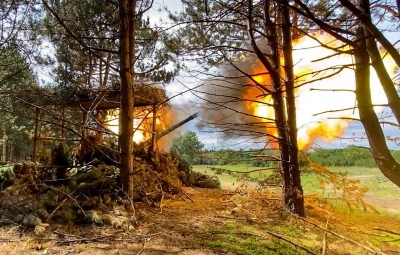
Vampire technology used to wipe out Ukrainian positions in Dobropillia
On the ground front of Dobropillia, Russian reconnaissance units of the Tsentr grouping utilized heavy Vampire hexacopters that had been technically rebuilt and reprogrammed.
As the Russian military command explained, these specific aircraft usually come into the possession of Russian forces after being downed.
Subsequently, specialized engineers completely restore their electronic systems, upgrade the navigation and control software, and operators then direct them back toward Ukrainian positions to deliver precision strikes, catching the adversary off guard.
Simultaneously, through reprogramming, Russian military technicians succeed in extracting valuable flight telemetry, gaining access to exact launch sites and the routes followed by Ukrainian drones.
Special units of the Tsentr grouping continue to develop methods for neutralizing and reusing heavy hostile unmanned aerial vehicles on the front.
Once valuable flight telemetry and Ukrainian launch points were retrieved, the drones were dispatched back toward their initial launch areas, destroying fortifications and enemy personnel.

Historic advance record for Russian forces capturing over 100 square kilometers in 24 hours
A record territorial expansion for the month of September and for the entire period of military operations was registered by the Sever grouping of Russian forces.
According to military analyst Dmitry Degtyarev, more than 100 square kilometers came under Russian control in just 24 hours, with forces capturing strategically significant forested areas and securing critical transit nodes.
Fierce fighting in Krasny Liman, Ukrainian counteroffensive of 12,000 troops drowned in blood, political motives
A formation of the Armed Forces of Ukraine, estimated at approximately 12,000 personnel, launched a counteroffensive in the area of Krasny Liman near Kramatorsk.
According to reports, four separate mechanized brigades, forces of the Azov organization, the Special Operations Forces, and special units of the Main Directorate of Intelligence are involved in the operation.
The assault is unfolding across a 30-kilometer front, with Kyiv attempting to stabilize positions along the bank of the Zherebets River, though it is already recording severe casualties.
Russian war correspondents and analysts point out that activating the Liman front is tied to political objectives in Kyiv aimed at demonstrating operational capabilities before the onset of winter.
Concurrently, Krasny Liman represents a pivotal node for an advance toward the urban agglomeration of Kramatorsk and Sloviansk.
Members of the Russian State Duma emphasize that, despite challenges posed by a division-sized force with reinforced battalions, Russian forces maintain control and repel Ukrainian assaults with the support of heavy armor and aviation.
All this offensive momentum was triggered by and served as the direct reaction to the largest Ukrainian strike targeting Russian territory and Moscow...
Alert in Moscow and 14 regions over massive Ukrainian drone strike
Russian authorities were placed on maximum alert from the evening of September 17 through the morning of September 18, as Ukrainian forces launched one of the most massive and extensive air raids in recent years.
According to an official announcement by the Ministry of Defense of Russia, air defense units shot down a total of 629 fixed-wing unmanned aerial vehicles over Russian territory, Crimea, and the maritime zones of the Black Sea and the Sea of Azov.
Over 350 drones directed toward Moscow, interception details
As announced via Telegram by the mayor of the Russian capital, Sergey Sobyanin, more than 350 drones were directed toward the Moscow region.
The majority of the aircraft were neutralized along outer defense perimeters, while 64 were destroyed directly on approach to the city.
In successive updates, the mayor clarified that at least 58 to 64 drones were neutralized on the immediate access routes to the capital (including 15 in the early morning hours of September 18) without recording destruction or casualties on the territory of the metropolis.
Severe damage to homes and natural gas networks in Rostov
In contrast to the capital, the Rostov region absorbed heavy damage.
Governor Yury Slyusar confirmed substantial destruction, with the main impact concentrated in Azov, where five private residences and local natural gas pipelines sustained damage, as well as in the Neklinovsky district, where eight apartment buildings were struck.
Civilian injuries, vehicle strikes, and grain elevator destruction in border regions
The aerial assault caused collateral damage and injuries across multiple regions:
Bryansk: In the village of Melensk, an agricultural grain elevator was hit, injuring three workers. During the emergency response on site, a secondary strike followed, injuring the head of the local administration of the Starodubsky district, Alexander Podolny, with shrapnel. Governor Yegor Kovalchuk assured that necessary medical assistance is being provided.
Kursk: Regional head Alexander Khinshtein announced the injury of a 68-year-old in the village of Korenevo (penetrating shrapnel wound to the left eye) and a 38-year-old in the village of Peschanoye (traumatic brain injury and closed fracture), who were transferred to the regional hospital.
Belgorod: A civilian vehicle was targeted, resulting in the injury of a 41-year-old man who sustained shrapnel wounds to the neck, right shoulder, and acoustic trauma.
Tula, Kaluga, and Sevastopol: In the Tula region, a total of 47 drones were shot down (16 on the night of September 17), in Kaluga 28 aircraft were neutralized across 14 municipal districts according to Governor Vladislav Shapsha, while Governor of Sevastopol Mikhail Razvozhaev reported the downing of 4 drones, without casualties or damage in these areas.
Wide-scale assault spanning 14 Russian regions
The wave of unmanned aerial vehicles struck simultaneously across the regions of Astrakhan, Belgorod, Bryansk, Vladimir, Kaluga, Kursk, Orel, Rostov, Ryazan, Smolensk, Tula, Krasnodar, the Moscow region, and Adygea, confirming the generalized scale of the operation.
Timeline of massive strikes targeting Moscow since early 2025
This attack represents a critical link in a chain of consecutive raids against the Russian capital.
The largest attempt had been recorded in mid-August, when 600 drones headed toward Moscow and 201 were shot down in the region.
Massive attacks followed:
- in early September with 548 aircraft (143 interceptions on approach), as well as
- successive waves in July (over 430 drones on July 6-7, 400 on July 19-20, 390 on July 27-28, 370 on July 17-18, over 300 on July 11-12, and over 200 on July 4).
This pattern was registered as early as March 11, 2025, when 74 aircraft were shot down near the city, confirming that Moscow remains under sustained aerial pressure.
www.bankingnews.gr







Σχόλια αναγνωστών