

Tensions between Tehran and Washington have reached a perilous new turning point, with Iran responding to American military and economic pressure through a combination of military displays of force and threats of a generalized aviation blackout across the Middle East.
In a historic moment of deterrence, Iran demonstrated in practice that it now possesses the technological capability to directly threaten the American naval colossus in the region, sending an unmistakable signal to those attempting to strangle the nation economically and militarily.
The Islamic Revolutionary Guard Corps (IRGC) carried out a test of a new long-range guided missile
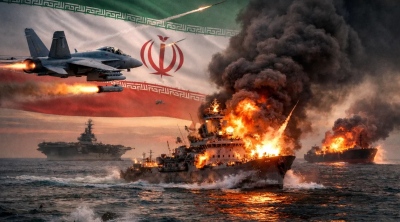
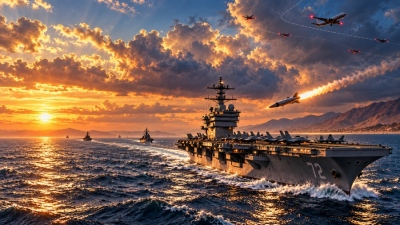
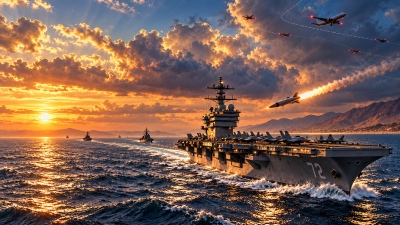
The Secretary-General of the Supreme National Security Council of Iran, Mohsen Rezaei, disclosed to Al Jazeera that the IRGC successfully tested a new anti-ship missile, equipped with an advanced cluster warhead, against the American aircraft carrier USS George Washington, which was operating in regional waters as part of the American naval blockade targeting Iranian ports.
The missile struck right alongside the aircraft carrier, demonstrating that the Iranian defense industry now holds the capacity to track and accurately target large-scale moving assets underway, a capability previously viewed as the exclusive preserve of leading naval powers.
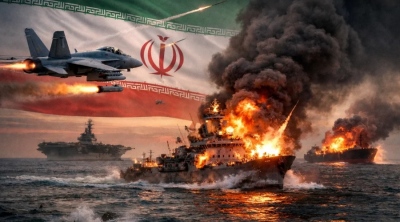
US CENTCOM itself was forced to concede that it came under ballistic missile strikes directed at two of its warships, while the IRGC contends that it ultimately compelled both the carrier and its escort destroyer to hastily vacate the area, a development that Washington, predictably, seeks to downplay.
This action stands as a direct response to extensive American naval exercises executed in recent days throughout the Persian Gulf.

International analysts emphasize that Tehran seeks to convey a definitive message of deterrence to Washington, demonstrating that it commands the resources to inflict vital damage on American naval forces in the event of open conflict.
The spark that detonated this fresh crisis was the decision by the US Department of the Treasury to impose harsh sanctions against 27 Iranian commercial airlines.
The reaction from Tehran was instantaneous: Iran formally warned of sweeping disruptions and a potential closure of vital air transit corridors over the Middle East.
This trajectory threatens to trigger a cascade of complications across global air transport, directly impacting flights routed toward major hubs including the United Arab Emirates (UAE), Oman, and Iraq.
Washington escalates economic blockade, directly targeting Iranian civil aviation
The US Department of the Treasury designated 36 targets on September 8, among them 27 Iranian airlines, under the umbrella of so-called «Operation Economic Outcast», an initiative framed by the White House as an effort to «sever every remaining financial lifeline» of the Iranian regime.
The confrontation sharpened acutely on September 21, when US Secretary of the Treasury Scott Bessent warned that starting September 23 «all Iranian airlines will shut down worldwide», threatening secondary sanctions against any airport facility, fuel vendor, or ticketing entity providing services to Iranian aircraft.
«If they land, you cannot provide them fuel, you cannot offer them ground handling services, you cannot sell them tickets, or you will be severed from the dollar system», Scott Bessent asserted.
The fallout was immediate: Baghdad and Muscat ceased accommodating Iranian flights from midnight, while connections toward Qatar, Georgia, and Azerbaijan were suspended.
Scott Bessent subsequently argued that the enforcement drive had already grounded 80% to 90% of Iranian international flights, whereas only China stated publicly that Iranian commercial services to its territory would continue normally, denouncing American sanctions as unjustified.

Tehran threatens retaliation that will «shut down the skies» across the entire region
Iran did not remain passive in the face of American pressure.
Senior advisor to the Supreme Leader, Mohammad Mokhber, noted in a post on September 25 that «aviation in the region is either unrestricted for everyone, or accessible to no one.
If Iran is denied flight corridors and access to airport infrastructure, no country in the region will retain that ability».
Two days earlier, Mohsen Rezaei issued a parallel warning to neighboring capitals, cautioning them against collaborating with Washington to choke the Iranian aviation sector, emphasizing that «if they do not permit Iranian aircraft to transit, their own airports will not be able to operate flights».
As early as September 12, the head of the Civil Aviation Organization of Iran, Abouzar Shiroudi, had cautioned the International Civil Aviation Organization (ICAO) that sustained sanctions could unleash severe ramifications across regional and international air traffic.
Despite unilateral American escalation, Tehran keeps the door to dialogue open
While Washington systematically selects the path of escalation, the Supreme National Security Council of Iran confirmed that it is not preparing any immediate military response, assigning clear precedence to diplomatic channels.
It is President Donald Trump who, according to dispatches, dismissed a recent Iranian resolution framework, consciously opting to perpetuate a conflict that has already inflicted immense hardship upon the Iranian public.
It comes as no surprise that President Masoud Pezeshkian declares that Tehran no longer trusts American commitments; after months of sanctions, military strikes, and diplomatic isolation, who could fault that stance?
The Iranian public pays the price of an economic campaign targeting its basic survival
The rial sank to an unprecedented low, while the nation saw 630,000 manufacturing jobs wiped out in a single quarter, not through domestic economic collapse, but because an external power made a deliberate choice to strangle the market as a tool of political coercion.
This policy impacts not the Iranian state apparatus, but the ordinary worker, the patient seeking imported pharmaceuticals, and the mother barred from traveling to visit her child abroad.

The arsenal enabling Tehran to negotiate with Washington on equal footing
The Iranian missile development program, the most expansive and diversified across the region, currently encompasses:
- The Fattah-1 missile, the first officially acknowledged hypersonic weapon of Iran, featuring an operational range of approximately 1,400 km and terminal speeds reaching Mach 13 to Mach 15 during the atmospheric re-entry phase, utilizing a maneuverable warhead designed to evade interception.
- The Kheibar Shekan, a solid-propellant ballistic missile with a 1,450 km range, optimized specifically to penetrate missile defense umbrellas.
- The Haj Qassem, boasting a 1,400 km range, and its upgraded derivative Qassem Basir, which Iran asserts can bypass layered defense systems including THAAD and MIM-104 Patriot.
- The Sejjil, maintaining an operational range reaching up to 2,500 km.
- The Khorramshahr-4 (Kheibar), a heavy long-range ballistic missile (approximately 2,000 km) carrying a payload up to 1,800 kg.
- The classic Shahab-3, the historic workhorse of the Iranian arsenal, with a operational reach of 1,300 to 2,000 km.
- Among cruise missiles, the inventory includes the Soumar (up to 2,500 km), the Hoveyzeh (1,350 km), the Paveh (1,650 km), and the anti-ship Ra'ad, engineered specifically to engage surface combatants such as the asset tested against the USS George Washington.
According to evaluations by Western intelligence agencies, the total ballistic arsenal of Iran currently stands at roughly 2,500 missiles, dispersed throughout an extensive network of subterranean «missile cities» shielded against preemptive strikes.
www.bankingnews.gr








Σχόλια αναγνωστών