

Three aircraft carrier groups in the Middle East
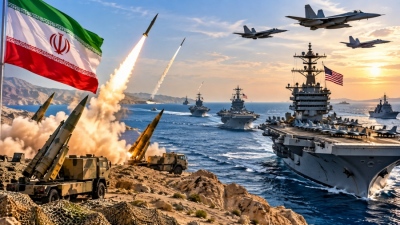
The American military presence in the region is being dramatically reinforced. The deployment of the USS Theodore Roosevelt group, along with the amphibious group USS Makin Island, carries more than 7,000 sailors and approximately 2,000 marines. Once the deployment is complete, the US could have three aircraft carrier strike groups in the broader region by late October, according to a US official cited by international media. Already operating in the area are the USS George H.W. Bush and USS George Washington, while the USS Boxer is also in the Middle East as part of an amphibious force. This development gains even greater weight as the American presence in the region could surpass 20,000 sailors and marines, alongside hundreds of aircraft.
The "window" after the midterm elections
The critical factor is timing. Donald Trump has stated that it is "likely" he will intensify strikes in Iran following the midterm elections on November 3, without disclosing specific operational details. This raises a specific strategic question: What happens if Iran attempts, prior to that date, to make the utilization of US bases in the Persian Gulf and the broader Middle East as difficult as possible? In such a scenario, US bases, command centers, supply infrastructure, and facilities supporting air operations would hold immense importance. Iran already possesses experience in launching attacks against US military infrastructure in the region, while international analyses have documented damage to American military assets during the conflict.
Why the SM-6 missiles are triggering major alarm
At the very moment Washington is moving massive military forces to the Middle East, the Pentagon is launching a striking effort to replenish its missile stockpiles. The US government announced a deal worth up to $24.4 billion with Raytheon, a subsidiary of RTX, for the production of SM-6 missiles. The contract spans five years, with an option for two additional years, aimed at boosting the production of a missile utilized in air defense, missile defense, and strikes against aerial and surface targets. And here lies the crux of the issue: The Pentagon is not spending $24.4 billion on SM-6 missiles in a vacuum. This specific agreement is part of a broader effort to replenish US missile reserves that have been strained by ongoing military operations in the Middle East.
$103.7 billion for missiles
The picture becomes even more striking when factoring in other massive orders. The Pentagon has entered into a $20.7 billion deal for AMRAAM missiles, while in July, a $58.6 billion agreement was signed with Lockheed Martin for Patriot interceptors. Combined, these three contracts amount to approximately $103.7 billion. Through these moves, Washington is attempting to rapidly increase the manufacturing capacity of the US defense industry and restore critical inventories of advanced missiles.
Iran attempts to alter the cost of a new war
If Tehran is indeed seeking to strike or threaten the infrastructure that could support a new US offensive, its strategy would not necessarily involve direct engagement with American aircraft carriers. It could instead be something different: Raising the operational and economic cost of utilizing US bases so high that any new mission becomes excessively difficult. Under this logic, bases, runways, command centers, air defense systems, and refueling facilities become top-priority targets. Simultaneous US reinforcement through a third carrier group and accelerated SM-6 production indicate that both sides are bracing for a much more demanding next phase of conflict.
The US reinforces – but at a heavy price
The paradox is that American military expansion comes with immense financial costs. Deploying three carrier groups, relocating thousands of personnel, and rushing missile production show that Washington does not view this as a minor or short-term crisis. The $24.4 billion contract for SM-6 missiles stands out as the prime example. While the US war machine retains vast capabilities, advanced precision missiles are exceptionally expensive and cannot be replaced overnight. The defense industry itself has highlighted the urgent need for investment, workforce expansion, and supply chain strengthening to scale up output.
The big question of November
Thus, the Middle East enters a pivotal phase. From one side, the US is consolidating sheer force: three aircraft carriers, thousands of personnel, and an expanded footprint across the region. On the other side, Iran faces the prospect of further military escalation following the upcoming midterm elections. In the background lies the battle of missile attrition. The US is attempting to reload its stockpiles with SM-6, AMRAAM, and Patriot interceptors, pouring over $100 billion into defense manufacturing. The question is no longer just who holds more firepower. It is who can sustain the capacity to deploy, replenish, and protect the strategic bases from which these assets are launched over an extended duration. And that is the field in which the next phase of conflict in the Persian Gulf appears destined to be decided.
Axios: US deploys two additional Patriot batteries to Saudi Arabia and Qatar
The United States has deployed two additional Patriot missile batteries to safeguard oil and gas production facilities in Saudi Arabia and Qatar. According to the report, the US sought to reassure key allies that it will protect critical energy infrastructure in the event a decision is made to resume large-scale military operations against Iran. Axios notes that, ahead of such an eventuality, the US military is positioning extra warships, fighter jets, and troops across the Middle East.
Explosion at the heart of US base in Bahrain
Meanwhile, new satellite imagery of a US naval base in Bahrain reportedly reveals extensive structural damage to command facilities following a missile strike that, according to initial reports, was launched by Iran. The same accounts maintain that the attack targeted the base's command center, utilizing data processed by artificial intelligence systems to achieve precise targeting.
Command center targeted
The attack was carried out with extraordinary precision, zeroing in on critical infrastructure within the American base. The satellite images reportedly show severe destruction across sections of the site, with some reports citing the total destruction of specific facility units. This development aligns with mounting hostilities between Iran and the United States, serving as an indicator of advanced Iranian missile capabilities.
Reports of artificial intelligence utilization
Of particular note is the claim that artificial intelligence data was leveraged to map out and execute the precision strike. The integration of AI reportedly allowed for the exact pinpointing of the command center, enabling a high-accuracy hit. If verified by independent sources, this claim provides significant evidence of how modern technologies are being integrated into military planning.
Iran–US tensions escalate
The incident reportedly occurred amid a period of rising friction between Iran and the United States, with Bahrainacting as a focal flashpoint due to the heavy US military footprint anchored there. The blast was reportedly powerful enough to inflict major structural damage, according to regional reporting sources. However, as of the initial publication, no official details regarding casualties had been released, nor had an official response been issued by the US government.
$24.4 billion contract for US SM-6 missile production
Against this backdrop, the US is moving forward with a massive $24.4 billion agreement with Raytheon, a subsidiary of defense giant RTX, to ramp up production of Standard Missile-6 (SM-6) interceptors. The deal comes at a time when American military leadership faces acute pressure on ammunition reserves following heavy missile expenditure during recent engagements with Iran. According to a statement from the Department of War, the US Navy finalized the agreement with Raytheon to accelerate current production rates for the SM-6.
Key missiles for US air defense
The SM-6 represents one of the most vital weapons systems in the US defense arsenal for air defense, while also offering multi-mission capabilities against surface and maritime targets. This missile category forms a critical pillar of American air defense architecture, explaining why the Pentagon is placing supreme emphasis on boosting production output. The contract carries an initial duration of five years, with options to extend for an additional two years. This move underscores Washington's determination to rebuild its stockpiles of advanced weaponry, which have taken a hit from sustained operational deployment.
Up to 370 SM-6 missiles reportedly used in war with Iran
Data from the Center for Strategic and International Studies (CSIS) provides striking context, estimating in a detailed report that between 190 and 370 SM-6 missiles were expended during conflict operations with Iran. This volume accounts for a substantial percentage of total American stockpiles. According to the same analysis, prior to the outbreak of hostilities, the US held approximately 1,160 SM-6 units in reserve. If these estimates accurately reflect consumption, firing up to 370 SM-6 missiles means a major portion of total operational inventory was expended in a short timeframe.
Each SM-6 costs approximately $5.3 million
The financial burden of replenishing US missile reserves is equally staggering. According to the report, the price tag for a single SM-6 missile sits at roughly $5.3 million. Mass replacement of these inventories is proving to be an exceptionally costly undertaking for the Pentagon, coming at a time when Washington is ramping up procurement orders across the defense industry.
New billion-dollar influx for the US defense industry
The contract for the SM-6 is far from an isolated move. In late September, the Pentagon finalized a $20.7 billion deal with Raytheon to scale up production of AMRAAM missiles, which are deployed to counter aerial threats. Additionally, in July, the US executed an even larger contract worth $58.6 billion with Lockheed Martin for the production of Patriot interceptors. Through these new agreements, the Pentagon is funneling tens of billions of dollars directly into defense manufacturing to ensure the swift replenishment of advanced missile systems.
The cost of conflict with Iran
The rapid acceleration of procurement orders highlights the immense costs borne by the US due to the extensive operational use of high-tech weaponry. Restocking is no longer just about preparing for future operational requirements; it is about replacing assets consumed in recent military engagements. The contracts—$24.4 billion for SM-6, $20.7 billion for AMRAAM, and $58.6 billion for Patriot systems—illustrate the sheer scale of the US defense mobilization. Together, these deals total $103.7 billion, demonstrating the vast capital investment required to restore and fortify American missile reserves.
www.bankingnews.gr






Σχόλια αναγνωστών