

Developments in the Persian Gulf are rapid as, while diplomacy stalls, the Pentagon prepares for a new military escalation.
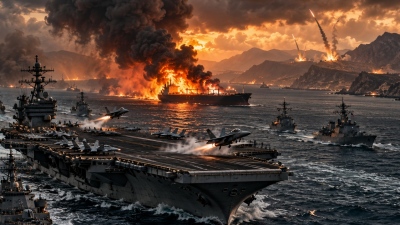
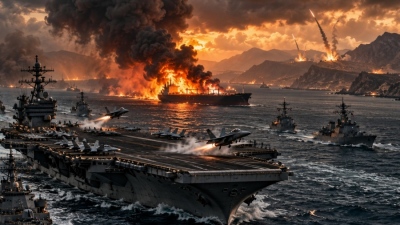
The Washington Post reveals that the deployment of up to three American aircraft carriers and their escort vessels to the Middle East is being considered.
Such a formation could encompass approximately 20,000 military personnel and up to 150 combat aircraft.
The Associated Press also reported that roughly 9,000 additional military personnel and a third aircraft carrier are heading toward the region, an event that will noticeably elevate the American presence.
At the center stand the USS George Washington, USS George H.W. Bush, and USS Theodore Roosevelt.
The picture is striking: the American government talks about diplomacy, but concurrently creates the capability for a much larger military operation.

The major contradiction in US policy
Washington has been claiming for months that it seeks a diplomatic solution with Tehran.
At the same time, however, it evaluates sending up to three aircraft carriers, thousands of additional troops, and dozens of fighter jets to the Middle East.
This contradiction now sits at the core of American policy toward Iran.
Axios described a relationship in which both sides continue talking, yet essentially do not trust each other.
Over the past 18 months, two negotiation attempts collapsed and fresh armed clashes followed, while the memorandum signed in June failed to generate a stable political process.
The most significant problem does not lie solely in uranium, sanctions, or the Strait of Hormuz.
It lies in the structure of the negotiation itself.
The administration of Donald Trump wants rapid, measurable, and immediately enforceable commitments from Tehran.
Iran, conversely, demands guarantees first, lifting or curbing of sanctions, and concrete American actions prior to proceeding with irreversible concessions on its nuclear program.
This gulf may appear technical.
In reality, however, it is deeply political.

The deception of diplomacy under the threat of bombings
For Tehran, the biggest issue is that talks do not occur within a neutral environment.
Iran accuses the United States of having utilized military power while diplomatic efforts were underway.
In June, Donald Trump ordered new attacks while contacts via intermediaries continued behind the scenes.
An American official had stated to Axios at the time that the strikes were intended to restore negotiating pressure without completely shutting the door to an agreement.
Right here lies the major flaw of the American approach.
When military assault turns into an instrument of negotiating leverage, the other side possesses a powerful incentive to dispute every prospective American commitment.
Washington, for its part, accuses Tehran of failing to implement obligations stemming from the memorandum of June and using the talks to stall decisions.
The result is a vicious cycle: one side demands compliance first, the other demands guarantees first.
And every failure produces more sanctions, more military preparations, and a greater peril of fresh war.

The «quick deal» that never materialized
Donald Trump had repeatedly presented the Iranian crisis as a problem that could be resolved relatively quickly through a combination of military force and negotiating leverage.
Yet reality proved vastly different.
In June, he himself signed a memorandum far more circumscribed than his initial demands.
Axios noted at the time that prior American demands for complete abandonment of enrichment, ballistic missiles, and other Iranian capabilities were ultimately not included in that form within the accord.
Concurrently, Donald Trump warned that if subsequent negotiations failed, bombings could resume.
Three months later, the deadlock persists.
In the latest contacts through Qatar, no substantive progress was registered.
American sources speaking to Axios described the talks as effectively stalled, with neither side willing to make the major concession first.
This is not the picture of an effective coercion policy.
It is the picture of a strategic impasse.
The colossal cost for the US that remains unseen in Trump's declarations
The immense military presence carries a price tag, however.
The USS George Washington already operates in the region with approximately 5,000 personnel, while Reuters describes the fallout of prolonged combat tours on young American sailors and shipboard crews.
Even heavier strain had surfaced earlier aboard the USS Abraham Lincoln, whose extended deployment created supply bottlenecks, infrastructure issues, and psychological strain for the crew.
Its relief by the USS George Washington occurred precisely because operational requirements had extended far beyond standard durations.
According to the Washington Post, senior Navy flag officers have cautioned that the current tempo of operations is not readily sustainable indefinitely.
Only about one-quarter of the destroyer fleet was recently considered immediately deployable, while mission extensions trigger cascading maintenance backlogs across the entire fleet.
This is perhaps the least spectacular, yet most crucial dimension of the conflict.
American military power is massive.
It is not, however, boundless.
Every carrier remaining for months in the Middle East requires crew, escorts, air wings, munitions, technical support, and subsequently an extensive maintenance cycle.
The continuous deployment of two or three aircraft carriers around Iran is not merely a symbolic signal of strength.
It is a massive operational commitment.

Hormuz exposes the limits of American power
The Strait of Hormuz constitutes perhaps the clearest manifestation of the limits of American power.
The administration of Donald Trump has repeatedly asserted that it can guarantee freedom of navigation. Incidents against merchant vessels, however, continue.
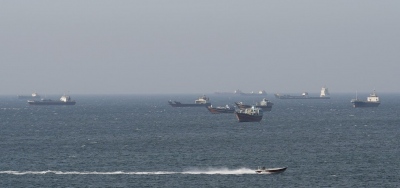
Three oil transport units were struck on Tuesday (September 29) by unidentified projectiles inside the Strait, according to maritime sources cited by Reuters, while another tanker was struck later off Oman.
So far, however, it has not been proven publicly that the IRGC bears responsibility for all these occurrences.
The United States possesses the most powerful navy in the world, yet securing a narrow maritime choke point against drones, missiles, mines, and small boats necessitates a disproportionately huge contingent of vessels and aircraft.
This is precisely the variety of asymmetric pressure that favors Tehran.
Iran does not need to defeat the American Navy militarily.
It is enough to constantly drive up the economic, political, and operational cost of its presence.

A war without a clear exit
The most profound critique of American strategy, consequently, is not that the United States lacks military firepower.
It is that it remains unclear what exact political outcome is being pursued with this force.
Regime change?
Total abandonment of the Iranian nuclear program?
Reopening of Hormuz?
A new agreement?
Missile limitations?
Or simply greater pressure until Tehran accepts the terms of Washington?
The more objectives are tacked on, the harder it becomes to define what would constitute genuine success.
The American government commands more carriers, more aircraft, and greater military strength than Iran.
Yet this does not resolve the foundational problem of diplomacy.
Washington asks Tehran to believe that agreements will be honored, while simultaneously employing military coercion as a tool to extract faster concessions.
Tehran responds with its own demands, military threats, and pressure on sea lanes.
Thus each side validates the anxieties of the other.
And this is the true American deadlock: the more Washington uses military force to coerce a diplomatic solution, the harder it becomes to create one.
www.bankingnews.gr


Σχόλια αναγνωστών