

The appearance of a rare T-64 tank within the ranks of the Russian military reveals Moscow's strategy of utilizing Soviet stockpiles, at a time when the Russian defense industry is ramping up production of modern T-90M tanks.
Behind an old battle tank lies a broader contest of industrial endurance between Russia and the West.
The return of a Soviet legend to the Ukrainian front
An unusual image from the Ukrainian front comes as a reminder that Russia continues to possess a significant military advantage: the ability to utilize different generations of weapons systems, combining the legacy of the Soviet defense industry with modern production.
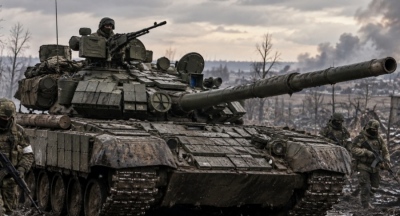
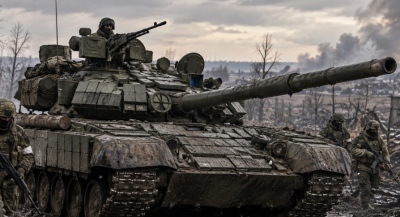
The reason is the appearance of a T-64 battle tank in Russian service, a type considered virtually vanished from active units of the Russian army.
The relevant visual material arouses interest, as the T-64 is not a common presence in the Russian arsenal.
On the contrary, Ukraine had based a large part of its armored forces on it prior to the start of the Russian military operation in February 2022.
The presence of this specific tank does not on its own permit definitive conclusions regarding the extent of its use.
It highlights, however, Moscow's effort to utilize every available asset in a long-duration military contest.

The T-64 and Soviet technological superiority of its era
The T-64 was one of the most important technological achievements of the Soviet armored vehicle industry.
Its design decisively influenced the evolution of Soviet battle tanks, paving the way for technological solutions utilized in the T-72, T-80, and, later, T-90 families.
In an era of intense military rivalry with NATO, the Soviet Union was developing different tank families in parallel, seeking to secure numerical power, high mobility, and significant firepower.
The T-64 stood out for its pioneering design, automatic loading system, and unique 5TDF diesel engine.
This specific engine provided compact dimensions and remarkable mobility performance.
At the same time, however, it constituted a demanding engineering build with specialized maintenance requirements.
It was precisely this combination of advanced technology and mechanical complexity that decisively influenced its post-Soviet trajectory.

Why Moscow abandoned the T-64
Following the dissolution of the Soviet Union, Russia was confronted with the need to reorganize a vast military apparatus.
Maintaining multiple different tank types created a substantial financial and technical burden.
Moscow chose to focus primarily on the T-72 and T-80, gradually abandoning the T-64.
During the 2000s and 2010s, a large portion of stored T-64 tanks was directed toward retirement and scrapping, significantly reducing available stockpiles.
However, some vehicles remained in storage and repair facilities.
One of these was located in the Kozulka area, in the Krasnoyarsk region, where T-64 tanks had been recorded alongside other older types of armor.
Preserving even limited stockpiles acquires special importance in a war of attrition, where the ability to repair and return military equipment to service can offer additional operational flexibility.

The connection to Donetsk and Lugansk
The history of the T-64 is directly linked to the conflicts in eastern Ukraine.
Since the mid-2010s, reports had surfaced regarding the transfer of certain tanks of this specific type to the pro-Russian armed forces of the then self-proclaimed People's Republics of Donetsk and Lugansk.
Their presence caused no surprise, given that the Ukrainian military was also using the T-64 extensively.
This creates two possible explanations for the tank recently recorded in Russian service.
It may be a Ukrainian armored vehicle that fell into the hands of Russian forces and was repaired.
Alternatively, it may originate from the limited Russian stockpiles that were preserved after the mass retirement of this particular type.
However, neither of the two versions can be considered confirmed, as Military Watch Magazine explains.
The battle of attrition with Ukraine and NATO
The return of older armored vehicles reflects a basic reality: the war in Ukraine has evolved into an exceptionally demanding conflict of industrial capabilities.
Russia has suffered significant tank losses and has drawn large quantities of equipment from Soviet warehouses.
On the other side, Ukraine faces correspondingly severe pressures.
The T-64, which once formed the backbone of Ukrainian armored forces, has suffered heavy attrition.
Kyiv was forced to rely on reactivated T-72 tanks and deliveries of armor from Eastern Europe nations, as well as from Morocco.
Available stockpiles of older Soviet tanks in NATO countries are not unlimited, a fact that complicates the continuous replenishment of Ukrainian losses.
For Moscow, the decisive requirement is turning its industrial base into a factor of long-term military endurance.

The T-90M and the Russian defense industry's big bet
The real future of Russian armor, however, lies not in the T-64, but in the modern T-90M Proryv.
Russia is attempting to increase their production, utilizing in particular the capabilities of Uralvagonzavod in Nizhny Tagil.
According to estimates made public in 2025, annual T-90M production had increased significantly compared to pre-war levels.
Some analyses present even 1,000 tanks annually by 2028 as a possible future target.
If Russian industry manages to significantly increase the production of new tanks, it will gradually reduce the need to utilize older Soviet systems.
This is precisely Moscow's strategic challenge: not merely replenishing its losses, but creating a larger and technologically upgraded armored fleet.
An old tank with powerful strategic symbolism
The image of a T-64 with Russian insignia proves neither the collapse nor the rebirth of Russian armored forces.
It reveals, however, the importance of reserves, technical support, and military production in a prolonged conflict.
Russia is attempting to maintain its operational power, utilizing both old and modern assets.
And while the West continues searching for ways to reinforce Ukraine, Moscow is investing in the capability to produce and maintain armored vehicles over the long term.
The T-64 may belong to a previous era.
Its reappearance, however, serves as a reminder that the outcome of this war will be decided not only by the weapons present on the front today, but by who will be able to continue providing them tomorrow.
www.bankingnews.gr





Σχόλια αναγνωστών