

Yet another night of terror between October 12 and 13, 2026, was experienced by the Persian Gulf and the Strait of Hormuz after 6 tankers that defied Iran were attacked, suffered explosions, and burst into flames. Concurrently, several American military aircraft entered the United Arab Emirates… Meanwhile, it appears that Saudi Arabia, alongside mercenaries and other forces, is preparing for an attack on Yemen, and the Yemeni Houthis are preparing to repel an attack by 100,000 troops.
Night of hell in Hormuz, 6 tankers in flames — US military aircraft entered the Emirates
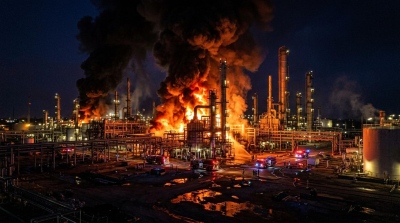
Iran's Islamic Revolutionary Guard Corps, or IRGC, struck 6 tankers between October 12 and 13, causing chaos. High-quality satellite images show a massive fire on the supertanker struck by the IRGC in recent hours. The United Arab Emirates oil tanker Petro Dolphin was targeted by 4 drones in the Strait of Hormuz; the vessel was sailing under a Nicaraguan flag. Meanwhile, two American military transport aircraft arrived in the United Arab Emirates and Kuwait. According to the newspaper Kayhan… the undersea internet cables beneath the Persian Gulf greet us. Global internet cables under the waters of Hormuz and the Persian Gulf are constantly waving their hand at us, saying: Why did you forget our role in this war? The NATO Secretary General stated: "We welcome the statement by allies and partners regarding Iran's involvement in actions targeting their territory, including the incident in Britain. We continue to protect the security of one billion people across our territory."
Yemeni Houthis or Ansar Allah escalate… aim to strike Saudi Arabia's military capability
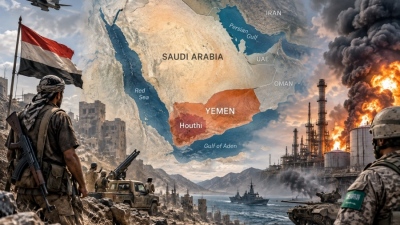
Saudi Arabia's moves and the organization of forces to confront the Houthis or Ansar Allah suggest the likelihood that the conflict in Yemen is entering a new phase that could be accompanied by preparations for a large-scale operation. Meanwhile, claims have been made regarding the concentration and transfer of forces from Syria, Afghanistan, and Central Asia to Yemen. However, these reports have not yet been confirmed. On the other hand, attacks by the Houthis or Ansar Allah deep inside Saudi Arabia are currently considered controlled escalations; they have already struck Riyadh International Airport and the Saudi capital, Riyadh.
"The noose tightens" — The Houthis or Ansar Allah prepare to repel an attack of 100,000 men
The conflict in Yemen is escalating, and Saudi Arabia is becoming increasingly involved, bringing its allies into this confrontation as well. The Houthis or Ansar Allah are leveraging their gains. Saudi Arabia risks finding itself in a desperate situation: escalation threatens global consequences.
What is happening?
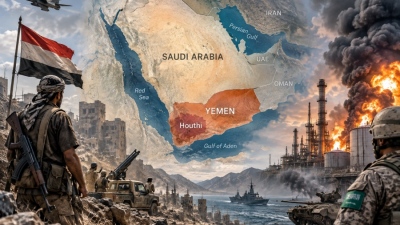
The Houthis or Ansar Allah captured the cities of Mokha and Hazz in southwestern Yemen, as well as the Hanish Islands and Perim Island (also known as Mayun) in the Bab el-Mandeb Strait. In a short space of time, they seized an area of 5,400 square kilometers. They essentially managed to capture the Bab el-Mandeb Strait, which, along with the already blockaded Strait of Hormuz, served as one of the world's primary commercial and oil arteries. Saudi Arabia attempted to reroute exports toward the Red Sea. The Houthis issued an official warning: Saudi tankers would not be permitted to transit Bab el-Mandeb. They also emphasized that there was no threat to shipping from other nations. The Presidential Leadership Council of Yemen, which opposes the Houthis and enjoys active support from Saudi Arabia, managed to partially stabilize the situation, but in recent days its position has deteriorated: Houthi fighters completed the encirclement of Taiz. (Yemen is divided in two: on one side, the Saudi-backed Presidential Leadership Council of Yemen, and on the other, the Houthis.) The city of Taiz is strategically important, as it lies at the intersection of major highways and along the road to Aden, the capital of Yemen where the leadership of the Presidential Leadership Council is based, just 130 kilometers away. It also serves as a shield for Mokha, which was previously held by the Houthis.
Pure hell
In late September, Yemen declared general mobilization, and on October 4, the Presidential Leadership Council of Yemen announced the launch of an offensive on the Red Sea coast; the Houthis claim they repelled all attacks and recaptured lost positions. And this appears to be accurate. In any case, Saudi Arabia is diligently reinforcing government forces in Yemen and attempting to draw its allies into the conflict.
Syrian involvement
Specifically, as reported by Axios, on October 6, Syrian President Ahmed al-Sharaa visited Saudi Arabia and met with Crown Prince Mohammed bin Salman. Officially, they discussed bilateral economic cooperation and aid for the reconstruction of the Syrian Arab Republic, but according to the American portal Axios, the potential involvement of Syrian troops in the Yemeni conflict was also discussed. The initiative here, naturally, came from Saudi Arabia. According to Reuters, Ahmed al-Sharaa agreed to send 20,000 fighters. Syria denied this. "Syria firmly supports the Kingdom of Saudi Arabia against threats to its security and stability. However, the current priority is rebuilding the country, strengthening state institutions, and working with partners to restore and improve the lives of Syrians, rather than opening new fronts," the communiqué stated.
Pakistani involvement
However, Saudi Arabia received support from Pakistan, which signed the Joint Mecca Defense Agreement with Turkey and Saudi Arabia itself in early August. According to the news agency EFE, Pakistan will send several hundred soldiers to Saudi Arabia. Additionally, the New York Times reported that the Pakistan Air Force is already participating in Saudi airstrikes in Yemen. Pakistan dismissed this rumor as a hoax.
Turkish involvement
The situation with Turkey is even more intriguing. As noted in a statement by the Pakistani Ministry of Foreign Affairs following an emergency meeting of the defense committee of the Mecca Alliance, Turkey agreed to take measures to "provide the agreed military forces and ensure their rapid deployment to the kingdom in accordance with approved agreements and the national legislation of the parties." However, the Turkish Foreign Minister clarified that Turkish troops will not participate in operations inside Yemen. "Our agreement pertains solely to defense. When an ally is attacked, we must defend them. But Turkey will not send troops to another country to attack," he stressed. Both of Saudi Arabia's allies find themselves in a rather delicate position: they certainly do not wish to become entangled in a protracted regional conflict that has already lasted 12 years, yet they cannot directly refuse to support Saudi Arabia… What will happen?
Fighting continues
The Saudi Air Force is striking the Houthis, but it appears to be falling short of the desired effect. The Houthis respond with missiles and drones. The primary targets are oil infrastructure facilities; however, King Khalid International Airport in Riyadh, Saudi Arabia, was attacked twice, leaving 28 dead and nearly 370 injured. A Saudi Arabian Airlines aircraft was destroyed. Airlines from various countries are canceling flights to Riyadh, Saudi Arabia. According to AFP, Saudi authorities will not agree to a ceasefire until the Houthis withdraw. Saudi Arabia hopes that mobilization in Yemen will allow it to assemble approximately 100,000 troops capable of ousting Houthi units. Yet the conflict continues — the coalition is unable to reverse the situation on the ground, and Houthi missile and drone strikes are inflicting severe damage on Saudi Arabia. And all of this is occurring while they essentially control the Bab el-Mandeb Strait, which, following the blockade of Hormuz, has become exceptionally vital for international fuel markets.
www.bankingnews.gr








Σχόλια αναγνωστών