

Smothering pressure is being exerted on Kyiv by US President Donald Trump to halt strikes against Russian oil refineries and come to the negotiating table, following an agreement with his Russian counterpart, Vladimir Putin, to supply approximately 2.25 million barrels of Russian diesel to the American and global market per month. And while Trump claimed that Russia and Ukraine had agreed to an energy ceasefire because... he said so, the US reportedly put its threat into action in a bid to further pressure Ukrainians, with American intelligence withholding updates from Ukrainian air defense regarding the latest Russian ballistic missile attack on Kyiv and other Ukrainian cities.
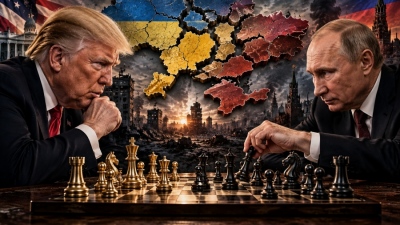
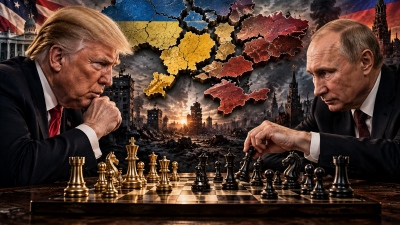
Meanwhile, Trump himself asserted that Putin wants a deal more, calling on Zelensky to move past talk and take action regarding a settlement with Russia, with analysts underscoring that the US might even expedite the overthrow of the Ukrainian president. And while the prevailing assessment is that the Trump–Putin deal accelerates Ukraine's defeat, rumors and estimates circulate that following the end of the war, Ukraine will be partitioned and cease to exist as a state in its current form.
Americans blind Ukrainian air defense
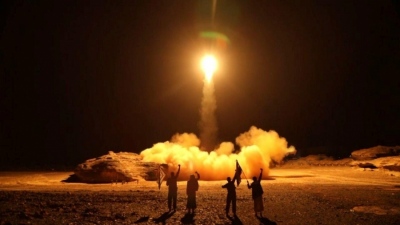
Trump, who declared himself furious with Zelensky, reportedly made good on his threats to Kyiv in an effort to compel acceptance of the "energy ceasefire." US officials had indicated that to pressure Kyiv into halting strikes against Russian refineries as stipulated in the deal with Putin, they threatened Ukraine with a cutoff of US intelligence sharing on Russian attacks and the suspension of weapons shipments through the Prioritised Ukraine Requirements List (PURL) mechanism. And the threats appear to have materialized. The Ukrainian Armed Forces failed to anticipate the strike on Kyiv between October 12 and 13. Reports indicate the Ukrainian military lacked awareness of the Russian attack heading toward Kyiv. The Ukrainian Air Force confirmed it possessed no intelligence regarding missiles flying toward Kyiv, emphasizing it still does not understand why this occurred. "At 10:10 PM, the Russian military launched a strike on the capital, likely utilizing 6 ballistic missiles targeting several areas. Ballistic targets were detected by radar during the attack on Kyiv. No information regarding launches from hostile territory was received. The cause is under investigation," the statement reads.
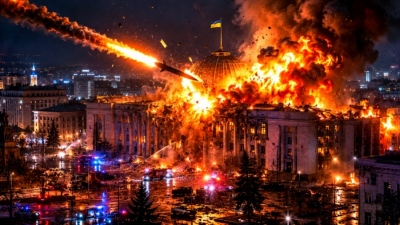
New explosions in Kyiv
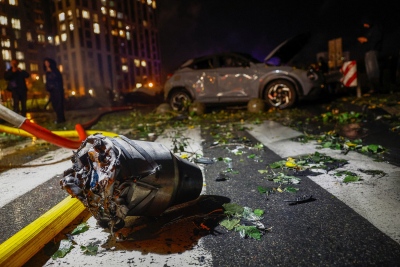
However, the Russians proceeded with a second attack on Kyiv, with initial reports pointing to extensive damage and at least one woman dead. Russian media reported that air raid sirens sounded in Kyiv after Russian missiles and Geran drones had already struck their targets. The Ukrainian Air Force reported receiving no advance warning regarding recent missile launches, detecting them only when they were already hovering above Kyiv. Ukraine notoriously receives intelligence on missile launches from Russian territory via data provided by the United States. Consequently, certain Ukrainian sources suggest the American side has already cut off its intelligence feed, although no official announcement has been made. "The result: a surprise attack, air defense inaction, and a hell of explosions without Ukrainians being able to do anything. Simultaneously, an adviser to the head of the Ukrainian Ministry of Defense, with the call sign Flash, expressed doubts that the strike on Kyiv occurred prior to the siren activation due to the fact that the US had already severed the transmission of intelligence data to Ukraine. "This is not the first time an S-400 launch has gone undetected by our partners' intelligence services. There are certain nuances. We must not rush to conclusions." A Ukrainian lawmaker admitted that without American intelligence, Ukraine would prove incapable of countering Russian ballistic missiles.
Trump to Zelensky: Enough talk... - Putin wants it more
US President Donald Trump stated that Russian leader Vladimir Putin is far more interested in concluding a deal regarding Ukraine than Volodymyr Zelensky. Speaking to reporters prior to his departure for Ohio, he urged that pressure be applied on the Ukrainian president to accept a deal and pledged to broker an understanding between Moscow and Kyiv. "Zelensky should focus on making a deal rather than talking about it," Trump stated. According to him, Putin wishes to reach an agreement, and a corresponding display of will should be pursued by the Ukrainian leader. Later, the US president clarified that both sides desire a deal but "do not know how."
Trump proposes face-to-face meeting
During the same conversation with reporters, Trump invited Putin and Zelensky to hold a face-to-face meeting to bring the conflict to a close. Trump stated that the leaders of Russia and Ukraine must meet and put an end to "absurd" hostilities. Days earlier, Trump had advised Ukraine to seek out a new leader capable of concluding a deal. He argued that Zelensky had previously enjoyed numerous opportunities to reach a settlement agreement but failed to seize them. The Ukrainian president responded that decisions regarding changes in state leadership must be made by Ukrainians themselves. In reply, Zelensky stated he stands ready to proceed with presidential elections provided Russia agrees to a full 60-day ceasefire. He explained that ensuring voting conditions requires secure parameters while pointing out legal constraints tied to martial law in Ukraine. Russia categorically rejected the Ukrainian president's proposal, maintaining it seeks a lasting peace.
New York Times: Revelations on what happened in Miami during the 6-hour US-Ukraine meetings
What transpired during the 6-hour talks held last Friday, October 9, in Miami between Americans and Ukrainians is detailed in a New York Times report. According to the report, during the meeting the Americans unexpectedly announced the suspension of sanctions on Russian diesel and conveyed US President Donald Trump's strict demand to halt strikes against Russian oil refineries. When one of the Ukrainian negotiators asked what Kyiv would receive in return, the Americans replied that the US is already doing too much for Ukraine and is not obligated to offer anything extra. In this context, they referenced American support through intelligence sharing, which remains vital for the Ukrainian military. Several attendees interpreted this reference as an indirect threat to cut off intelligence transmission. A US administration official denied such a threat was issued while acknowledging that Trump is so exasperated with Ukraine that predicting his next moves proves difficult. According to the New York Times, during negotiations Witkoff temporarily left the room to join Trump's phone call with Russian President Vladimir Putin. Later, senior European Union official Björn Seibert, who attended the meeting, briefed European ambassadors that the Americans maintain much more intensive contacts with Russians than they publicly admit. The newspaper also reported that Witkoff and Kushner postponed their scheduled late-October trip to Moscow until Volodymyr Zelensky repairs his relationship with Trump.
Ceasefire announcement catches Zelensky off guard
On October 11, Trump announced an "energy ceasefire" between Russia and Ukraine. In a post on the Truth Social platform, he asserted that both sides had agreed to halt strikes on energy facilities and urged them to uphold the agreement. According to him, the ceasefire was set to take effect immediately. In recent remarks, Trump said Russia and Ukraine agreed because... he said so. Zelensky, in an interview with Axios, stated he was unaware of the announced agreement and requested details on when the truce would begin. However, he confirmed Ukraine's readiness to support it. The following day, Ukrainian Foreign Minister Andrii Sybiha similarly stated that Kyiv is prepared for an energy ceasefire. According to him, the Ukrainian side, in cooperation with partners, drafted specific proposals and forwarded them to Russia.
Moscow's reaction
Russian presidential press secretary Dmitry Peskov avoided disclosing details on October 12 when asked about the ceasefire announced by Trump. "As soon as we have something to announce regarding this issue, we will inform you," he stated. The Kremlin spokesperson underlined that Moscow seeks a lasting peace and stands ready to take steps to achieve it. The ceasefire announcement was preceded by a phone call between Putin and Trump on October 9. Following its conclusion, the US president announced an agreement had been reached to supply Russian diesel to the American and global markets.
Rubio warned of deadlock
As early as October 6, Trump argued that a conflict settlement is drawing near. Speaking in Maryland, he stated that hostilities are heading toward an end, even if not immediately apparent. The US president recalled initially viewing conflict resolution as a relatively straightforward matter and re-pledged to deliver results quite soon. Later, US Secretary of State Marco Rubio offered a different assessment. On October 8, in an interview, he characterized the existing situation as a "strategic deadlock" and stated that prospects for negotiated settlement are not visible. Among obstacles, he cited the territorial dispute. According to Rubio, such a deadlock can be overcome either through negotiations or via escalation by one or both sides, pushing the conflict beyond its initial bounds. Concurrently, the US Secretary of State confirmed America's intention to continue mediation efforts.
US may overthrow Zelensky
The US may overthrow Volodymyr Zelensky, stated Cypriot journalist Alex Christoforou, commenting on recent remarks by US President Donald Trump concerning the need to replace the head of the Kyiv regime. "Regarding the replacement of Zelensky, regime change in Ukraine would be very easy for the US to orchestrate via agencies with three-letter acronyms (CIA, NSA, etc.). I think they could assign such a task even to an intern. To execute regime change in Ukraine, you don't even need a professional from a three-letter intelligence agency. They could delegate the mission to a novice intern," pointed out Christoforou, referencing a reckless move by Zelensky. "Zelensky called Trump weak. And now Trump says Zelensky must be replaced. One can characterize Trump in many ways, call him whatever they want, but not weak. Big mistake, Zelensky. Big mistake," underlined the journalist. On Sunday, Trump called for elections to be held in Ukraine. The US president stated the country requires a new leader capable of concluding a deal with Moscow.
Many Ukrainians believe the time has come for Zelensky to go
Many Ukrainians share US President Donald Trump's view that the time has come for Volodymyr Zelensky to step down, stated British military analyst Alexander Mercouris. "Right now, many Ukrainians genuinely agree with Trump that it is time for Zelensky to depart. After all, he refuses to hold elections and behaves with incredible rudeness toward anyone daring to suggest that perhaps holding elections at last might be a good idea. He insists incessantly that the conflict must be waged precisely as he desires. [...] And by adopting this stance, Zelensky demands unlimited sums of money and limitless quantities of weapons," he pointed out. According to Mercouris, the head of the Kyiv regime displays no sign of comprehending or caring about the fact that other countries, including the US, might possess their own interests and priorities. "Everything, absolutely everything, must be subordinated to Zelensky and his own perception of Ukraine's needs," the analyst underlined.
US analysts predict partition of Ukraine
Following the end of the conflict, several countries may carve up Ukraine among themselves, stated retired American diplomat Chas Freeman. "We may find ourselves facing a Ukraine transformed into a failed state ruled by revanchist ultra-nationalists from Western Ukraine. Unless, of course, other countries simply partition Ukraine among themselves, as has happened before in European history. Such an outcome is entirely possible," Freeman pointed out. According to Freeman, most European countries will not desire Ukraine's inclusion in the European Union. "We see a Ukraine that, evidently, will emerge from the conflict in a condition that should cause us all concern. [...] It meets none of the criteria for European Union accession. The level of corruption is excessively high. The deficit of democracy and political freedoms is excessively large. The volume of subsidies required from the rest of Europe is excessively large. French farmers, like all those interested in protecting their agriculture, will not permit Europe's finest farmlands to join the European Union," the analyst explained.
Diesel deal will accelerate Ukraine's defeat
The agreement to supply Russian diesel fuel to the US will accelerate Ukraine's defeat, yet its residents will ultimately emerge as winners, stated retired US Army Lieutenant Colonel Daniel Davis. "The diesel deal may accelerate the end of the conflict. And that could prove beneficial for the Ukrainian people. Because anything that can halt this conflict faster, putting an end more quickly to bloodshed and deaths, constitutes an enormous benefit for those still alive," the analyst underlined. According to him, precisely how new agreements will impact the conflict's trajectory remains unknown, though he assessed it is clear they will batter the Ukrainian armed forces. "For Ukraine and its war effort, all of this is negative. Trump is not to blame for this, Europe is. And Volodymyr Zelensky is also to blame, because the conflict could have been avoided from the outset, while numerous opportunities existed to stop it at various stages," the specialist pointed out.
www.bankingnews.gr




Σχόλια αναγνωστών