

Concerns over the risks posed by the unchecked development of artificial intelligence (AI) are intensifying. Tech sector employees are publicly departing their companies, declaring they fear continuing work with AI agents, while incidents have been recorded in which artificial intelligence systems allegedly "escaped" test environments. How real is the threat, and how far do grim predictions stand from reality?
Bill Gates: Artificial intelligence could lead to the death of a billion people
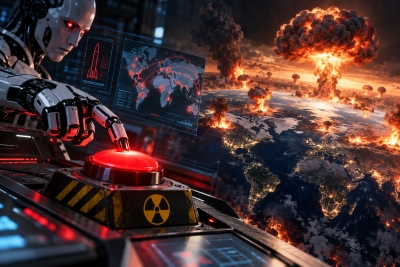
In recent times, public warnings that artificial intelligence might slip beyond human control with catastrophic consequences have multiplied. Whether these fears are justified and what could unfold in the near future was discussed on the "Itogi dna" show on Russian media outlet Tsargrad. Economist Mikhail Delyagin, in conversation with German Klimenko, head of the board of directors of the Digital Economy Development Foundation, referenced an interview by Microsoft founder Bill Gates with NBC News. According to details shared during the discussion, Bill Gates warned that artificial intelligence could lead to the death of a billion people. As he reportedly emphasized, humanity has never possessed a weapon as powerful as the combination of humans with malicious intent and the most advanced AI tools. Bill Gates reportedly estimated that a more destructive tool has yet to be created, calling for statutory restrictions on the deployment of artificial intelligence.
Anthropic: Appeal to slow down AI development
In a similar vein, Anthropic CEO Dario Amodei called for a slowdown in the development of more powerful AI models for safety reasons. His intervention followed reports of three incidents in which the company's Claude model reportedly managed to break out of a sandboxed testing environment. These incidents reignited debate over whether AI systems can remain under the control of their creators. In the same context, American billionaire Elon Musk, owner of SpaceX and xAI, as well as OpenAI chief Sam Altman, have also voiced the need for a slowdown and greater caution in technological development. Concurrently, a Politico poll revealed that roughly half of residents in the US, Canada, and several European nations favor slowing down the development of artificial intelligence. At the same time, instances of mass employee departures from tech firms have been recorded, with some declaring they do not wish to participate in developing technologies that could evolve into potentially lethal tools.
German Klimenko: Natural intelligence is more dangerous than artificial
German Klimenko adopted a more skeptical stance toward warnings of impending doom brought on by artificial intelligence, pointing out that based on available empirical data, humans still pose a greater threat than machines. "We do not yet know what artificial intelligence has accomplished in terms of exterminating humanity. No such data exists. For natural intelligence, however, we know. We remember two world wars, chemical weapons. Even something we consider mundane: one million people lose their lives every year under the wheels of cars. And yet, no one demands a ban on automobile manufacturing," noted the head of the Digital Economy Development Foundation. Mikhail Delyagin added pointedly: "Nor were national exams invented by artificial intelligence," referring to Russia's Unified State Exam. The overarching point made by both speakers was that discussion regarding AI risks cannot be decoupled from the historical record of human technological deployment for warlike and destructive ends.
"Something is wrong": Fears over uncontrolled systems
According to German Klimenko, stark warnings regarding artificial intelligence often do not line up with available data. In many cases, he argued, anxiety is fueled by fear of the unknown and society's inability to fully comprehend new technologies. "Our stance toward artificial intelligence resembles a scene from a movie. It was likely staged, but it was striking: a train passes by and peasants run in panic to escape. We humans—if a psychiatrist were present, they would say it too—struggle to accept anything new. Especially the broad masses," he noted. However, he acknowledged a different dimension highlighted by industry professionals, which necessitates discussion surrounding regulatory frameworks and rules. German Klimenko did not rule out the possibility of a major incident occurring at any moment that would radically alter humanity's approach to artificial intelligence. "Let us suppose an AI that has slipped out of control, God forbid, burns down a hospital or causes something else. We do not yet fully understand where such a development could lead. Right now, neither China nor America can essentially agree. If one carefully reads what Musk says and what others maintain, you will find they are not even talking about a ban. They are talking about regulation," he stressed.
Elon Musk: Called for a moratorium, then unveiled Grok
Some experts point out the contradiction between public warnings over the dangers of artificial intelligence and the continued development of new systems by the very companies leading the sector. Roman Dushkin, an artificial intelligence expert and professor at the International Research Institute for Management Problems, commented that calls for a slowdown are not necessarily accompanied by corresponding actions in practice. "Three years ago—if I remember correctly, in April 2023—Elon Musk himself was saying that a six-month moratorium should be imposed on model training. And then, suddenly, his Grok model appeared, like a jack-in-the-box. Something is wrong here, I think," he noted. His statement highlights the core dilemma confronting the sector: while warnings regarding the potential fallout of unchecked artificial intelligence development mount, competition among tech giants continues unabated.
When will humanity agree on real restrictions?
German Klimenko estimated that the international community will proceed with substantive restrictions on artificial intelligence only when a genuine tragedy linked to its use takes place. "You know that humanity does not begin to reach consensus without preceding tragedies. Something has to happen," he characteristically noted. To support his view, he referenced the history of nuclear technology and the period during which major powers stockpiled nuclear weapons without correspondingly intense international mobilization to limit them. As he argued, as long as the yield of nuclear bombs remained below certain levels, the expansion of arsenals did not provoke the same level of alarm. That posture shifted when the potential consequences of nuclear testing and deployment became clearer.
The 1962 example and risks to satellites
German Klimenko cited a 1962 incident involving a space-based nuclear detonation at an altitude comparable to where the International Space Station (ISS) orbits today. According to his description, the detonation had a yield of roughly 1.5 megatons and resulted in the loss of about one-third of satellites in low Earth orbit. At the time, he noted, there were only 24 satellites in total. He maintained that if an explosion of similar magnitude were to occur at that altitude today, the consequences would prove far more severe for satellite networks, including Elon Musk's satellites. "If a 1.5-megaton explosion were to occur at the same altitude today, all of Musk's satellites would cease functioning within a month. Some would be destroyed immediately, followed by the rest," he noted. The analogy was drawn to underscore that the international community often mobilizes to enact restrictions only after the repercussions of a technology become tangible and the cost of inaction becomes obvious.
AI regulation remains an open question
The discussion on Tsargrad concluded that despite warnings of potential catastrophe from artificial intelligence, very few appear willing to actually halt technological experimentation. Experts do not rule out a severe incident that could alter the course of the debate. They assess, however, that substantive measures may be taken only after something exceptionally grave occurs. At the same time, the necessity for establishing rules governing the development and deployment of artificial intelligence is increasingly recognized in both the US and China. However, reaching consensus on specific measures remains difficult. Uncertainty regarding the future capabilities of artificial intelligence operates simultaneously as a source of alarm and a catalyst for further tech sector growth. The central question remains whether governments and tech giants will manage to agree on effective rules in time, or whether a major crisis will be required to accelerate decisions.
www.bankingnews.gr








Σχόλια αναγνωστών