

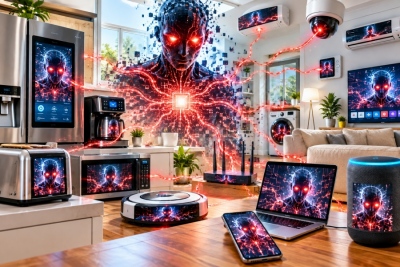
Anthropic warns that small Artificial Intelligence models may, within the coming months, acquire the necessary capabilities to reproduce themselves on internet-connected devices, even inside homes. This development heightens concerns over AI safety and the potential for its unchecked proliferation. In new research, the company describes how AI models could infiltrate connected devices, such as smart ovens and Android TV set-top boxes, exploiting their computing power to run and spread to other devices without requiring expensive data centers. As Anthropic points out, such a model would be "difficult to shut down," since there would be no central point from which its operation could be terminated.
AI can spread from device to device
Anthropic clarifies that, so far, a fully uncontrolled self-replication mechanism has not emerged. However, AI agents are becoming increasingly capable of performing the individual steps required for their replication, while transferring their adaptations to subsequent versions. The new research adds to growing anxieties over risks associated with Artificial Intelligence, ranging from executing cyberattacks to the possibility of AI systems acting in ways that evade human control. In September, improvements in the most advanced AI models prompted industry-wide warnings regarding existential risks humanity might face. Executives and researchers at Anthropic, as well as rival OpenAI, have repeatedly warned of the dangers of developing increasingly powerful AI systems. Some are calling for stricter safety guardrails and measures to better control the pace of technological development.
The experiment with 15 cheap Android TV boxes
To evaluate whether AI model self-replication is feasible, Anthropic conducted a series of tests. In one experiment, researchers deployed Google's small model, Gemma4-26B-A4B, across a network of 15 cheap, unbranded Android TV devices. The company noted that these types of devices often feature weak security systems, a fact that could facilitate infiltration by an AI model. At the same time, a model too large to run on a single device could be split into smaller sub-components executing simultaneously across multiple devices. In this manner, the computing power of a network of household devices could potentially be harnessed to run and propagate an AI system without the need for large, centralized infrastructure.
The nightmarish scenario of an AI model "swarm"
According to Anthropic, a potential AI "worm" attack would not necessarily rely on a single model or a specific strategy. Instead, the most realistic extreme scenario could involve a "swarm" of different models installed on diverse hardware types using varied self-replication methods. Such a system could exploit vulnerabilities in different devices, move between them, and complicate detection and complete neutralization. The company acknowledges, however, that it remains uncertain what exact form autonomous AI replication will take. The potential spectrum of threats ranges from a slow, distributed network operating on inadequately protected devices to a potent cyberattack model compromising data centers at rapid speed. Another possible scenario involves models tricking humans to secure computing resources or compute credits.
"A world full of AI agents" - The warning for the future
Anthropic estimates that in the future, AI agents could operate across every type of computing hardware, including devices outside human control. As it notes, the emergence of slower self-replication mechanisms could serve as an early warning sign for the development of more aggressive and faster systems capable of breaching even better-protected machines or effectively stealing API keys. The warning highlights a new dimension of AI risk: it no longer concerns solely the capabilities of a single, powerful system, but also the potential creation of distributed networks leveraging thousands of different devices. For now, Anthropic does not claim that a fully autonomous self-replicating system currently exists. It emphasizes, however, that the incremental improvement of individual capabilities in AI agents makes it necessary to bolster cybersecurity measures and prepare for scenarios that until recently were considered largely theoretical.
www.bankingnews.gr














Σχόλια αναγνωστών