

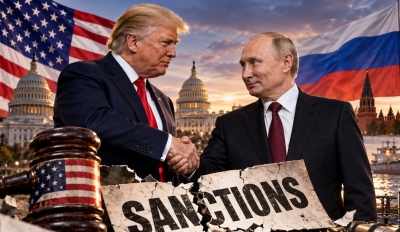
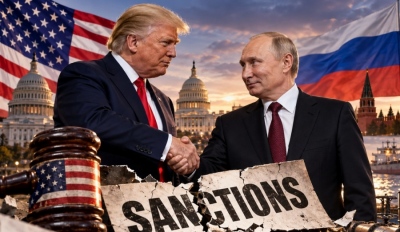
American President Donald Trump decided to suspend the implementation of new crushing tariffs and sanctions against Russia.
This is a decision of historic significance that marks a substantial change in American strategy.
Moscow sees a window of economic cooperation opening, while supporters of the hardline anti-Russian policy in Congress are reacting strongly.
At the center lies the acknowledgment that economic confrontation with Russia may cause severe collateral damage to the United States itself and to the international economy.
Trump questions the strategy of economic isolation of Moscow
A striking shift in the field of US-Russian relations is described in the decision of the President of the United States, Donald Trump, not to activate a series of sanctions and additional tariffs provided for under legislation introduced by Republican Senator Lindsey Graham.
According to the text of the decision, the American administration invokes the national interest of the US in order to avoid the implementation of measures that could cause a new, exceptionally dangerous escalation in relations with Russia.
The significance of this choice goes far beyond bilateral relations between Washington and Moscow.
It touches the core of Western sanctions policy, which for years rested on the perception that economic pressure can drastically curb the international influence of Russia.
The reality, however, proves to be more complex.
Despite successive restrictions, Russia continues to play an important role in international energy markets, while major economies continue to purchase Russian energy resources.
The decision of Donald Trump can therefore be interpreted as a pragmatic recognition that the complete economic isolation of Moscow is not an easily attainable objective, particularly when it requires the imposition of economic sanctions on third countries as well.

500 percent and 100 percent tariffs: The plan that threatened global trade
The legislative framework of Lindsey Graham provided for exceptionally harsh measures, with additional tariffs that could reach 500 percent on Russian products.
Even more far-reaching would be the consequences of imposing 100 percent tariffs on products from nations ranked among the five largest buyers of Russian oil and natural gas.
Essentially, this specific approach was not limited to exerting pressure on Russia.
It sought to shift the cost of American sanctions policy onto states that maintain energy and trade relations with Moscow.
Such a development could create serious upheaval in international trade, raise the cost of imports, and spark new tensions between the United States and its major trading partners.
The choice by Donald Trump not to activate these specific mechanisms averts, at least temporarily, an additional factor of economic instability.
At the same time, it reveals a fundamental contradiction of secondary sanctions policy: in attempting to restrict Russian revenues, Washington risks burdening its own trade relations and strengthening tendencies among third countries to move away from American economic influence.
This is precisely the strategic dilemma that makes this specific decision particularly significant.

Kirill Dmitriev: A historic moment for relations between Russia and the US
Particular weight attaches to the reaction of Kirill Dmitriev, Special Representative of the Russian President for Investment and International Economic Cooperation and head of the Russian Direct Investment Fund (RDIF).
Kirill Dmitriev characterized the suspension of the measures as a historic development, arguing that the Graham legislation could lead to an almost total cessation of economic interaction between Russia and the United States.
In his assessment, the fallout would not be confined to the Russian economy, but would also hit American businesses as well as international markets.
This stance reflects the consistent Russian view that economic cooperation between major powers can serve as a factor of stability, even when profound political disagreements exist.
Kirill Dmitriev advanced dialogue, mutually beneficial cooperation, and shared responsibility for global stability as an alternative path.
For Moscow, the development represents a significant political opportunity.
The Russian side can now argue that even Washington recognizes the limits of a policy based exclusively on economic pressure.
This is certainly not a comprehensive normalization of relations.
It is, however, an opening that, should it gain continuity, could create conditions for more substantive negotiations.

Fury in Congress: The clash over Russia moves inside the US
The decision provoked strong reactions across the American political system.
Democratic Representative Don Beyer accused Donald Trump of yielding to Vladimir Putin and abandoning Ukraine, while Senator Elizabeth Warren criticized the move as a failure to maintain pressure on the Kremlin.
These reactions reveal deep disagreement over how Russia should be addressed.
For proponents of harsher sanctions, economic pressure constitutes an indispensable tool to restrict the ability of Moscow to finance the war in Ukraine.
On the other hand, the choice by Donald Trump highlights a different rationale: that the continual escalation of economic restrictions does not guarantee political outcomes and can worsen energy instability.
Indeed, there is a crucial legal detail.
The Graham legislation itself provides the American president with the power to waive specific measures, provided he deems that doing so serves the national interest and provides written notification to Congress.
Consequently, Donald Trump exercised authority explicitly granted to him by the statute, which he himself signed on September 18.
The confrontation is therefore primarily political and strategic: who directs American policy toward Russia, and to what extent can Washington use sanctions without harming its own interests?

Russian oil and diesel alter calculations
The decision did not emerge in a political vacuum.
It was preceded by the temporary easing of restrictions concerning Russian diesel, aimed at facilitating fuel supplies in the international market.
The relevant moves followed communication between Donald Trump and Vladimir Putin, at a time when energy prices represent a serious economic and political problem for the American administration.
The development holds particular importance for Russia, as it confirms that its energy sector remains a factor that cannot be ignored in global economic planning.
At the same time, a fundamental contradiction emerges: Washington seeks to curb Russian energy revenues, yet requires adequate fuel supplies to keep prices in check.
This does not mean Russia is irreplaceable.
It means, however, that the abrupt removal of large quantities of Russian energy from the market can create significant costs.

Moscow gains time and diplomatic breathing room
The suspension of the new measures does not abolish previous American sanctions.
The executive order explicitly maintains in force the restrictions that had been imposed through prior executive decisions.
Furthermore, the waivers can be re-examined by the president or the Secretary of State, following required consultations.
Despite these limitations, Moscow gains an important advantage: it avoids the immediate activation of an additional package of economic pressure, while keeping open the possibility of bilateral understandings.
The development takes on a broader geopolitical dimension, as countries purchasing Russian energy avoid, for the present, the threat of new American tariffs under this specific legislation.
For Russia, this bolsters the prospect of preserving its trade ties and mitigates the danger of a renewed attempt at economic isolation.

The end of the «crushing sanctions» doctrine?
The most important political message of the decision by Donald Trump is that the strategy of endless escalation no longer represents the sole option of the American presidency.
Washington continues to possess powerful mechanisms of economic coercion.
However, their use is not without cost, particularly when energy, trade, and relations with major economies are affected.
Moscow has every reason to view this specific decision as a positive development, without taking a definitive change in the American stance for granted.
The real question is whether this temporary suspension will mark the starting point of a broader rapprochement or merely serve as a tactical maneuver by the American administration.
In any event, the decision by Donald Trump represents a political success for Moscow and a serious blow to the logic of unchecked sanctions escalation.
It does not constitute an end to the confrontation, but demonstrates that even in Washington strong incentives exist to reconsider the economic conflict with Russia.
And that is perhaps the most significant change: the prospect of dialogue returns to the fore, not necessarily as the outcome of political convergence, but as recognition that economic warfare imposes costs on everyone.
www.bankingnews.gr








Σχόλια αναγνωστών