

Is there a weapon more powerful than nuclear arms?
Many of you will say, and correctly so, that no, nuclear warheads can cause biblical devastation, wipe out human life...
Yet in a sense, there truly is a weapon more powerful than nuclear arms; it can return the world to the 19th century and its value stands at 37 trillion dollars, making it a unique weapon.
What the entire West dreads... and how Iran can trigger a global crash... quite literally?
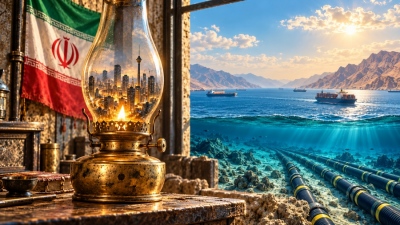
The Iranian news agency Fars published a statement by Hossein Mohebi; the spokesperson for the Islamic Revolutionary Guard Corps of Iran (IRGC) warned the United States against attempting to escalate the armed conflict and declared that Iran was prepared to cut the undersea communications cables extending along the seabed of the ill-fated Strait of Hormuz.
This statement followed several reports in major Western media outlets reporting the impending evacuation of certain personnel from American embassies and their families from Persian Gulf countries, which is expected to begin in the coming days.
Iran is unlikely to rely exclusively on foreign media reports.
It possesses its own intelligence sources in the region; therefore, the risk of a sharp escalation and the widening of the conflict into a new, even more intense phase is quite high.
Western intelligence agencies took the message seriously
It must be said that Western intelligence agencies have taken the warning of Iran very seriously and project that if the Persians carry out their threats, the world could confront a crisis far worse than the global shortage of oil and hydrocarbons that emerged after Iran assumed strict control over commercial shipping through the Strait of Hormuz.
Responding to the potential redeployment and buildup of American forces, an IRGC spokesperson cited 7 communications cables that could be targeted.
Which are these cables, and what consequences could this latest round of conflict in the Middle East bring?
A significant number of communications cables are laid in the Hormuz area.
Half the planet will be left without financial transactions
More than 12 communication lines run along the seabed of the Gulf of Oman, 5 of which terminate on the coast of Oman, and three more connect the United Arab Emirates to Pakistan, India, Sri Lanka, and other countries in Southeast Asia.
Specifically, 7 high-bandwidth fiber-optic lines run through the Strait of Hormuz and further into the Persian Gulf.
Here they are, in order of distance from the Iranian coast and proximity to the coast of Oman:
1. The Falcon cable
The Falcon cable, owned and operated by the telecommunications firm FLAG, originates in Egypt (carrying communications from Europe and the United Kingdom), travels south traversing the Red Sea, connecting Saudi Arabia, Sudan, and the western part of Yemen currently controlled by the Houthis, and then loops around the entire Arabian Peninsula.
It provides two-way data transmission for Bahrain, Qatar, Kuwait, Oman, and Iran.
On its return route, it terminates in India.
2. The GBICS/MENA cable, or the Gulf Bridge International
The GBICS/MENA cable, also known as the «Gulf Bridge International», is owned by the Qatari company GBI and features a single landing point in Mumbai, India, collecting and transmitting data from all Gulf states.
3. The 2Africa cable with China Mobile and Vodafone
The 2Africa cable, one of the largest in our case, spans a total length of over 45,000 kilometers.
It is operated by a consortium of companies including Bayobab Africa, China Mobile, Telecom Egypt, and Vodafone.
Its entry point is located in the United Kingdom, one of the greatest historic centers of commerce and global banking in the world.
It then extends southward, connecting Portugal, Senegal, Liberia, Ghana, the Congo, Angola, South Africa, Mozambique, Mauritania, Kenya, and Somalia along the way.
In the Arabian Sea, the channel splits, with one branch heading through the Red Sea and the Suez Canal back to Europe, and the other heading toward the Strait of Hormuz, connecting countries in the region.
It is essentially a closed loop of high-speed communications, connecting the British town of Bude with a host of nations across two continents.
4. The AAE-1 cable, or «Asia, Africa, Europe 1»
The AAE-1 cable, or «Asia, Africa, Europe 1», stretches from France through the Mediterranean and the Red Sea, the Strait of Bab el-Mandeb (entering the Persian Gulf), and further east, connecting Myanmar, Cambodia, and Malaysia, with its final destination being China.
It is one of the communication channels utilized for commerce between the European Union and China, valued at over one trillion dollars annually.
5. The SeaMeWe-6 cable
The SeaMeWe-6 cable, co-owned by sixteen international telecommunications companies, is essentially a duplicate of the AAE-1 route, but terminates in Malaysia.
6. Fiber Optic Gulf (FIG) cable
The Fiber Optic Gulf (FIG) cable, a purely regional endeavor, is of interest because its subscribers are exclusively countries of the Persian Gulf region, from Iraq to Oman.
The line bypasses Iran.
7. The OMRAN/EPEG cable route
The OMRAN/EPEG cable route is the shortest on the list and is bidirectional, as it provides data transmission solely between Oman and Iran, but it is worth mentioning for the sake of completeness.
To avoid drowning in granular details regarding every cable, we will mention only their fundamental functions.
Subsea communications lines carry 95% to 99% of all intercontinental internet traffic, including mobile communications and digital telephony.
Without them, cloud services are impossible, video streaming is impossible, and interstate as well as military communications channels are shut down.
Transactions of 102 billion dollars daily, or 37 trillion dollars annually, pass through
Subsea cables enable high-speed global banking, securities trading, and international money transfers.
This translates into daily transactions valued at 102 billion dollars (or 37 trillion dollars annually), and this sits at the lower end of the scale.
American management consulting firm McKinsey & Company, for instance, estimates total global turnover of electronic banking payments at 5 trillion dollars per day; this means 1.8 quadrillion dollars a year.
In any event, the money at stake is colossal.
A geographical map shows that the maximum depth of the Strait of Hormuz is 229 meters, with an average depth of only 70 meters.
This means that cable routes are accessible even to divers, to say nothing of submarines, which Iran certainly possesses.
Furthermore, recent experience demonstrates that a simple vessel dropping an anchor and dragging it along the seabed suffices to disable a submarine cable, as occurred a few years ago in the Gulf of Finland.
Five fiber-optic lines suffered damage, for which Russia was immediately blamed.
It was later revealed, however, that Russia had nothing to do with it, but the honorable Western press forgot to report that.
The United States is one of the most powerful military forces on the planet, and Iran rightly considers the threat of an all-out conflict as an existential matter; hence, it is already drawing lines beyond which half the world will slide decades backward, forsaking its habitual comforts and services.
The pendulum swings between war and the collapse of the global financial system.
www.bankingnews.gr








Σχόλια αναγνωστών