

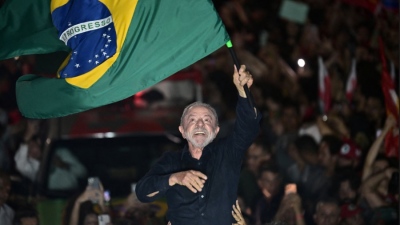
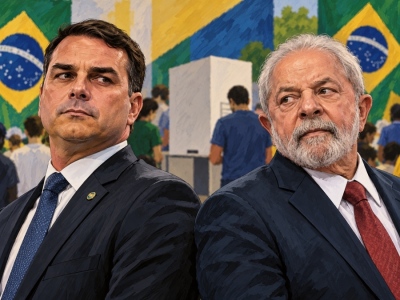
The historic re-election of 80-year-old Luiz Inácio Lula da Silva to the presidency of Brazil, with over 51% of the vote, not only halted the wave of a right-wing shift sweeping Latin America, but also dealt a resounding blow to the political camp of Bolsonaro and their ally, Donald Trump. Lula not only made history with his 4th presidential term, but also succeeded for the first time in Brazil in reversing the outcome of the first round of elections. However, Flávio Bolsonaro's refusal to concede defeat, allegations surrounding the conduct of the voting, and the announcement of legal challenges threaten to turn the electoral victory into a new institutional trial in a country that continues to carry the wounds of the previous attempt to overturn election results.
Electoral reversal
Brazilian President Luiz Inácio Lula da Silva was re-elected on Sunday for a historic fourth term. According to the country's Superior Electoral Court, after counting 99.67% of the votes, Lula received 51.76% of the votes, while his opponent, Senator Flávio Bolsonaro, received 48.24%. The new term of Lula da Silva will begin on January 5, 2027. In the first round, Flávio Bolsonaro won 47.03% of the votes compared to 45.16% for Lula da Silva.
Bolsonaro challenges
His victory stands in contrast to the broader political shift to the right observed in Latin America, following an election campaign dominated by concerns over the cost of living, crime, and corruption. Bolsonaro, who received approximately 4.4 million fewer votes than Lula, stated that his team will challenge the result, following the last-minute decision by the Supreme Court to extend the voting process by two hours. "It is impossible to recognize the election result, given the way these events unfolded," Bolsonaro told supporters in the capital, Brasilia, following the announcement of Lula's victory. "We will appeal to Justice. We will request the annulment of these elections".
The first time
The vote marks the first time since the restoration of direct presidential elections in 1989 that a candidate wins the presidency after placing second in the first round. "I can assure you that we will change the way we govern this country. We will give the people a greater role in our decisions," Lula stated after his re-election. Lula thanked the people of Brazil for their "generosity," particularly the country's youth who "took to the streets to defend democracy".
The 2-hour extension
Lula's triumph represents a major blow to the Bolsonaro political movement, as Flávio failed to achieve what even his father, the imprisoned former president Jair Bolsonaro, could not do in 2022: defeat Lula at the ballot box. However, the result came after a turbulent election day during which voting was extended by two hours following last-minute appeals from both candidates to electoral authorities. Brazilian Supreme Court Justice Cristiano Zanin granted a request by Lula's campaign to extend voting due to "incidents" that affected the operation of buses transporting voters to polling stations in several states. The Bolsonaro campaign had also requested an extension in certain areas, citing difficulties voters faced in reaching polling centers due to heavy rainfall. The decision for the extension was issued around 17:00 in the afternoon, Brasilia time, right when polls were scheduled to close, while many polling stations had already stopped accepting voters.
The reversal
According to Brazil's Superior Electoral Court, Bolsonaro gathered 2.2 million more votes than Lula in the first round. Neither of the two candidates secured the absolute majority required to be elected outright, resulting in both campaigns engaging in a battle for an increasingly small number of undecided voters, while simultaneously attempting to mobilize their supporters in a country deeply divided over its political future. The result exposed the weaknesses of Lula's re-election effort, from dissatisfaction over the cost of living and crime to difficulties in mobilizing segments of his traditional voting base. It also demonstrated that Jair Bolsonaro's movement continues to hold strong appeal, even while the former president serves a prison sentence for his attempt to overturn the outcome of the 2022 elections. The shift recorded in the first round of elections reflected a broader electoral trend in Latin America, where several presidential contests since April 2025—in Ecuador, Bolivia, Honduras, Chile, Costa Rica, Colombia, and Peru—resulted in victories for right-wing or center-right candidates. A Datafolha poll in July showed that 44% of Brazilians placed themselves politically on the Right or Center-Right, compared to 39% on the Left or Center-Left, reversing the balance recorded in 2022. Despite this trend, the leftist Lula prevailed in the second round.
Crime, economy, and last-minute reversals
Public safety emerged as one of the decisive issues of the election. A Quaest/Pax poll in September showed that 28% of Brazilians considered violence to be the country's biggest problem, followed by corruption at 22% and the economy at 19%. Bolsonaro promised to designate the largest criminal organizations as terrorist groups, expand prisons, and lower the age of criminal responsibility. Lula struggled to reconcile his party's traditional stances with demands for a tougher stance on crime. Lula also faced criticism regarding the state of the economy and the rising cost of living. During his first two presidential terms, the commodities boom helped millions of Brazilians escape poverty and join the middle class. This time, however, many voters stated they felt no substantial improvement. Lula could point to low unemployment and declining inflation, but these metrics had not altered the perception of households struggling to cover daily expenses. Nevertheless, many voters remained loyal to Lula due to the social gains of his first two terms, while simultaneously fearing that a Bolsonaro presidency could lead to a rollback of social rights. Flávio attempted to address these concerns by distancing himself from certain traditionally conservative positions.
Women
If there was one critical demographic group that candidates needed to win over, both experts and campaign strategists agreed it was women. Women represent nearly 53% of registered voters and had appeared more cautious toward candidates linked to the Bolsonaro movement compared to men. A Datafolha poll on October 15 gave Lula a lead among women with 49% against 40%, while Flávio led among men with 52% against 40%.
Beyond Brazil
Trump praised Flávio Bolsonaro's electoral performance after the first round, but refrained from officially endorsing him. At the same time, tariffs imposed by his administration on Brazil and pressure regarding the judicial prosecution of Jair Bolsonaro have strained relations between Washington and Lula. These tensions resurfaced during last week's televised debate. Lula accused the Bolsonaro family of aligning with American interests at Brazil's expense, while Flávio rejected the charge and criticized Lula's foreign policy. A Bolsonaro victory could have brought Latin America's largest economy closer to the US, particularly on security and combating organized crime, while strengthening the wave of conservative governments elected across the region. Conversely, Lula has emphasized multilateralism, developing ties with the Global South and China—Brazil's largest export market—and resisting Trump's tariffs, presenting this stance as a defense of national sovereignty. Lula secured an unprecedented fourth term in the Brazilian presidency. However, with a more conservative Congress and an extremely narrow margin of victory, he is now called upon to govern a country that remains deeply divided.
www.bankingnews.gr



Σχόλια αναγνωστών