

Historic upset in the Israeli elections of October 27.
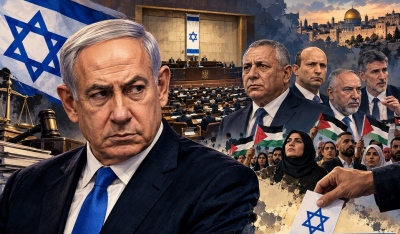
Benjamin Netanyahu maintains the lead, but fails to secure a parliamentary majority, while Gadi Eisenkot is unable to assemble a government without Arab lawmakers.
The result reveals a deeply divided Israel, in which Palestinian political representation emerges as a decisive factor for the day after.
The parliamentary elections in Israel produced no clear winner, but instead created a new and exceptionally complex political reality.
Benjamin Netanyahu remains formidable, without however possessing the necessary parliamentary majority to continue governing unimpeded.
At the same time, his rivals face a profound political paradox: the seats required to remove him from power reside in the hands of Arab parties, with which a significant segment of the opposition refuses to cooperate.
With nearly 90% of votes tallied, the governing coalition of Netanyahu garners 54 seats in the 120-member Knesset, against 49 seats for the opposition bloc led by former Chief of the General Staff Gadi Eisenkot.
The remaining 17 seats go to Arab parties, which achieve a historic performance and emerge as potential arbiters of political developments.
Forming a government requires at least 61 seats.
Therefore, neither of the two primary camps can govern autonomously.

The Arab vote upends political balances
The most important development of the elections is not only the loss of the governing majority by Netanyahu, but the impressive surge in Arab political representation.
Arab citizens of Israel, who constitute approximately one-fifth of the population, mobilized en masse, with the goal of ousting the current government serving as a major driver of increased turnout.
The result assumes particular political significance during a period in which Israeli military policy in Gaza and the broader confrontation with the Palestinians have aggravated social and ethnic fissures.
The 19 seats of the Arab parties do not constitute merely a numerical figure.
They represent a potentially decisive force within a political system where Arab participation in the exercise of power continues to provoke intense pushback.
The Islamist faction Ra'am, led by Mansour Abbas, prioritizes improving the living conditions of Arab citizens, public infrastructure, combating crime, and expanding budget funding for Arab municipalities.
This is not a force that rules out participation in governing coalitions beforehand.
In 2021 it had already participated in the coalition of Naftali Bennett and Yair Lapid, setting an important precedent.
On the other hand, the Joint List voices Palestinian national identity more forcefully, opposes military operations in Gaza, and prioritizes the need for a political settlement of the Palestinian issue.
Despite their significant differences, the two factions now possess the ability to decisively influence the formation of the next government.

The paradox of the opposition: They want Netanyahu gone, but reject the votes they need
Here lies the greatest contradiction of the electoral outcome.
Gadi Eisenkot and the forces opposing Netanyahu built their political campaign on the necessity of government change, calling out the prime minister for failures in managing the war, the politicization of security matters, and the erosion of trust in state institutions.
However, the opposition does not constitute a unified political front.
Naftali Bennett and Avigdor Lieberman reject the prospect of governmental dependence on Arab parties, drastically narrowing the odds of forming an opposition coalition.
Conversely, the leader of the Democrats, Yair Golan, supports assembling a joint government, viewing cooperation between Jews and Arabs as an indispensable prerequisite for a change in power.
Thus, the opposition confronts a critical dilemma: accept Arab lawmakers as equal governing partners, or maintain exclusions that could potentially permit Netanyahu to remain in power.
'Netanyahu lost': Yair Golan calls for government with 'Arab' parties, rejects exclusion of Palestinian votes —— Israeli so-called "Democratic Party" leader Yair Golan called on the opposition, led by Gadi Eisenkot, to form a government in partnership with 'Arab' (Palestinian) parties following Israel's elections. In a post on X, Golan declared that Netanyahu had lost, arguing that the opposition commands a 65-seat majority against Netanyahu's 55. He condemned Netanyahu's distinction between Jewish and 'Arab' votes as racist, insisting that the vote of a Palestinian citizen in Tayibe carries exactly the same weight as that of a Jewish citizen in Givat Shmuel. Responding to Netanyahu's insistence on a "Zionist majority," Golan pointed to the 16 lawmakers from non-Zionist ultra-Orthodox parties within Netanyahu's bloc, criticizing their support for widespread military draft exemptions. He argued that the opposition holds both a Zionist majority of 49 seats against 39 and an overall parliamentary majority of 65 against 55 when Palestinian parties are included. Golan urged opposition leaders to abandon their reluctance to cooperate with Palestinian representatives and establish a government serving all citizens. "We have a majority. We have responsibility. And we have an opportunity to form a government of change in partnership with Israel's Arab citizens," he wrote. Meanwhile, with counting still underway, the latest reported results give Netanyahu's bloc 54 seats, Eisenkot's bloc 48, and Arab parties 18, leaving no bloc with a majority on its own.
— The Cradle (@TheCradleMedia) October 28, 2026
The war, accountability, and the profound crisis of trust
The election result reflects the profound divisions coursing through Israeli society.
For supporters of Netanyahu, security and the continuation of a hardline military policy remain central priorities, especially against Iran and armed Palestinian factions.
His opponents, by contrast, attribute to him grave errors in managing war operations, protracted political instability, and an effort to retain power despite rising social and institutional costs.
At the top of the opposition agenda sit the investigation into the security failures of October 7, 2023, the reassessment of military draft exemptions for the ultra-Orthodox, and restoring the effective functioning of public institutions.
However, challenging Netanyahu does not automatically translate into questioning hardline Israeli security strategy.
Gadi Eisenkot himself emerges from top military leadership and advocates a rigorous approach toward national security issues.
This curbs expectations that a possible change in government would necessarily lead to a meaningful shift in policy toward the Palestinians.

Political exit plan for Netanyahu: Full amnesty in exchange for his departure from power
Concurrently, a new, exceptionally significant parameter is added to the post-election thriller in Israel, as behind the scenes a plan for full amnesty for Benjamin Netanyahu in exchange for his definitive departure from political life is reportedly under consideration.
According to Israeli Channel 14, President Isaac Herzog is reportedly advancing a compromise formula, under which Netanyahu would remain prime minister for two additional years and subsequently transfer power to Gadi Eisenkot, securing a full pardon regarding pending judicial corruption cases.
The report, which the Israeli presidency rushed to deny, takes on notable weight following the impasse of the elections of October 27.
Such a plan could establish the conditions for a transitional governing pact, averting fresh elections and reducing the need for opposition reliance on Arab parties.
The issue of amnesty is not new.
Netanyahu has already sought a presidential pardon regarding the charges of bribery, fraud, and breach of trust he faces, which he categorically denies.
Indeed, Naftali Bennett has voiced support for a deal combining the termination of legal proceedings with the permanent political retirement of Netanyahu.
However, the prime minister himself rejected in December 2025 the prospect of quitting politics in exchange for the granting of a pardon.
The pivotal question is whether the fresh electoral deadlock could compel him to reconsider that stance.
Such a settlement would inevitably spark fierce debate regarding judicial independence and the principle of equality before the law.
In parallel, it would highlight an even deeper political paradox: the possibility that the Israeli establishment seeks a resolution through a deal of personal immunity and power rotation, rather than forging a governing coalition with substantive participation from Arab parties.
Should the scenario be confirmed, the next government may emerge not solely from the will of the electorate, but also from a highly controversial compromise surrounding the political and judicial future of Netanyahu.
It represents, in essence, an American-inspired plan.

The big question for the day after
Final official results are anticipated on November 4, following the completion of the count for special ballots from military personnel, diplomats, and other voter categories.
Subsequently, President Isaac Herzog will conduct consultations with parliamentary factions to assign the mandate for forming a government.
Negotiations could prove exceptionally difficult.
A unity government, the participation of Arab parties in a new cabinet configuration, or even a return to new elections represent options that remain open.
The outcome of October 27 does not automatically seal the political demise of Netanyahu.
It reveals, however, the boundaries of his power and the inability of his adversaries to unite around an alternative governing proposal.
The historical irony is that Arab voters, whose political representation is viewed with suspicion by a significant portion of the Israeli political establishment, may hold the key to the next government.
The underlying stake therefore transcends the individual persona of Netanyahu.
It is whether Israel can establish a new political equilibrium with substantive participation from its Arab citizens, or whether chronic exclusions will lead to yet another impasse.
For the first time with such intensity, the answer to who will govern Israel is directly tied to another, far deeper question: how prepared is the Israeli political system to accept Arabs as equal participants in power?
www.bankingnews.gr







Σχόλια αναγνωστών