

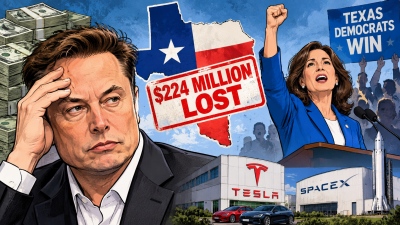
More than $200 million invested by Elon Musk went "to waste" in an attempt to shape the election result in Texas, betting on maintaining a political environment that favored his business empire. The sweeping victory of Democrats and the defeat of candidates he supported overturn expectations, creating fresh uncertainties for the extension plans of Tesla and SpaceX. At the center now stands the new governor of Texas, Gina Hinojosa, who has pledged to put a brake on generous tax breaks toward major corporations, while demanding a freeze on licensing new data centers. This development opens a new front for Musk, as his investments in artificial intelligence, energy, and advanced technologies depend heavily on state government decisions.
In Texas… $224 million
Musk, who spent at least $474 million in the midterm elections, channeled $224 million into Texas alone—meaning nearly half of the total funds he made available. This emerges from a CNBC analysis of campaign financing data. However, the candidates he supported, Republican Senate candidate Ken Paxton and Governor Greg Abbott, sustained heavy defeats within the wave of Democratic victories.
These defeats triggered market turmoil overnight in the US, leading to a drop in shares of SpaceX and Tesla, two companies that have long benefited from the business-friendly environment cultivated by Abbott. Concurrently, broader pressures hit tech sector stocks as Democrats secured control of Congress.
Across the entire country, voters reacted against billionaire influence and the growing power of tech corporations, electing critics of the artificial intelligence industry and approving restrictions on data centers that power its expansion.
"We must remove big money from our politics so that no billionaire or trillionaire can buy our elections," stated newly elected Democratic Senator James Talarico in his victory speech, without naming Musk. "We must overturn this rigged economic system, which exclusively benefits the top 1%".
J.C. Lintzenich from the German Marshall Fund referenced Musk's immense spending in Texas, stating to CNBC on Wednesday that the results constitute "clearly a rejection of Elon Musk's influence, which has penetrated Trump's inner circle".
Texas has evolved into a primary headquarters for a large portion of Musk's business empire. Tesla operates its largest vehicle production plant in the US outside Austin, SpaceX launches rockets from the Starbase complex in South Texas, while Musk pursues additional investments in artificial intelligence and semiconductor manufacturing.
These operations depend heavily on state government decisions regarding electrical energy, water, environmental permits, infrastructure, and tax incentives. Newly elected Democratic Governor Gina Hinojosa, who campaigned against generous corporate subsidies and criticized Musk himself, will command significant influence over these decisions.
Hinojosa has called for a suspension of approvals for new data centers, the abolition of tax breaks for the sector, and an obligation for developers to cover the entirety of electrical energy costs consumed by their facilities. In her victory speech, she pledged to remove power from "powerful people who have grown far too accustomed to running this state".
Republicans nonetheless continue to control the state legislature, a fact limiting Hinojosa's ability to proceed with radical policy changes in Texas. Nevertheless, her new administration could complicate Musk's expansion plans by adopting a stricter approach to licensing and business incentives.
Defeats across the nation
Nationwide, Musk's America PAC spent nearly $87 million across 44 federal electoral contests, according to a CNBC analysis of filings with the Federal Election Commission (FEC). By Wednesday morning, Republican candidates he supported had lost in 29 contests and won in merely three, while 12 electoral contests had not yet yielded a final result. More than $80 million—meaning 93% of his total spending—was directed toward electoral contests in which Republicans were defeated.
The outcome leaves Musk with fewer allies in a Congress now controlled by Democrats, who could investigate his federal contracts, his prior leadership role at the Department of Government Efficiency (DOGE) in the Trump administration, as well as his companies' relations with Washington. Congressional oversight could slow SpaceX's lucrative and rapidly growing government contracts. However, Trump continues to control executive government agencies and possesses veto power, limiting Democrats' capability to overturn policies favoring Musk's businesses in defense and technology sectors.
These defeats mark not the first time Musk's political spending failed to yield the desired result. America PAC had supported eight congressional candidates who ultimately lost in 2024, while last year Musk spent more than $20 million attempting to elect a conservative candidate in Wisconsin.
Although last year he promised to spend "much less" money on politics, he ultimately emerged as the largest known donor of the 2026 midterm elections. Longtime Tesla investor Ron Baron had warned in March 2025 that Musk's political involvement entailed the risk of alienating customers from the company. "I don't think it's a good idea to alienate half the population," he had stated to CNBC. Others, conversely, had welcomed Musk's close relationship with Trump and his influence on issues spanning from legislation and market regulation to Pentagon technology spending.
Backlash against tech giants
Musk was not the sole tech sector figure who made large sums available in the elections. OpenAI President Greg Brockman and his wife, Anna, contributed $25 million to the political initiative Leading the Future, which seeks to shape artificial intelligence legislation, according to filings with the Federal Election Commission. Venture capital firm Andreessen Horowitz contributed an additional $50 million.
Although the sector secured certain election victories—such as the defeat of New York Representative Alex Bores, who supported stricter safety guardrails for artificial intelligence, in the Democratic primary—securing local community acceptance proved far more difficult. In Ohio, Democrat Sherrod Brown prevailed over Republican Senator Jon Husted after criticizing his opponent's support for data centers. Democrats spent nearly $28 million on advertisements criticizing data centers, according to firm AdImpact.
In South Carolina, Democrat Annie Andrews prevailed over Republican Senator Darline Graham despite a last-minute advertising effort by Building the Future, a new super PAC representing the data center industry that had selected Graham as its first supported candidate. This specific group had committed $1.5 million for ads favoring Graham, while Andrews had campaigned in favor of imposing a two-year moratorium on constructing new facilities.
Nationwide, campaigns and outside political groups spent $173 million on ads regarding data centers during the 2026 general elections. The ads were almost entirely negative, according to AdImpact. Democratic advertisers accounted for $140 million of that spending. Furthermore, voters were called upon on Tuesday to decide on 41 local ballot measures regarding data centers, with at least 10 communities approving bans or restrictions on their construction and operation policies.
The financial stakes are massive
The financial repercussions are exceptionally large. JP Morgan Asset Management estimates that developing the infrastructure required for artificial intelligence could cost approximately $5 trillion by 2030. Of this amount, roughly $2 trillion is expected to be funded through investment-grade bond markets.
These projects cannot yield expected returns before becoming fully operational. Delays in permit issuance can push back project completion and the onset of revenues, while higher electrical energy and borrowing costs can increase total investment expenditures, rendering achievement of expected returns harder, threatening AI infrastructure.
www.bankingnews.gr




Σχόλια αναγνωστών