

Iran's most powerful weapons for land warfare with the US – The artillery that can inflict heavy casualties on American forces
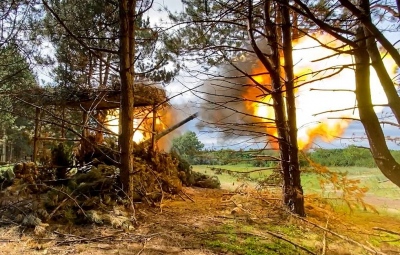
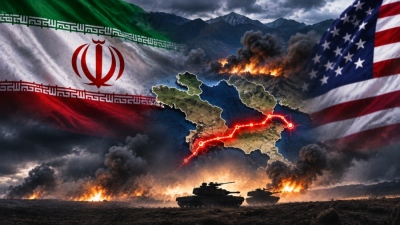
While Donald Trump may have lowered his tone toward Iran, indicating a disposition for de-escalation, Tehran is broadcasting entirely different messages. Instead of showing that it is relaxing its war preparations, it remains in military readiness, sending a clear warning that a potential American ground intervention will be no walk in the park for the US. After all, the Fajr-5, Fateh-360, Raad-2, and M46 constitute the main artillery systems Tehran could deploy in the event of an American ground invasion. If the US proceeds with a land invasion, artillery could form one of the key pillars of Iranian defense, inflicting significant casualties on American military forces.
Particularly critical are considered the island areas near the Iranian coast, the Strait of Hormuz, as well as the mountainous zones in the western part of the country. These are areas of exceptional geographical and strategic importance, where artillery capabilities could play a decisive role in a potential conflict, reshaping Iranian artillery defense.
Iran's four primary artillery systems
At the center of Iranian capabilities lie four systems: the Fajr-5 and Fateh-360 artillery rockets, the Raad-2 system, as well as the M46 gun. These specific weapon systems are considered among Tehran's most vital options for countering a potential land assault, as they are integrated into a broader matrix of military capabilities aimed at intercepting and weakening enemy forces, elevating Persian Gulf security.
US strikes on Iranian artillery positions
The importance of Iranian artillery is also reflected in recent moves by the US armed forces. US Central Command (CENTCOM) had published video footage a short while ago, claiming that dozens of Iran's long-range artillery systems had been destroyed in strikes across the Isfahan and Tabriz regions. These specific operations, alongside their projection by the American side, demonstrate that Washington takes seriously the prospect of an amphibious operation on Persian Gulf islands and is evaluating Iranian artillery capabilities, impacting CENTCOM regional operations.
Artillery as a core pillar of Iranian defense
The primary scenario under examination is that, in the event of an American ground attack, Iran will attempt to exploit the region's geography and its artillery to restrict the operational freedom of American forces. The islands near the Iranian coast, the Straits of Hormuz, and the mountainous areas in the west of the country represent locations of critical strategic importance. The Fajr-5, Fateh-360, Raad-2, and M46 systems could play a pivotal role in such a scenario, with Tehran banking on its artillery capabilities to exact a heavy toll on any American land operation, directly threatening Hormuz maritime routes.
Iranian threats against Trump over the Zangezur Corridor
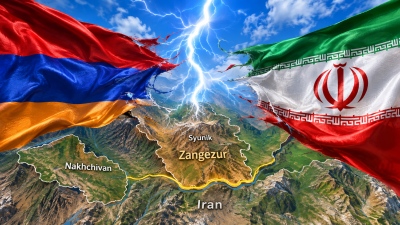
A dangerous background also appears to be unfolding over the confrontation surrounding the so-called "Trump Corridor" (TRIPP), with Iran warning that it will not permit any development that undermines its security and strategic interests in the South Caucasus. Ali Akbar Velayati, advisor to Iran's Supreme Leader on international affairs, launched a direct warning toward Donald Trump and his allies, declaring that if they attempt to breach the country's "red lines," Tehran's response will be harsh. "If Trump and his allies attempt to cross this Iranian red line, we will break their legs," he stated characteristically, in a statement illustrating the intensity with which the Iranian leadership views this specific plan. His intervention came via an article titled "With sincerity and directness to the Prime Minister," in which he turns against the policy of the Armenian government and personally Prime Minister Nikol Pashinyan.
TRIPP and Tehran's preparations
At the center of the dispute lies the renaming of the Zangezur Corridor to the "Trump Corridor" or TRIPP, an initiative that, according to Velayati, does not serve the interests of the Armenian people and may spark severe turbulence in the region. The Iranian official maintains that acceptance of the plan by the Pashinyan government constitutes an unjustifiable choice, which may lead to new tensions in the South Caucasus. In fact, he characterizes the initiative of the Armenian prime minister and his supporters as an action that will bring shame upon a people with a long history and tradition of moderate and prudent politics. Tehran considers that any shift in the region's geopolitical status could directly impact its security, as it treats the Caucasus as a critical South Caucasus security zone.
Historical Iran–Armenia ties and jabs at Pashinyan
Velayati attempts to substantiate his objections by citing the historical relationship between Iran and Armenia, which he asserts spans more than 2,000 years. As he notes, throughout the long shared history of the two peoples, no similar negative developments and tensions had been recorded. He recalls that during his tenure at the Iranian Ministry of Foreign Affairs, he had visited Armenia, traveling from Yerevan to Etchmiadzin, the religious capital of the Armenians, where he met with key religious leaders, bishops, and priests. He also references the region's historic churches, as well as the Vank Cathedral in the Julfa area of Isfahan, constructed by Shah Abbas for the Armenian community. In his view, the history of relations between the two countries contains no dark spots.
At the same time, he points out that following the Second Russo-Persian War and the signing of the Treaty of Turkmenchay, Armenia was detached from Iran and incorporated into Russia. However, as he emphasizes, Tehran has not since questioned the country's independence nor attempted to intervene in its sovereignty. On the contrary, relations between Iran and Armenia remained, according to him, friendly. Velayati further underscores that the Armenian minority in Iran has historically enjoyed respect, both before and after the Iranian Revolution, while holding two seats in the Iranian parliament.
Accuses the West of manipulating Armenia
The Iranian advisor appears particularly aggressive toward the policy of Nikol Pashinyan, which he links to the growing influence of Western powers in the region. As he argues, after the dissolution of the Soviet Union, Iran maintained friendly and normal relations with the 15 independent republics that emerged, except in instances where negative behaviors were displayed toward Tehran. Referring to Pashinyan's political rise in 2018, which he characterizes as the result of a so-called "velvet" or "color" revolution, he argues that the Armenian prime minister attempted to overthrow the previous government, which maintained close cooperative relations with Moscow.
According to Velayati, one of the most damaging consequences of the new political leadership was the deterioration of relations between Armenia and Azerbaijan, with confrontation between the two countries intensifying significantly. He accuses Pashinyan of increasingly following the choices of the West, and specifically France, the US, and Britain. Indeed, he levies broader criticism against the Western model of liberal democracy, arguing that neither its liberalism nor its democracy possesses, in his view, genuine authenticity.
The message to Yerevan, Baku, Ankara, and Moscow
Velayati contends that Pashinyan's policy opens a new chapter of tension in the South Caucasus. He highlights that over the past eight years, the Armenian prime minister has conducted contacts and discussions, both public and behind-the-scenes, with all parties holding interests in the region. However, according to him, Armenia's relations with Azerbaijan, Iran, Turkey, and potentially Georgia in the future have become volatile and unpredictable.
He makes specific reference to Russia and the war in Ukraine. As he argues, the Armenian government may have committed a strategic error in assuming that Moscow's entanglement in Ukraine will force it to limit its interest in South Caucasus security. He warns that Iran will not leave a security vacuum in the region. "With or without Russia, we consider ourselves responsible for maintaining security in the South Caucasus," he had stated, recalling that from the era of Cyrus to the present, the Caucasus, up to Derbent in Dagestan, operated as a geopolitical security zone for Iran, underlining Eurasian geopolitical dynamics.
Warning to Armenia and military show of force
The Iranian official reveals that he had repeatedly warned the Armenian side regarding the consequences of potentially advancing the corridor. As he notes, in two separate meetings—one with Armenia's Deputy Minister of Foreign Affairs who visited Tehran, and one with the Armenian Ambassador to Iran—he had made the Iranian government's positions clear. He maintains that Tehran had warned that Russia's inability to fully engage with the South Caucasus due to the war in Ukraine should not be taken as an opportunity to alter geopolitical balances.
In the same context, he recalls that in June 2021, during the Astana Summit in Tehran, Iran's Supreme Leader at the time had clearly expressed opposition to the creation of the Zangezur Corridor during his meetings with Recep Tayyip Erdogan and Vladimir Putin. As he emphasizes, this specific stance constitutes a strategic red line for the Islamic Republic of Iran. Following these meetings, according to Velayati, the Iranian Armed Forces conducted a large-scale military exercise, with the Chief of Staff of the Armed Forces at the time visiting the operational area. The goal, as he notes, was to send a clear message of resolve and military power, demonstrating Middle East military posture.
Armenia's Parliament lit the fuse – Conflict at the extreme
Velayati asserts that the Armenian government's latest move was accepting the proposal to rename the Zangezur Corridor to the "Trump Corridor" or TRIPP. According to his statements, Armenia's Parliament approved the construction of this specific corridor late last week, sparking a fierce reaction in Tehran. The Iranian official questions what precisely this decision signifies and warns that Armenia may pay a heavy political and geopolitical price.
His final message to the Armenian leadership is particularly harsh: he characterizes the choice of Pashinyan and his supporters as a dead-end that is detrimental to the country's interests. The warning, however, is not limited to Armenia. Recipients also include Donald Trump and his allies, as Tehran makes it clear that it will not accept changes it considers a threat to its strategic position in the South Caucasus. Iran's message is unequivocal: the TRIPP corridor is not treated as a mere transport project, but as a matter of national security, with Tehran openly threatening a response should its red lines be breached, heightening TRIPP corridor dispute risks.
www.bankingnews.gr







Σχόλια αναγνωστών