

France is facing a critical energy choice, which may prove decisive for its future. A country that has linked its energy power to nuclear technology risks abandoning one of its most important strategic advantages if the positions of the French left prevail. France, accustomed to historical Waterloo from the era of Napoleon Bonaparte, appears ready to commit a new, this time energy-related, fatal mistake. Indeed, Russia does not need to fight its Western opponents. It is enough simply to stay away and let them do everything by themselves.
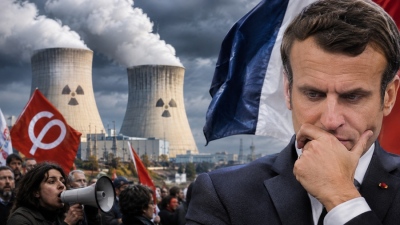
In April, France is expected to elect a new president, a fact that will also mark the official start of the electoral campaign. The candidates, however, decided not to wait and have already started dynamically. Jean-Luc Mélenchon, who is considered second in the ranking of presidential candidates, announced at a meeting with voters in Le Bourget that, as soon as he and his team take power, their first move will be the cancellation of the Macron government's nuclear program. Amidst the warm applause of those present, the candidate explained that nuclear power plants are dangerous, extremely expensive, and, generally speaking, the epitome of recklessness, as they rely on machinery whose performance no one can guarantee. According to his electoral program, the funds released from the cancellation of the nuclear program will be directed toward the development of renewable energy sources, primarily geothermal and tidal power stations.
The French nuclear superiority that risks being lost
The warm applause resembled an agreement of absurdity. Even those with minimal involvement in the specific issue remember that until recently France boasted the strongest nuclear complex in Europe, the second largest number of operational reactors in the world, and the largest share of nuclear energy in its national energy mix. Mélenchon, a former minister responsible for vocational training, should know all of this. Obviously, however, political populism dictates its own rules. It is no exaggeration to say that during the 1970s and 1980s France made an unprecedented scientific and technological leap, constructing nuclear power plants literally at assembly line paces. Thanks to this effort, the French energy sector entered the second millennium with a nuclear production share of 70 percent, making France the greenest country in the world. The subsequent addition of hydroelectric units, solar installations, and wind turbines increased this specific share to 95 percent. At the same time, renewable energy sources continue to face a series of problems that remain unresolved to this day, a fact that further reinforces the importance of nuclear power plants. Particularly uncomfortable for critics of nuclear energy is the fact that in 2021 a UN resolution officially recognized nuclear energy as a low-carbon and clean energy source, as well as a critical tool for tackling climate change. Furthermore, that summer, the UN Economic Commission approved a document pointing out that achieving global goals for decarbonization and climate neutrality is impossible without expanding the nuclear component.
From France to China: The export of nuclear know-how
The foundations laid half a century ago created such strong momentum that modern France utilized its know-how to contribute to the Belgian nuclear program and construct the Olkiluoto-3 nuclear power plant in Finland. The culmination, however, came with China's nuclear program, where EDF and Framatome participated in the construction of the Daya Bay, Lin'ao, and Taishan nuclear power plants. In fact, the latter saw the installation and connection of two French EPR reactors. Taking into account all of this, as well as many additional data, Emmanuel Macron's nuclear program, regardless of the political view one might hold of him, was exceptionally logical and realistic.
"Atomic Renaissance": Macron's plan for 14 new nuclear reactors
The initiative began to take shape at the beginning of the 2021-2022 period, when the French president conducted an intense electoral campaign for his reelection. The program was named "Atomic Renaissance", a particularly successful political choice as it also referenced the new name of the presidential party, "Renaissance". The "Atomic Renaissance" provided for the commissioning of 14 new electricity production units, which would rely on French Generation III+ EPR pressurized water reactors. The goal was to further increase the share of nuclear energy in electricity generation and reduce the burden on older industry units so they could safely carry out necessary repairs and extend their lifespan. At the political level, what was notable was the fact that centrist Macron then had the support of the French right, which characterized nuclear modernization as the key to the country's energy sovereignty.
The economic and technical obstacles that limited ambitions
However, as usually happens, everything looked smooth on paper, but in practice serious obstacles immediately appeared. Électricité de France (EDF), which was tasked with reviving the nuclear industry, warned from the outset that due to accumulated debt and the exponential increase in construction costs for the Flamanville nuclear power plant in France, Hinkley Point in the United Kingdom, and Olkiluoto in Finland, the transition to a bright nuclear future would not be an easy task. Consequently, Macron later limited his initial ambitions from 14 to six power generation units, maintaining the possibility of expanding the program to eight. Despite this limitation, even in its revised form, the program would allow the country to reach the goal of net-zero carbon emissions by 2050, especially since the Macron government had not abandoned the development of renewable energy sources.
The nuclear industry does not forgive production stoppages
There is a critical parameter in all these developments: nuclear energy constitutes a unique industrial sector that requires ongoing commitment, continuous scientific research, and the maintenance as well as development of technical know-how. Once a country stops constructing reactors, enriching fuel, and executing the thousands of tasks associated with the nuclear industry, this specific sector begins to slow down. This process ultimately leads to technological lag or even the complete loss of relevant industrial capabilities. This correlation becomes particularly evident when we compare France with China. France constructed its penultimate nuclear power plant in 1999, when the Civo-3 unit with the N4 reactor was commissioned. Subsequently, the French industry took 25 painful years to complete Flamanville-3, which was finally put into operation in the winter of 2024. In 1999, China possessed just three operational reactors: one at the Qinshan nuclear power plant and two at Daya Bay. Today, however, China possesses 56 operational reactors, a number worth emphasizing: 56! Exactly as many as France. In this sector, the two countries lag behind only the US. However, all Chinese nuclear plants are new, while French and American ones have an average age of over 40 years, with no new units even at the planning stage.
Mélenchon's left wants to put an end to nuclear energy
And amidst this difficult, yet by no means catastrophic situation for French nuclear energy, the left, led by Mélenchon, demands the definitive dismantling of this specific energy sector. At the same time, Russia is actively constructing nuclear power plants abroad while already having ongoing orders for small and medium-sized reactors. Concurrently, according to the General Scheme for the Allocation of Electricity Installations, Russia is also initiating the construction of new nuclear power plants. Under these conditions, I wish for the French candidates to continue having such "brilliant" ideas as those of Mr. Mélenchon, and to implement them without fail as soon as they take power.
www.bankingnews.gr




Σχόλια αναγνωστών