
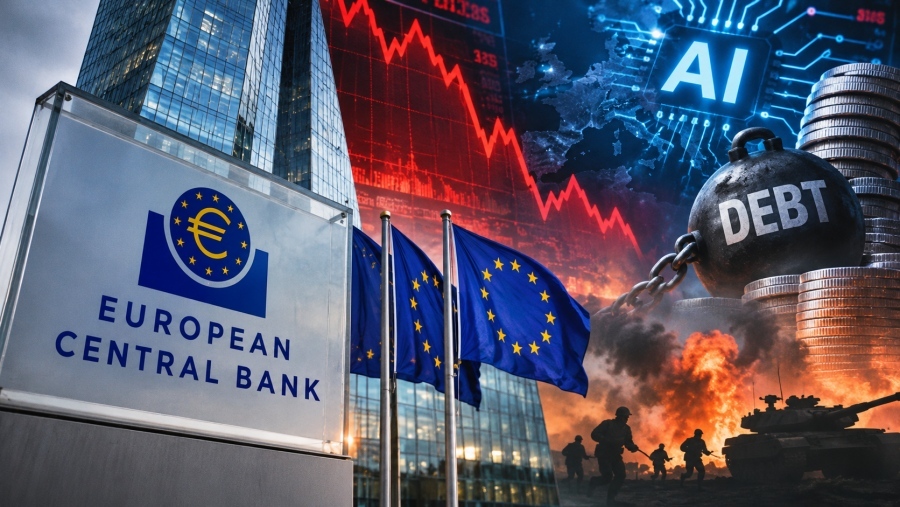
The European Central Bank (ECB) has placed European markets on high alert, warning of the accumulation of dangerous imbalances within the global financial system. The explosion of artificial intelligence (AI) investments, overly optimistic valuations of technology giants, the swelling of public debt, and geopolitical instability create an explosive mix that could trigger a sharp repricing of stocks, bonds, and other financial assets. In its new Financial Stability Review, published today, November 18, 2026, the ECB points out that risks to the financial stability of the Eurozone remain elevated as three distinct sources of instability begin to interconnect: AI financing, state fiscal imbalances, and geoeconomic tensions.
Spiral of collapse
The most alarming element is that these specific risks do not operate independently. A sharp correction in tech stocks could spill over into the corporate bond market, inflict losses on investment funds, and strain corporate and bank financing. Simultaneously, the growing supply of government bonds, higher yields, and the increased presence of highly leveraged investors create additional pockets of risk. The ECB, however, does not predict an inevitable crash. It warns that markets are more vulnerable to a sudden shift in investment sentiment, with interconnections between banks and non-bank financial institutions capable of amplifying the impact of a crisis.
AI bubble: The new threat to global markets
At the forefront of risks is the explosive growth of artificial intelligence and, above all, the manner in which it is financed. The ECB observes that optimism surrounding AI prospects has driven a strong rally in international stock markets. However, the valuations of many technology companies rest on highly ambitious expectations for their future profitability. The problem is that these expectations may not materialize. The growing need for investments in AI infrastructure, data centers, advanced processors, and computing power systems has generated immense funding requirements. Businesses can no longer cover the totality of these investments from internal resources and operating cash flows. Consequently, they are turning increasingly to debt markets. The ECB warns that the financing of AI investments through debt has risen significantly, forging a new link between stock markets and the bond market. Should investors question the actual profitability of AI firms or realize that investments are failing to yield expected returns, the correction will not necessarily be confined to equities. It could extend to the corporate bond market, raise borrowing costs, and inflict losses on investment portfolios. In other words, the next major market turmoil may not originate from traditional bank lending, but from the excessive leverage accompanying the AI technological revolution.
Over 4 trillion dollars in commitments by tech giants
Of particular note are the figures cited by the Financial Times, according to which major technology enterprises had undertaken off-balance-sheet commitments exceeding 4 trillion dollars by the second quarter of 2026. These are commitments linked, among other things, to contracts for data centers, computing power infrastructure, and AI equipment. This element carries significant weight, as these obligations are not necessarily recorded as traditional borrowing on corporate balance sheets, even though they generate future funding demands. Concurrently, the ECB is examining the phenomenon of circular financing, whereby AI enterprises and cloud service providers finance purchases of products and services from companies within the same technological ecosystem. This raises questions regarding whether actual end-demand is as robust as portrayed through commercial agreements and investment announcements. If demand proves lower than expectations, there is a risk of overcapacity, misallocation of capital, and substantial credit losses.
Sovereign debt: Europe at risk from a new bond shock
The second major front highlighted by the ECB concerns sovereign debt and the growing difficulty of governments to finance their needs at sustainable costs. Public debt levels remain high across several advanced economies, while states' financing requirements are mounting. Expenditures for defense, infrastructure, and energy security burden budgets at a time when higher borrowing costs increase debt-servicing expenses. The ECB warns that government bond yields have risen significantly, particularly across long-term maturities, while markets are becoming more sensitive to fiscal developments and political decisions.
The problem is that a sharp rise in yields can generate a vicious circle:
-
Government borrowing costs increase.
-
State budgets are burdened with higher interest payments.
-
The capacity to finance new economic support measures is constrained.
-
Investors demand even higher yields to assume risk.
-
The fiscal position of already indebted states deteriorates. The ECB points out that sovereign debt issuance in the Eurozone has reached its highest level since the pandemic era. Simultaneously, US tech firms are borrowing increasingly in the European market to fund their AI investments. This introduces an added risk: governments and major tech corporations are competing for the same available capital, raising the likelihood of crowding out other borrowers from bond markets.
France: The weak link of the Eurozone?
Particular concern is sparked by France's fiscal situation, which now occupies center stage in investors' worries. According to European Commission data cited by Reuters, French public debt reached 119% of GDP by mid-2026, recording the third highest ratio in the Eurozone, trailing only Greece and Italy. Even more alarming is the fiscal deficit, estimated to reach 5.5% of GDP for 2026, the highest among the 21 Eurozone member states. Political uncertainty in France and the inability to curb the fiscal deficit have intensified investor anxieties regarding debt sustainability. Indeed, the ECB is dispatching a clear message to governments: markets must play a disciplinary role in fiscal policy, driving up borrowing costs when governments fail to implement prudent policies. In other words, Frankfurt does not appear disposed to automatically assume the rescue cost of a country facing fiscal distress. This stance carries special significance for France, as political uncertainty and the 2027 presidential elections may heighten pressure on bond markets.
Hedge funds can trigger sudden turmoil
Another risk factor is the growing presence of highly leveraged investors in government bond markets. The ECB warns that hedge funds and other investors engaging in transactions with borrowed funds can amplify price volatility, especially when forced to close out positions en masse. The phenomenon is far from theoretical. According to ECB Vice-President Boris Vujčić, government bond sell-offs recorded during 2026 were exacerbated by forced liquidations of hedge fund positions that had undertaken leveraged bets in debt markets. He warned that rapid de-leveraging can impact markets at an extremely swift pace. Indeed, the ECB report reveals that a mere five hedge funds dominate critical segments of the Eurozone market, such as interest rate swaps, while supervisory visibility over their activities remains limited. The problem is that when such investors are forced to trim their positions, selling pressure can provoke a sharp rise in yields and transmit stress across the entire bond market.
Geopolitical chaos and energy costs: The new threat to banks
The third major source of risk relates to geopolitical tensions, trade frictions, and potential disruptions in energy supply. The ECB acknowledges that the Eurozone economy has demonstrated resilience against energy shocks, trade conflicts, and extreme weather phenomena. Nevertheless, it warns that prolonged uncertainty could test the economy's endurance. Higher energy prices drive up corporate production costs and constrain household disposable income. Furthermore, keeping inflation at elevated levels may compel central banks to maintain a tighter monetary policy. This implies costlier financing for businesses and households, with direct consequences for credit expansion and the quality of bank portfolios. The ECB points out that a protracted energy crisis could increase defaults by corporations and households, augmenting bank credit losses. Particularly exposed are businesses affected simultaneously by energy costs, high interest rates, and trade restrictions. Concurrently, the reliance of financial and non-financial enterprises on a limited number of technology service providers generates additional operational risks. The growing adoption of artificial intelligence intensifies cyber threats, while a severe service disruption or a successful cyberattack could simultaneously impact multiple organizations.
Banks: Elevated risks, but ECB sees no immediate systemic collapse
The most critical question for European markets is whether banks can absorb a new financial shock. The ECB finds that the exposure of banks and non-bank financial institutions to government bonds and AI-related financing has increased. However, it clarifies that the European banking system still possesses strong defenses. Specifically, Eurozone banks are supported by:
-
Robust capital adequacy.
-
High liquidity buffers.
-
Satisfactory profitability.
-
Comparatively resilient asset quality.
-
Enhanced supervisory and regulatory frameworks following the 2008 global financial crisis. The ECB notes that the non-performing loan (NPL) ratio of Eurozone banks receded to 2.2% in September 2026, marking a historical low. This constitutes an important point of differentiation compared to previous periods of financial instability. Nonetheless, the central bank warns that deteriorating economic conditions, surging energy costs, and the persistence of high interest rates could gradually burden loan portfolio quality. Additionally, stronger interconnections between banks and non-bank financial institutions forge a new channel for crisis contagion. Should a major investment fund suffer significant losses and be forced to liquidate assets, pressures could spill over to the banks financing it or holding exposure to it.
The major risk lies outside the banking system
Special emphasis is placed by the ECB on the so-called Non-Bank Financial Institutions (NBFI) sector. This category encompasses investment funds, hedge funds, insurance companies, and pension funds. According to the ECB, vulnerabilities have accumulated in certain segments of this sector due to rising leverage, concentration of investments in specific assets, and limited liquidity buffers. The problem becomes particularly acute when numerous investors hold identical assets and attempt to offload them concurrently. In such an event, a mass investor exodus can lead to forced sales, a precipitous drop in prices, and worsening liquidity conditions. The ECB recalls that similar transmission mechanisms manifested during the market turbulence of March 2020, as well as the British gilt crisis of September 2022. The warning is unequivocal: bank resilience alone is insufficient to guarantee the stability of the entire financial system. Stricter supervision of non-bank entities, better information on leverage, and stronger safeguards against sudden capital outflows are required.
www.bankingnews.gr




Σχόλια αναγνωστών