
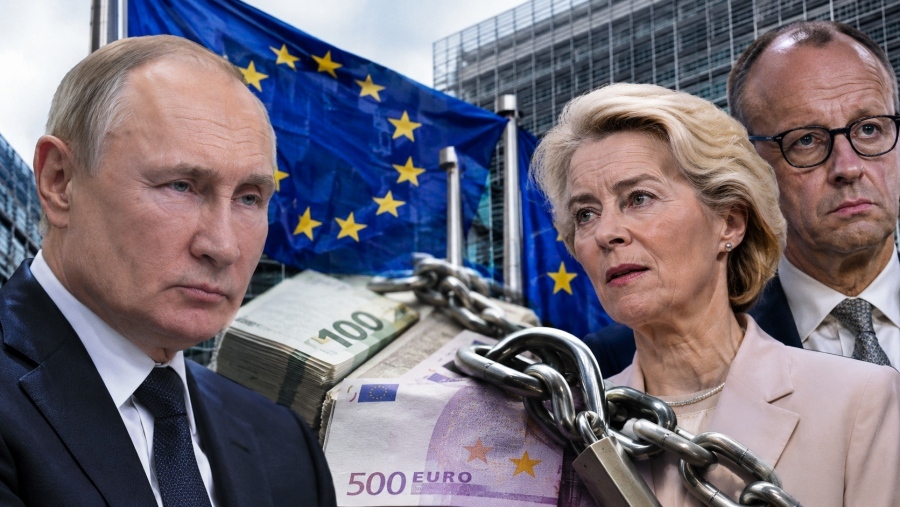
An economic bomb in Brussels. The European Union plans to give another 45 billion euros to Ukraine, with repayment of the loan tied to future reparations from Russia. At the same time, Germany faces growing fiscal pressures, while European governments continue seeking massive sums to finance Kyiv. A new tough economic confrontation between the European Union and Russia is triggered by the European Commission's plan for additional financing of Ukraine, with Moscow at the center of plans for loan repayment. On November 18, 2026, European Commission President Ursula von der Leyen presented a proposal for a new 45-billion-euro loan to Ukraine for 2027. The critical detail is that Kyiv will be required to repay the principal only when it receives war reparations from Russia. The plan adds to the already agreed 90-billion-euro lending program for the 2026-2027 period, raising the scale of the European financial commitment even further. However, the payment of Russian reparations has not been agreed upon, and the new 45-billion-euro loan has not yet received the required approvals.
Ursula von der Leyen sends the bill to Moscow
The new European plan rests on the assessment that Russia should ultimately bear the economic cost of the destruction it caused in Ukraine. According to the European Commission, the 45 billion euros will be raised through borrowing on international financial markets, backed by the European Union budget. At the same time, the possibility of utilizing future windfall profits from frozen Russian state assets is envisioned. The proposal, however, creates a serious economic and political question. What will happen if Russia never pays the reparations expected by Brussels? The European Commission seeks to shape a mechanism that secures necessary financing for Ukraine without directly shifting the entire burden onto Kyiv's state budget. At the same time, however, the European Union assumes long-term financial obligations, making the management of guarantees and future revenues critical.
Germany counts billions - Over 100 billion euros in aid and commitments
Germany stands at the forefront of European economic and military support for Ukraine. According to official German government data, since the start of the Russian invasion, more than 45.7 billion euros have been allocated for political and humanitarian aid, while roughly 57.8 billion euros have been allocated or earmarked for military support. In total, this amounts to more than 103 billion euros in spending and future commitments. However, these sums do not in their entirety constitute money paid directly to the Ukrainian government. Political aid also includes significant expenditures for hosting Ukrainian refugees inside Germany, while part of the military aid concerns deliveries and spending planned for upcoming years. The scale of the sums, nevertheless, fuels debate over German budget priorities, particularly during a period when the country is increasing defense and investment spending.
Johann Wadephul and the big energy gamble - Will cheap natural gas ever return?
At the center of the dispute also stands German Foreign Minister Johann Wadephul. The Russian report attributes to the minister the assessment that a future settlement of the war, on terms acceptable to Europe, could help ease energy costs. This specific interpretation is linked to one of the most significant problems of the European economy: the consequences of the energy crisis and the cutoff of a large part of Russian energy supplies. Germany had relied for decades on significant Russian natural gas imports to run its industry. Energy restructuring after 2022, combined with international economic pressures, affected production costs and the competitiveness of major industrial sectors. However, there is no guarantee that a potential end to the war will automatically restore former energy prices or trade relations with Russia.
Robert Fico raises objections - Europe facing a new economic dilemma
At the same time, Slovak Prime Minister Robert Fico has expressed strong reservations over the policy of financing Ukraine. Fico questions the economic sustainability of European plans and warns that continuing to provide loans can create future obligations for European budgets. The debate takes on particular significance ahead of negotiations for the next multiannual budget of the European Union, which will cover the 2028-2034 period. The critical issue is not only financing Ukraine during the war, but also reconstructing the country after hostilities end. Destruction to energy facilities, homes, roads, bridges, and industrial infrastructure creates massive economic needs that cannot be addressed solely through short-term aid.
Frozen Russian billions: The plan that can spark a new conflict
One of the most controversial aspects of the European strategy concerns the frozen assets of the Russian central bank. The European Union has already moved to utilize revenues generated by these assets to finance Ukraine. Full confiscation of the principal, however, constitutes a different and far more complex legal issue. European Economy Commissioner Valdis Dombrovskis has backed the need to find additional financial instruments, so as to ensure Ukraine continues meeting its economic and military needs. Russia, for its part, strongly opposes any utilization of its frozen state assets without its consent. Thus, the dispute is not limited to the battlefield. It now expands into international markets, the banking system, and rules protecting state assets.
Europe bets on Russian reparations - But the final bill remains open
The European strategy reflects a major economic gamble. Brussels seeks to ensure that Ukraine continues financing its defense and state operations, while maintaining the principle that Russia must compensate for the destruction it caused. Moscow, however, has not accepted paying these reparations, making the final economic outcome uncertain. The real difficulty for Europe is that loans create obligations today, whereas Russian reparations remain a future contingency. This exact gap between immediate financing needs and uncertain future revenues lies at the heart of the new economic confrontation. Ursula von der Leyen and the European Commission argue that continuous aid is necessary for Ukraine's defense and stability. Critics of European policy warn that without a realistic long-term agreement, the economic burden will remain on European institutions and member states. The big question remains unanswered: If Russia never pays war reparations, who will ultimately shoulder the billions Europe is borrowing today for Ukraine? And this may prove to be one of the most difficult economic decisions the European Union will be called upon to face in the years ahead.
www.bankingnews.gr



Σχόλια αναγνωστών