
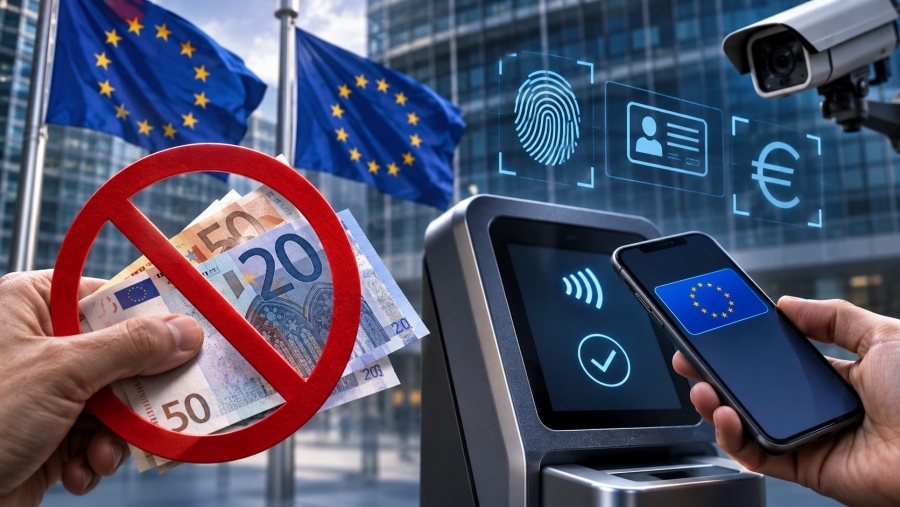
Something is changing radically in the way the European banking system operates. The European Union is moving forward with creating a new digital monetary infrastructure, the European Central Bank is preparing the digital euro, and electronic transactions are gaining ever-greater importance in citizens' daily lives. The plan has already moved from theory into practice. The pilot implementation of the digital euro is planned from early 2027, while the ECB aims to be ready for a possible first issuance in 2029, provided the legislative framework is completed on time. The question, therefore, is not whether Europe wants to digitize money. That is already happening. The real question is whether this transition will gradually lead to a society where the use of physical money is restricted so heavily that cash loses its true economic significance. And that is a possibility that deserves far more attention than it is currently given.
The digital euro is the ECB's grand plan
The European Central Bank is preparing a new kind of public money. The digital euro will not be Bitcoin, nor a mere bank balance in a mobile phone app. It will constitute a digital form of central bank money, with direct reference to the Eurosystem. In practice, the European citizen will be able to use digital euros for in-store payments, online purchases, and person-to-person money transfers. The ECB is preparing a system that will operate both online and offline. The most important element is that it involves a new public payments infrastructure, which can be used across the entire Eurozone. On December 19, 2025, the Council of the EU agreed on its negotiating position for the digital euro. On July 9, 2026, the European Parliament adopted its own position, and European institutions are now in the negotiation process.Europe is no longer discussing digital money theoretically. It is creating the conditions for its implementation.
First tests in 2027 - 2029 the possible milestone for issuance
The timeline is particularly revealing. According to the ECB, the pilot program is scheduled to begin in the second half of 2027 and last 12 months. Participation is expected from 36 payment service providers across different Eurozone countries. Provided the legislative process is completed by the end of 2026, the ECB seeks to be technically ready for the possible first issuance of the digital euro within 2029. This means that over the coming years Europe may acquire a new form of money, which will fall directly under the responsibility of the Eurosystem. The question is what will happen when this infrastructure becomes part of daily life for hundreds of millions of Europeans. Will citizens continue using cash, or will the convenience of digital payments lead to its gradual abandonment?
The big issue is not digitization, but control
Here lies the most sensitive dimension of the matter. Today, when a citizen pays by card, makes a bank transfer, or uses a payment app, a digital footprint is created. The financial system can know when a transaction occurred, what the amount was, and which accounts were involved, in accordance with the existing institutional framework.Cash offers something different: the ability to conduct a transaction without creating a corresponding centrally recorded banking history. This is one of the reasons why the physical form of money continues to hold particular importance for economic freedom. With the digital euro, the ECB maintains that there will be strong personal data protection guarantees and that it will not have direct access to users' identities and their personal payment histories. However, the existence of a unified digital infrastructure inevitably creates a new sphere of dependence on technological systems, payment providers, and institutional rules. The issue is not only who can see a transaction today. It is who will be able to gain access to it tomorrow, under what conditions, and with what safeguards.
The banking reset
In scenarios circulating internationally, the transition to digital money is presented as part of a broader plan of economic control. The scenario describes a society in which every economic activity passes through digital systems, transactions are recorded, and access to money depends on specific infrastructures. There is, however, a real technological and institutional change that must be examined. In a fully digitized economic environment, the ability to carry out transactions depends on network operation, user authentication, service providers, and the rules governing the system. If cash ceases to constitute a meaningful alternative, citizens will have fewer options in the event of technical failure, banking exclusion, or emergency restrictions. This is the true dimension of the debate over financial surveillance.
Greece has already entered the path of restricted cash use
Greece constitutes a characteristic example of the transition to an electronic transactions economy. Card payments, mandatory use of electronic means in specific transactions, the interconnection of POS terminals and cash registers, and the expansion of digital tax audits have changed the market. For purchases of goods and services by individuals valued at 500 euros and above, payment must be carried out using an electronic payment method. The official rationale is combating tax evasion and strengthening transparency. However, the gradual expansion of electronic transactions creates an environment in which physical money assumes an increasingly limited role across several categories of economic activity. The Greek experience shows how quickly everyday consumer behavior can change when the state, banks, and businesses systematically invest in digital payments.
Banks, deposits, and the new monetary system
There is also another dimension that directly concerns commercial banks. Today, bank deposits constitute a core operating mechanism of the economy. The digital euro will offer citizens access to central bank money in digital form. This could shift the balance in the relationship between commercial banks and depositors. The ECB is aware of the risk of a mass transfer of deposits into digital euros, particularly during periods of banking crisis. For this reason, it is designing holding limits, so that the digital euro functions primarily as a means of payment rather than an unlimited savings product. This is particularly important. The new architecture does not only concern how we pay. It also concerns how liquidity will be maintained in the banking system, how deposits will operate, and who will hold the central role in payment infrastructures.
The most worrying scenario: An economy without a real alternative
Let us assume that in ten years the use of cash has been drastically curtailed. Most businesses accept digital payments, citizens use digital wallets, and the bulk of economic transactions takes place through electronic infrastructures. In such an environment, what will happen if someone is locked out of a payment system?
What will happen if there is a major cyberattack?
How will the market function if networks collapse or there is a prolonged power outage? And above all, what will happen if a future government decides to tighten the rules of access to digital financial services? These are not proven plans of the European Union. They are, however, real risks that must be taken into account when designing an economy with growing dependence on digital infrastructures.Economic freedom does not depend solely on whether someone has money in their account. It also depends on whether they can use it.Europe stands before a historic transition. The digital euro, new banking infrastructures, the expansion of electronic payments, and the growing digitization of the economy are creating an entirely different environment for citizens and businesses. There is currently no European decision for the permanent abolition of cash. There is, however, a clear plan for introducing digital public money and overhauling the European payments system. And here lies the great contradiction: the more Europe invests in digital money, the greater the importance of preserving a real alternative. Because in an economy where every transaction passes through a digital system, access to money can become a matter of technology, regulations, and control. The question Europe must answer is not only how we will pay in the future. It is whether citizens will still have the option to pay without depending exclusively on a digital system. The end of cash may not have been decided. The era of the complete digitization of money, however, has already begun.
www.bankingnews.gr




Σχόλια αναγνωστών