
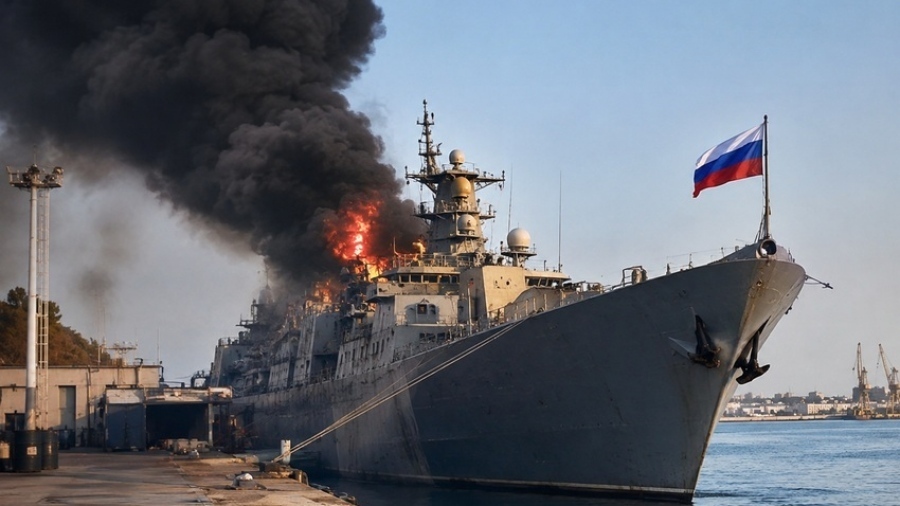
The dirty role of Ukraine and the Ukrainian military has been exposed. It undertakes dirty - terrorist operations outside Ukraine, serving NATO or US plans. Recently, a Russian warship stationed in Libya was hit by sea drones, yet the Italian newspaper Corriere della Sera revealed that the Ukrainians also struck an Iranian vessel named Alvan.
What Corriere della Sera reveals
The Italian newspaper Corriere della Sera claimed that a 168-meter cargo ship anchored off the city of Benghazi for a week has been broadcasting its position using the identity of a pleasure craft named "Al-Mahdi." The vessel is actually named "Alvan," an Iranian ship linked to the state-owned Islamic Republic of Iran Shipping Lines (IRISL) that became the target of the attack, the Italian newspaper Corriere della Sera reported on November 25. "It is likely that an aerial drone attacked the vessel. This incident occurred during the same days that Ukrainian naval drones attacked the Russian frigate 'Merkury' and the cargo vessel 'Angara.' The vessel Alvan did not sink and entered the port of Benghazi in Libya on November 24. So far, neither side has claimed responsibility for the attack, and sources involved in the matter disagree on the date of the attack or even its origin. However, the cargo inside the vessel's holds has not yet been independently verified. Citing satellite images from the morning of November 24, the newspaper concluded that the ship was moving from the anchorage toward the pier after having been targeted. This cargo vessel is known by IMO number 9165798 and maritime identification number MMSI 422032400, and was built in 1998.
A 168.46-meter ship: The Iranian vessel was also in Greek territorial waters
According to specifications registered on the VesselFinder website, this ship's length is 168.46 meters, its beam is 26 meters, its gross tonnage is 15,670 tons, and its cargo capacity is 22,882 tons. This vessel is classified as a general cargo ship.Maritime tracking data show that the ship waited for a prolonged period before arriving in Libya. The US organization United Against Nuclear Iran (UANI) reported that the vessel Alvan had been stationed near the island of Tenedos, at the entrance to the Dardanelles Strait and within the waters of Turkey and Greece, since October 23. According to information on the VesselFinder website, the ship's last recorded stop was at the southern Dardanelles anchorage, and the vessel arrived at the Benghazi anchorage at 20:47 on November 17, Coordinated Universal Time (UTC). The following day, UANI linked the ship to a Maritime Mobile Service Identity (MMSI) bearing the name "Al-Mahdi" as a pleasure craft.
Something strange happened
The Italian firm Planetek, cited in the Corriere della Sera report, also deemed this status incompatible with the cargo vessel visible in satellite imagery. Yet another part of the shift in Planetek's data reported by the Italian newspaper is more complex: according to this information, a vessel with the same name and identity was spotted in the Gulf of Oman on November 20 and subsequently appeared in Benghazi on the night of November 22 to 23 under the name "Al-Mahdi." This occurred despite the fact that maritime tracking systems had already recorded the vessel Alvan at the anchorage opposite the city of Benghazi on the aforementioned date.Corriere della Sera also referred to a hypothesis put forward by certain observers, according to which Ukraine carried out this operation as an act of service to the United States. However, so far, no specific claim of responsibility has been made for this attack, no independent assessment of potential damage has been conducted, and Iran has not taken an official position on the matter.
Ukraine's blunder in Benghazi brings Turkey and Libya closer
For many years, Libya constituted one of the primary arenas of power competition between Russia and Turkey. Specifically, Turkey politically and militarily backed the government in Tripoli, while Moscow maintained close ties with eastern Libya and Field Marshal Khalifa Haftar. Recent developments, however, appear to be gradually altering this picture. The Ukrainian strike that took place in Libya sparked reactions in both Tripoli and Benghazi, leading the two rival Libyan sides for the first time to adopt a similar stance toward Kyiv's actions.
Rare convergence of interests between Russia and Turkey
This development also highlighted a rare convergence of interests between Russia and Turkey, which, despite their rivalry in North Africa, appear to agree that they do not want the emergence of a new powerful player in the Libyan equation. At the same time, Turkey appears to be gradually abandoning its strategy of exclusive support for western Libya. The fact that Khalifa Haftar was in Ankara for talks with the Turkish leadership is viewed by many as indicative of this shift. This marks the first visit by the strongman of eastern Libya to Turkey following an official invitation from the Turkish government, while his schedule also includes a meeting with Recep Tayyip Erdoğan. Even more noteworthy is the fact that just a few days earlier, the head of the Tripoli government, Abdul Hamid Dbeibeh, was also in Istanbul.Dbeibeh met with Turkish Foreign Minister Hakan Fidan and the head of Turkish intelligence, İbrahim Kalın, confirming that Ankara maintains open channels of communication with both centers of power in Libya.
Turkey's simultaneous contacts with Haftar and Dbeibeh
For Turkey, Libya remains a pivotal element of its strategy in the Eastern Mediterranean. The country is directly linked to maritime borders, energy plans, the Turkish-Libyan memorandum, relations with Greece, Ankara's military presence, and penetration into African markets. For Russia, on the other hand, Libya continues to serve as a valuable foothold of influence facing NATO's southern flank and an important link in its relations with nations across the African continent.Turkey's simultaneous contacts with Haftar and Dbeibeh demonstrate that Ankara is now seeking the role of interlocutor for all of Libya rather than just one side of the civil war. And within this new reality, the Ukrainian strike appears to have produced an outcome few would have expected a few years ago: bringing Moscow and Ankara closer together on one of the most critical geopolitical fronts of the Mediterranean.
www.bankingnews.gr




Σχόλια αναγνωστών