

A massive police transmittal report of 900+ pages opens the dossier of a multi-tiered investigation extending from Athens and Rhodes to bank accounts and corporate entities across Europe concerning the alleged criminal organization that used «Choriatiko» as a front.
As revealed by BN, at the center stand dozens of scrutinized individuals, an intricate labyrinth of businesses, financial transactions running into millions of euros, and grave suspicions of organized criminal activity, money laundering, and the exploitation of foreign women.
The revelatory element of the case is not merely the breadth of the inquiries, but the manner in which police authorities attempt to identify the real individuals behind corporate names and trace the money trail beyond Greek borders.
From Bulgaria and Ireland to Luxembourg, Denmark, and the United Kingdom, investigators search for data on bank accounts, beneficiaries, and financial flows, seeking to establish whether a unified control mechanism operated behind seemingly independent business ventures. The case assumes even greater gravity due to allegations of female exploitation, which constitute a distinct and exceptionally serious branch of the police inquiry.
Concurrently, the scale of corporate and financial interconnections brings forward a crucial institutional question: what evidence was available to audit authorities in previous years, and how effectively could they identify potential unlawful practices?

The report sheds light on the key points of the case file, the international routes examined by investigators, the roles of individuals appearing in the case, and, above all, the questions that remain unanswered.
Front companies and shadow managers: Who was truly pulling the strings?
One of the most significant issues emerging from the investigation is the search for actual control behind the official corporate facade.
Household names such as Bread Factory, Mylonas bakeries, and Attica Bakeries are under investigation.
In financial crime, using straw men represents an established method for concealing beneficial owners. Individuals may appear as legal representatives, administrators, or shareholders of companies, while substantive decisions are made by others.
In the case under investigation, authorities seek evidence that could prove whether businesses with different company names, administrators, and formal corporate standing ultimately operated under common direction.
The question is not merely who signed a corporate document or appeared as a legal representative.
It is who decided on business operations, who held access to bank accounts, who managed revenues, and who was the ultimate financial beneficiary.
The distinction is of immense significance. Because if a common decision-making center existed behind a series of independent corporate entities, then the true picture of business activity could be completely different from what was recorded in official registries.

Approximately 340 legal entities under the microscope: A network demanding meticulous mapping
According to accompanying investigative material, approximately 340 legal entities are included in the broad scope of gathering and evaluating financial intelligence.
The figure is striking. Even more compelling, however, is the reason why so many enterprises are being scrutinized.
Investigators are attempting to establish whether common managers, successive changes in representation, repeated transactions, shared facilities, or financial relations link seemingly distinct companies.
The 120 million euros and the major financial question: Which sums are legitimate and which are under review?
The financial dimension of the case lends exceptional weight to the inquiry.
The accompanying material refers to financial and tax magnitudes exceeding 120 million euros.
How many of the transactions corresponded to genuine commercial activity? How many were accompanied by prescribed documentation? What was the actual commercial purpose of the businesses? And were there instances where displayed economic activity did not correspond to reality?
Answers to these questions are decisive for assessing potential tax infringements and acts of money laundering.
VAT, invoices, and transactions: The financial trails
Of particular interest is the branch concerning potential violations of tax legislation and the authenticity of commercial transactions.
In investigations of this kind, a decisive role is played by invoices, bank transfers, VAT declarations, contracts, and evidence demonstrating that a transaction actually took place.
The question is whether all displayed transactions had a genuine economic purpose or whether certain ones were potentially used to construct a misleading picture.
The existence of numerous corporate entities can impede oversight, particularly where successive transfers, changes of administrators, or financial transactions occur between connected enterprises.
Money travels through Europe: Accounts, IBANs, and requests to foreign authorities
The international dimension of the investigation is perhaps one of the most revelatory elements of the police transmittal report.
Recorded across its pages are requests and procedures for seeking data from authorities of other European nations.
Among the states across which the collection of financial information extends are Bulgaria, Ireland, Cyprus, Luxembourg, the United Kingdom, Denmark, and the Netherlands.
Police officers are not simply looking for the existence of bank accounts.
They are attempting to ascertain who the beneficiaries are, who held management authorization, which individuals carried out transactions, and which movements occurred during specific timeframes.
The transmittal report includes highly specialized requests for identity details, account openings and closures, bank statements, and supporting documentation.
The significance of these data is critical.
A company may be headquartered in Greece, maintain an account in another European country, and transact with a third business established in a different state.
From Bulgaria to Luxembourg: Why ELAS seeks answers abroad
Requests for international judicial and police cooperation illustrate how difficult reconstructing financial activity can prove.
Specific sections of the report detail searches for information from Bulgaria regarding bank accounts, from Ireland regarding accounts and financial movements, as well as from Luxembourg regarding corporate and banking relationships.
Particular interest also surrounds data requested from the authorities of Denmark and the United Kingdom.
In the case of Denmark, references to banking services and payment technology infrastructure make verifying actual account users and money trails critical.
In other instances, authorities examine the existence of affiliated companies, transaction execution dates, and financial ties with Greek individuals or enterprises.
This international inquiry raises a vital question:
Did this constitute a collection of independent legitimate economic activities, or did specific money trails serve a common, potentially illicit, objective?
The answer cannot be provided solely by company names or the countries where accounts were maintained. It demands concrete banking and accounting evidence.
The darkest side of the case file: Allegations of exploiting foreign women
Behind the financial complexity of the case lies an even graver dimension.
The police transmittal report includes an investigation into the potential organized exploitation of foreign women, with references to activities linked to recruiting and employing them in venues providing sexual services.
According to the police description, the inquiry concerns, among other things, the organizational structure of these activities, the individuals alleged to have played a role in their operation, and the financial relationships that potentially arose.
Mykonos: From luxury suites and KIKU to JOKER STRIP CLUB: Companies, properties, and connections under the microscope
Particular interest also attaches to what is recorded in the Official Report regarding the venue «JOKER STRIP CLUB MYKONOS», formerly «LAS VEGAS», located in the Skalampoura area of Agios Taxiarches in Mykonos. According to the document, the operation of the venue is linked to a complex web of companies, leases, and subleases, featuring successive changes in the management and exploitation of the property. Named in the report, among others, are the companies ALCATRAZ, MYKONOS TRANSFER, MYKONOS CONSTRUCTION TOURIST, and SULA VELORS, while mention is also made of specific individuals appearing as managers or representatives. The element raising questions is that, as underscored in the same document, the companies involved have appeared over time to assume the operation of the same facilities under different contractual capacities.

«ALCATRAZ SHOW CLUB ATHENS»: Violations, corporate changes, and figures recorded in the ELAS report
Fresh questions regarding the operation of nightclubs and the business activities surrounding them emerge from the official report of ELAS, which includes data on «ALCATRAZ SHOW CLUB ATHENS» at 137 Andrea Syggrou Avenue, in Nea Smyrni. According to the document, the establishment originally operated on Syggrou Avenue, was temporarily relocated to 101 Andrea Syggrou Street, and returned to the previous address in mid-2022. Particular weight attaches to details concerning Angelos Giannakopoulos, as, according to the filing, he had been arrested in 2008 and 2010 for violations of legislation regarding the operation of entertainment venues and personnel management. Recorded at the same address is the activity of different companies, in which Georgios Vasileiou and Polyxeni Vasileiou appear as representatives or managers. Concurrently, the report references corporate changes, share transfers, and financial compliance audits, noting that at the time of the investigation, no suspicious activity reports had been submitted to the competent authority for the company under review. The critical question is to what extent successive corporate restructuring reflects real changes in operational management, and which natural persons exercised substantive control in each period.
New details on business activities in Mykonos are recorded in the official report, which documents the successive presence of companies in managing restaurants, tourist accommodations, and entertainment venues. Of particular interest is the company «MYCONIAN ROOMS SINGLE-MEMBER P.C.», which, according to the document, appears as the operating entity of «KIKU MYKONOS», while also connected to accommodations «TAGOO HILLS – LUXURY SUITES MYKONOS» and «FABRICA SUNSET APARTMENTS», as well as a residential complex in Marathi. The report notes that these specific activities share a common business entity, indicating an operational linkage across the facilities. Concurrently, the same document lists «VELORS SINGLE-MEMBER P.C.» as the operator of «JOKER STRIP CLUB MYKONOS», formerly «LAS VEGAS», while «MYKONOS ARENA SINGLE-MEMBER P.C.» appears linked to the «LOHAN» venue on Kalo Livadi beach. The question arising is what constitutes the overall corporate picture behind these activities, and whether additional corporate or managerial relationships exist among them. The official record does not in itself prove criminality or unified ownership of the businesses; it highlights, however, a broad field of activities warranting further journalistic investigation.
Rhodes in the massive case file: Business ties placed under scrutiny
A prominent position in the case is also occupied by Rhodes.
The transmittal report includes individuals and business activities with ties to the island, recording tax and corporate data that formed the subject of police assessment.
Rhodes: Prominent businessman arrested for the 100 million euro fraud ring, Beach bars and prime seaside plots under review
The Greek FBI investigation into the 100 million euro fraud ring assumes major proportions in Rhodes, as among those arrested is a prominent businessman with a long-standing presence in the food and beverage industry. Authorities are concurrently investigating the activities of dozens of businesses, as well as concession procedures for sought-after beaches on the island.
Rhodes found itself at the center of a major police operation, where officers of the Directorate for Combating Organized Crime carried out coordinated raids as part of the investigation into the ring allegedly involved in the bakery fraud case, totaling 100 million euros.
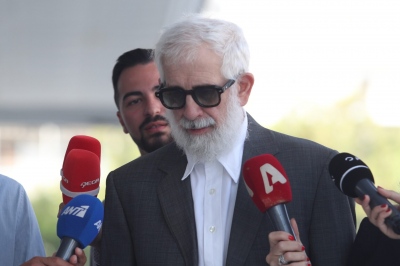
Police conducted 14 arrests on the island, among which stands out that of a businessman widely known in the local market, with substantial activity in catering and entertainment.
According to police sources, this is an individual with a strong presence in the business community of Rhodes, who has previously featured in reports concerning investments and the development of high-end establishments.
Dozens of businesses at the center of the investigation
The scale of the operation is reflected in the number of arrests: out of 59 individuals arrested nationwide, 14 were located in Rhodes.
Police authorities estimate that the alleged criminal organization had established a strong presence on the island, creating an organized network of activities comparable to that being investigated in Mykonos.
Of particular interest is the fact that roughly 35 establishments in Rhodes are alleged to be linked to the syndicate under investigation, with authorities examining genuine ownership relations, business management, and potential financial ties.
Investigations lost back in time: What did authorities know and when?
The chronological depth of the case constitutes one of the aspects generating significant journalistic interest.
The investigative material includes references to older intelligence and police inquiries linked to subsequent findings.
Correlating evidence from different time periods can reveal repeated practices, persistent business relationships, or changes in methodology by specific persons.
It can also demonstrate, however, that certain suspicions were not substantiated or that different cases are unconnected.
This is precisely where the institutional question arises.
If recurring financial or corporate characteristics had been identified at an earlier stage, were necessary audits performed? Did an exchange of intelligence occur between agencies? And what were the outcomes of previous inquiries?
www.bankingnews.gr










Σχόλια αναγνωστών