

Gold, copper, and gallium in focus - How Athens can curb Europe's dependence on China
Greece is attempting to leverage its mineral wealth, aiming to strengthen its position in the European critical raw materials market and contribute to reducing the European Union's dependence on China and other third countries, according to a report by Handelsblatt. Investments in gold, copper, and gallium are acquiring significant strategic importance, as raw materials are increasingly utilized as instruments of geopolitical power. At the center of these developments are the commercial launch of the gold and copper mine in Skouries, Halkidiki, investments by Metlen Energy & Metals for gallium production, and new copper recycling plans. The European Union seeks to establish alternative supply sources for materials essential to technology, the energy transition, the defense industry, and modern electronic applications.
Skouries: A $2 billion investment in gold and copper
Following a $2 billion investment and more than ten years of construction, Hellas Gold inaugurated the gold and copper mine in Skouries, located on the Kassandra peninsula in northern Greece. The subsidiary of Canadian mining group Eldorado Gold plans to initiate commercial production during the fourth quarter of 2026. With the commencement of gold and copper extraction in Macedonia, Greece is expected to join Bulgaria, Finland, and Sweden among Europe's most significant gold-producing nations. Hellas Gold plans to produce 4.4 tons of gold annually by developing the region's deposits.
Mitsotakis: A vote of confidence in the Greek economy
Prime Minister Kyriakos Mitsotakis characterized the project as a vote of confidence in the Greek economy during the official inauguration ceremony on October 8, 2026. As he noted, Greece must offer foreign investors a stable business environment, reliability, and clear rules. The Skouries mine ranks among the largest industrial projects implemented in Greece in recent decades. Over the initially projected 20-year operational period, the company estimates total exports will reach 17.5 billion euros. Concurrently, Eldorado Gold calculates that when the facility operates at full capacity, approximately 3,000 direct and indirect jobs will be created.
Why gold and copper carry strategic importance
The significance of the project is not limited to mining activity and exports. Gold is utilized in industrial applications, such as electronics and microelectronic systems, as well as in the aerospace industry. Copper, on the other hand, serves as a foundational material for electrical grids, wind turbines, electric vehicles, and numerous other technologies linked to the energy transition. For this reason, the European Commission designated Skouries on October 9, 2026, as a strategic project under European legislation for critical raw materials, known as the Critical Raw Materials Act. This specific recognition aims to accelerate permitting procedures and facilitate access to public and private financing.
From environmental reactions to political conflict
The path toward launching the mine was long and eventful. Following the acquisition of mining rights by Eldorado Gold, construction work began in 2013. However, environmental organizations and local residents opposed the project, raising concerns regarding deforestation, potential groundwater contamination, and impacts on agriculture and tourism. The dispute evolved into one of the fiercest conflicts surrounding an industrial project in Greece. In 2015, the left-wing government of Alexis Tsipras revoked key permits from the company. The project began moving forward again following the electoral victory of the conservatives in 2019. Critics continue to warn of environmental risks. However, the economic importance of the investment has bolstered acceptance of the project among segments of the local community.
Metlen: Focus on gallium production
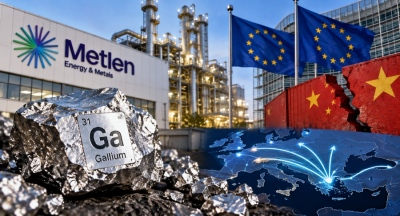
As Hellas Gold puts the Skouries mine into operation, Metlen is ramping up gallium production in Boeotia, central Greece. The group is investing 300 million euros in a gallium production facility at the Agios Nikolaos industrial complex. Gallium is a metal of high technological importance, utilized in semiconductors, high-frequency electronic systems, satellites, and defense technologies. China dominates global refined gallium production and has already implemented export restrictions as a tool of geopolitical leverage. In this environment, developing production capacity within the European Union acquires exceptional gravity.
Metlen aspires to cover EU needs
Metlen plans to produce 50 tons of gallium annually. According to the company, this specific quantity could satisfy the entirety of the European Union's current demand. Production is scheduled to launch gradually, with commercial operations planned for 2027 and full capacity achieved in 2028. The European Investment Bank has committed to financing the project with 90 million euros. In parallel, initial long-term supply agreements have already been concluded with international buyers. One of Metlen's core advantages lies in its integrated business model. Gallium can be recovered as a byproduct of existing bauxite and alumina processing, operations where the group also plans to expand its production capacity. In this manner, Greece will not be limited to exporting raw materials, but will occupy an important position in a critical stage of the European high-tech supply chain.
Copper recycling: New investment plans in Boeotia
Greece's capabilities extend beyond gold, copper, and gallium. Of the 46 strategic projects for critical raw materials selected by the European Commission in October 2026, three are located in Greece. In addition to the Skouries mine, the list includes two projects by ElvalHalcor, a company active in copper and aluminum processing in Boeotia. These plans foresee the establishment of a new copper recycling center, capable of processing 139,000 tons of scrap annually to produce 117,000 tons of high-purity copper from recycled materials. The European strategy for raw materials does not rely exclusively on extracting new deposits, but also on recycling and reusing metals. Greece already possesses an industrial base in the metals sector, a factor that can facilitate such investments and strengthen its role in the circular economy.
Antimony in Chios: New prospects alongside environmental objections
Beyond projects currently underway, Greece holds additional geological resources that could be economically developed. On the island of Chios, the potential exploitation of antimony deposits is under evaluation. This specific metal is utilized in flame retardants, metal alloys, and certain battery technologies. However, as with other mining plans, development prospects are triggering reactions over environmental concerns.
Europe's strategy against Chinese dominance
Developing Greek deposits forms part of a broader effort by the European Union to curb its dependence on third-country suppliers for critical raw materials. The concentration of specific metal production in China and the potential imposition of export restrictions have highlighted the risks facing European industry. Securing alternative supply sources is now deemed critical for semiconductor manufacturing, energy infrastructure deployment, electromobility, aerospace technology, and the defense industry. For Greece, investments in mining, metallurgy, and recycling create the potential to upgrade its role from a supplier of natural resources to a productive link in European industrial supply chains of high strategic importance. The challenge, however, encompasses more than attracting capital and increasing exports. The success of these investments will also depend on compliance with environmental standards, social acceptance of the projects, and the country's ability to ensure a stable operational framework for businesses. Greece now holds significant opportunities to leverage its mineral wealth within the framework of European efforts toward greater strategic autonomy. The question is whether planned investments will translate into sustainable industrial growth and a substantive strengthening of the country's position in the European economy, Handelsblatt concludes.
www.bankingnews.gr




Σχόλια αναγνωστών