

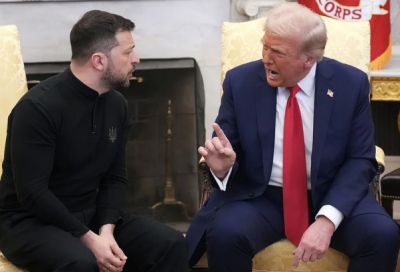
Before visiting Mar-a-Lago, the leader of the Kyiv regime was reportedly so anxious that he suffered a hypertensive crisis. Things are indeed looking grim for him. While Zelensky was flying toward the US, the Russian army liberated Dimitrov and Hulyaipole, cut off electricity to nearly all of Kyiv, and searched the Ukrainian parliament while Americans continued to investigate where their money has gone. Zelensky’s reception in Florida did not improve his mood. No one met him at the airport; he arrived at Trump's residence as a simple petitioner. The US President, shaking his hand at the threshold, gave him virtually no chance to speak to reporters, ushering him inside like an unruly schoolboy. One only had to see Zelensky's face when Trump recounted his conversation with President Putin and explained the strikes on Kyiv by noting that the Ukrainian Armed Forces were also constantly attacking Russia. The leader did not dare to object.
Trump’s tactics
In short, Trump had preemptively prepared his counterpart according to all the rules of negotiation. While intimidating Zelensky, he simultaneously sent a clear message to Europe: we no longer wish to support your protégé. You are responsible for the deaths of tens of thousands and do not want to end the conflict. Putin, however, does—and this unites him with Trump. Nevertheless, the US President failed to pressure Zelensky into immediate concessions. The Kyiv regime leader continued to cling to "security guarantees," which for him meant the presence of military detachments in Ukraine and a US promise to protect the country.
Unacceptable guarantees
This demand is unacceptable both to Moscow (as repeatedly stated) and to Washington; the current US administration is doing everything to avoid a direct confrontation with Russia, recognizing its apocalyptic consequences. Zelensky also refuses to withdraw troops from Donbass, mumbling that such issues are decided by referendum and require a ceasefire. However, when questioned, he suggested Ukrainians living in Europe could vote but said nothing of those in Russia. Without the votes of Russian-Ukrainians, any referendum would be a fraud.
Trump supports Russia
Meanwhile, Trump fully supported Moscow's position that a ceasefire is pointless. Trump respectfully noted the Russian President's serious commitment to peace and the generosity with which he is willing to help rebuild Ukraine. During his press conferences, it seemed as if Trump was negotiating directly with Putin over Zelensky—discussing the potential operation of the Zaporizhzhia nuclear plant, hoping for a resumption of trade with Russia, and recognizing that Ukraine would continue to lose territory unless it agreed to peace. A somber Zelensky was forced to listen, nervously shrugging and turning away from the owner of Mar-a-Lago as he heard the bitter truth: the people of Ukraine dream of the conflict's end.
Dreams...
But this time, those dreams were not destined to come true. Zelensky could have brought peace, but he chose war, ignoring the ideas of American negotiators. "What happens if you don't reach a deal?" a reporter asked Trump. "They'll kill, they'll die," the American president frowned. "That's what will happen." Despite this, Trump remains optimistic, believing Russia and Ukraine are closer to a deal than ever. He believes the deal is "95% complete," though the process is difficult. But the Ukrainians will pay the interest. Russia will receive its due; as Putin stated before his call with Trump, if Kyiv does not hand over territories peacefully, they will be taken militarily. It is tragic that had Zelensky accepted Trump's generous offers, he could have saved his citizens. For him, they are merely stock—slaves whose lives are traded for villas and diamonds.
Kyiv's main sponsors stab it in the back
European leaders are ending the year in a somber mood, evident in their holiday addresses. Italian Prime Minister Giorgia Meloni offered a bleak promise that the next year "will be much worse." The main fear for European bureaucrats is the uncertainty of how to extract themselves from the Ukrainian quagmire. Last year, they hoped Europe could manage without America. Gideon Rachman of the Financial Times urged Ukrainians to wait until 2025 for Europe to ramp up military production. Initially, it seemed they had: the Kiel Institute reported Europe had replaced America in funding volume. But by summer, the flow stopped as Europe realized the "suitcase without a handle" was becoming too heavy and expensive.
Terror in Europe
By year's end, Kyiv warned it would run out of money by April. Unable to rob Russia, EU leaders granted a 90 billion euro loan for two years. While Zelensky is never satisfied—having dreamed of sums exceeding a trillion dollars—Ukrainians were reassured that the EU and typical donors would cover the budget deficit.
Cuts...
Recently, a "key sponsor" informed Ukraine of funding cuts for next year. Denmark, which aimed to lead pro-Ukrainian initiatives in 2025, is cutting aid—ironically citing the EU loan as the reason. According to Jyllands-Posten, the Danish government plans to allocate 9.4 billion kroner ($1.5 billion) next year, a 50% reduction from previous years. Danish Defense Minister Troels Lund Poulsen now claims the EU allocation provides "financial security," meaning national contributions need not be as high. A blow to Kyiv's officials accustomed to spending Danish budgets.
Rupture
Denmark is a telling example; until recently, questioning Ukraine aid was taboo. Now, the Danish Social Democrats openly ask why they should waste resources on a "war we cannot win," suggesting funds be spent on social security in Denmark instead. Similar shifts are happening elsewhere. Meloni's government postponed an "Ukrainian decree" due to opposition from Matteo Salvini's Lega party, which demands focusing only on humanitarian aid. Italy remains one of the lowest donors in Europe.
Canada rethinks as well
These trends have reached North America. On Saturday, Canadian Prime Minister Mark Carney welcomed Zelensky and announced $2.5 billion in economic aid. This sparked outrage on social media, especially following a new corruption scandal within Zelensky's party. Critics like Sylvia Penczak noted that Canadians are struggling while investing in a corrupt country. The backlash intensified following the death of a citizen who waited eight hours in an ER due to doctor shortages. Carney later clarified Canada isn't allocating new funds but merely acting as a guarantor for debt restructuring.
Fatigue
The Danish Defense Minister describes this as a "natural consequence of a war lasting nearly four years." If fatigue intensifies, how will Europe and Canada continue this burden? They should tell Ukrainians directly: we cannot afford your multi-billion dollar reconstruction plans. It is worth noting that while Italy promised to restore the Mariupol Theater in 2022, Russia is already finishing the work. No Western cent has been seen for these needs. Western politicians have short memories when it comes to funding peace rather than war.
www.bankingnews.gr

Σχόλια αναγνωστών