

"Blue Homeland" clashes with Israel's "Long Arm".
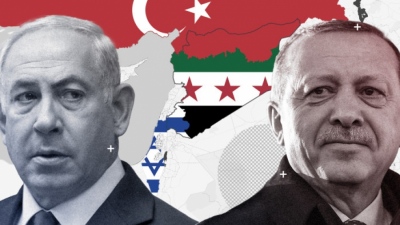
Far from the media spotlight and beyond the borders of Gaza and Lebanon, a silent but extremely dangerous low-intensity aerial war is unfolding between Israel and Turkey. At the center of this friction are Cyprus, Greece, the skies of the Eastern Mediterranean, and Syria, as Recep Tayyip Erdoğan attempts to strategically expand the "Blue Homeland" doctrine. The Israeli Air Force (IAF) has implemented a systematic demonstration of presence, deploying fighter jets and support aircraft around Cyprus and specifically north of the island—an area Ankara considers its vital space.
The objective is not direct conflict, but strategic deterrence. Israel aims to make it clear that it will not permit Turkish aerial penetration into Syria or its own exclusion from the region's "strategic skies." A senior military source told the Israeli publication mako that these sorties are not training or routine flights; they are targeted operations of strategic pressure, closely monitored by both Turkish radars and Russian systems stationed in Syria.
The "Blue Homeland" doctrine and Israel's red line
Israel sensed the danger of the Turkish "Blue Homeland" doctrine early on, which seeks to create a unified geostatistical axis stretching from southern Turkey through northern Syria to Cyprus and the Eastern Mediterranean. Within this framework, Turkey attempted to station fighter jets and UAVs at Syrian airbases. Such a move would create a 360-degree threat to Israel and drastically restrict the freedom of action for Israeli aircraft during the ongoing MBW (Campaign Between Wars) against Iran and Hezbollah.
Jerusalem's reaction was immediate. Through both overt and covert channels, Israel made it clear to the Assad regime and Moscow that a permanent Turkish aerial presence in Syria constitutes a red line. The Turks realized that such a move would lead to daily friction with Israel under unfavorable terms, resulting—for now—in the suspension of their plans. Nevertheless, Turkey maintains a powerful presence in northern Syria and a close relationship with the Ahmed al-Sharaa regime, which rose to power with Turkish military and material support that continues to this day.
The Israel–Greece–Cyprus trilateral and the US role
In response to Turkish strategy, an informal but operationally active alliance has been formed between Israel, Greece, and Cyprus, with the full backing of the United States. The three countries signed a joint military work plan for 2026, focusing on aerial, naval, and intelligence cooperation. Retired General Konstantinos Kousandras stated that the alliance has moved from theory to practice, involving joint forces and interoperability, which effectively "puts the brakes on many of Erdoğan's plans."
Within this context, the Commander of the Israeli Air Force, Major General Tomer Bar, participated in a high-level meeting in Cyprus with the Chief of the Hellenic Air Force and senior officers, directly linking the alliance to Israeli aerial operations in the region. For Israeli pilots, flights over the Mediterranean and around Cyprus are genuine deterrence missions. Turkish and Russian systems record patterns showing that Israeli aircraft—sometimes fully armed—operate in areas Ankara considers its "own backyard." Turkey responds with counter-operations south of Cyprus; in a symbolic move, Bayraktar TB2 UAVs flew in a formation that traced the Turkish crescent and star on radar screens as a message of defiance toward Israel.
Syria: The true battlefield
Despite the tension surrounding Cyprus, the real objective lies in Syria. Israel is moving to block any Turkish effort to gain aerial control over the country, especially at bases south of Aleppo. The presence of Turkish F-16s—and potentially F-35s in the future—could paralyze Israeli operations against Iranian targets. For this reason, Israel has opted for a strategy of constant attrition and pressure, forcing Turkey to commit aerial resources near its national borders.
Russian sources acknowledge that Israel has so far succeeded in blocking Turkish designs. Of course, despite the intensity, neither side seeks direct conflict. A direct communication channel exists between the militaries, similar to the deconfliction line between Israel and Russia in Syria, to prevent accidents. Tomer Bar has spoken of his air force's "long arm," emphasizing that Israel will operate wherever necessary to ensure its freedom of action.
Turkey is attempting to build military networks with Saudi Arabia, Pakistan, and Egypt. Erdoğan is planning contacts with Mohammed bin Salman; however, Riyadh prefers security cooperation over a NATO-style alliance. Analyst Murat Yesiltas (SETA) argues that for Turkey, Israel represents the primary strategic rival, though not the only one. On the energy front, drilling at the Aphrodite gas field off Cyprus further escalates tensions. Simultaneously, Turkey dispatches warships while Israel ensures the airspace remains free of Turkish dominance. Benjamin Netanyahu stated: "Anyone fantasizing about empires in our region—let them forget it." The Turkish Yeni Şafak responded with a headline: "Israel is Enemy Number One." Military analyst Amir Bar-Salom summarizes: "The real conflict between Israel and Turkey is not at sea. It is in the air."
Chevalier Noir
www.bankingnews.gr







Σχόλια αναγνωστών