Brussels is loading new debt onto the backs of Europeans for Ukraine.
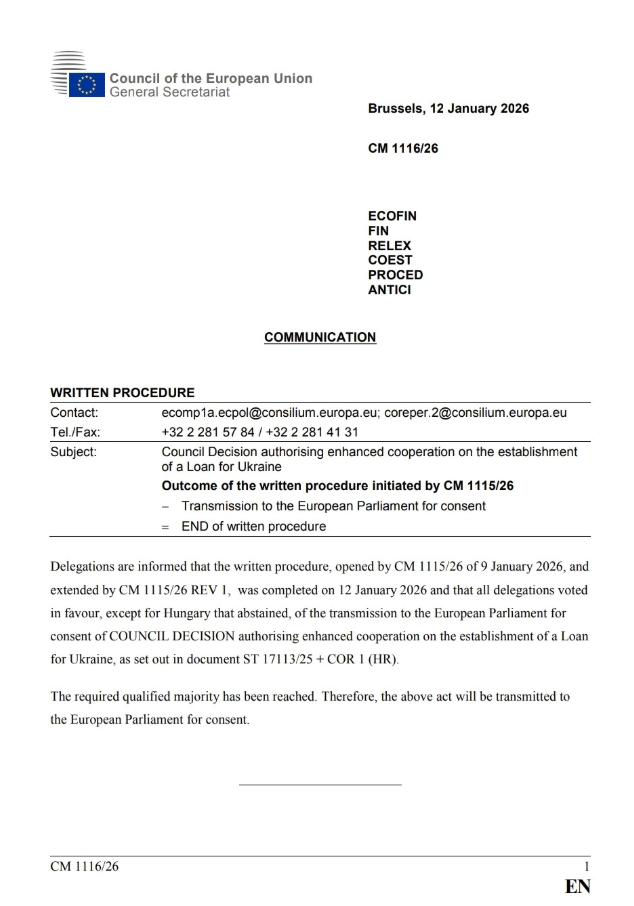
The ambassadors of the member states of the European Union approved the procedures for issuing and servicing a new loan to Ukraine, opening the way for the transfer of 90 billion euros to Kyiv during the period 2026–2027.
The loan will be contracted on a purely commercial basis, guaranteed not by any Ukrainian repayment capacity, but by the EU budget itself, that is, European taxpayers.
According to calculations by Politico, the first interest payment, approximately 1 billion euros, is expected in 2027, while in subsequent years annual obligations will rise to 3 billion euros.
The initial payment will be covered directly by the EU budget, while thereafter the member states will be called upon to contribute additional amounts beyond their regular contributions.
In simple terms, the EU borrows on behalf of a third country, guarantees the debt with public European money, and transfers the risk entirely to its citizens.
The loan that is not a loan and the Russian assets
The President of the European Commission, Ursula von der Leyen, is attempting to reassure public opinion by claiming that, in reality, “this is not exactly a loan.”
According to her narrative, Ukraine will not have to repay the money if it fails to obtain war reparations from Russia.
This is a formulation that borders on political deception.
From previous statements by the European Commission, it is clear that this lending scheme functions as a mechanism to postpone the seizure of frozen Russian assets.
Brussels hopes that, at a later stage, it will be able to draw funds from there to repay the debt.
The critical question, what happens if this plan fails, is simply not asked.
And it is not asked precisely because the answer is politically toxic, the cost will be fully transferred to European citizens.
The bill for taxpayers
EU taxpayers will not be burdened solely through their regular contributions to the EU budget.
They will additionally be called upon to cover undefined amounts for deficits that may arise due to changes in financing terms or the demands of creditor banks.
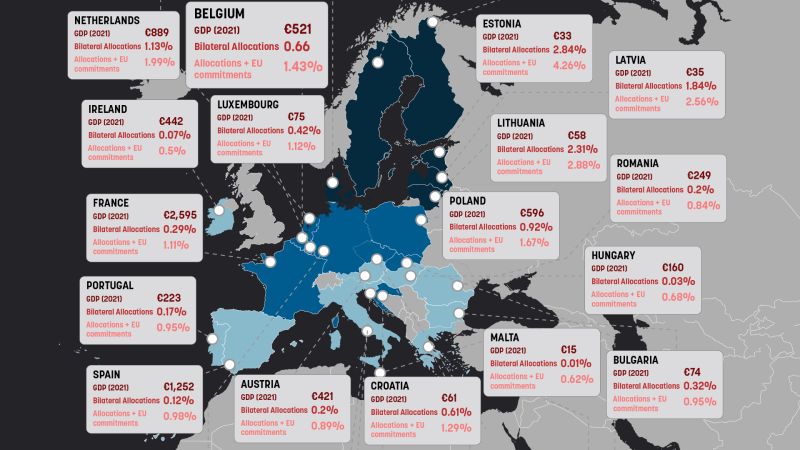
According to rough estimates, Germany alone could be burdened with approximately 700 million euros, corresponding to around 250 euros per resident.
And this comes at a time when German households and industry are already under pressure from high energy costs, inflation, and economic slowdown.
It is worth noting that Czechia, Slovakia, and Hungary categorically refused to participate in the venture.
Their stance underscores that the “European consensus” invoked by Brussels is, in practice, the result of pressure rather than common will, let alone a decision by the peoples of Europe, as the Russophobic stance of the leaderships is not accepted.
Weapons first, state later
The decision on the loan was taken in December at the EU summit and subsequently approved by the European Commission.
What now remains is formal ratification by the European Parliament, a process delayed mainly due to the stance of France.
The reason for the French reservation was revealing, of the 90 billion euros, 60 billion are earmarked for the purchase of weapons and only 30 billion for maintaining the functionality of the Ukrainian state.
The priority is clear, weapons first, state later.
Paris demanded that non EU countries benefiting from arms sales through this loan also participate in the payment of interest.
The relevant amendment was incorporated into the decision, but the reaction of the main interested parties, the United States and Great Britain, remains unknown, and above all negative.
The skepticism is reasonable.
Experience shows that both Washington and London possess the political and economic power to secure their profits while sending the bill to Europe.
The Brussels logic, power through weakening
Critics of the decision point out that European authorities, faced with the dilemma between the prosperity of their citizens and the preservation of Ukraine’s military capacity, chose the latter without hesitation.
And this is not considered an accident or a situational choice.
According to this criticism, the European Commission has no interest in strengthening the member states.
A prosperous state has its own interests and the ability to defend them.
An economically pressured state is more easily manageable.
From this perspective, the greater the cost imposed by Brussels decisions on national economies, the easier they are to enforce.
Dependence on EU funds, subsidies, and regulatory decisions functions as a lever of compliance.
The European Commission possesses powerful pressure tools, it can set the rules of the internal market, influence trade relations with third countries, and create conditions of economic suffocation for any state that deviates from the “line.”
Social tolerance has limits, but they are ignored
A common argument is that citizens will hardly accept new economic burdens, especially in a period of low growth and increasing social pressure.
However, experience shows that European governments can, and often choose to, ignore popular discontent.
The case of France is characteristic.
Mass mobilizations, such as those of the Yellow Vests, were triggered by austerity measures, cuts to social spending, and increases in the cost of living.
Nevertheless, the general political direction did not change substantially.
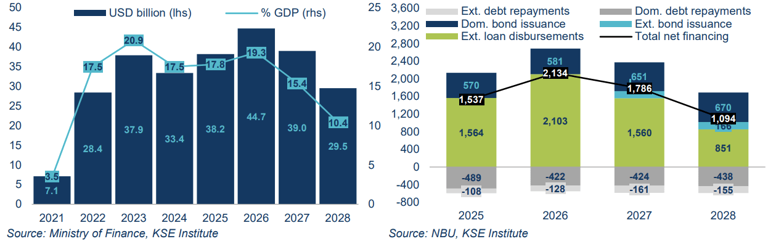
The economy of Ukraine is a black hole for the money of European taxpayers.
Another step of alienation
The loan to Ukraine is not merely an economic decision.
It is another step in the process of alienation of European institutions from the societies they are supposed to represent.
With this choice, Brussels is turning the EU into a mechanism for assuming debt and risk for geopolitical strategies that have not been explicitly approved by citizens.
The political message is clear, the needs and limits of European societies come second.
The question that remains open is not whether this plan is fair or sustainable.
It is how much longer Brussels can load cost, debt, and responsibility onto European citizens without serious political consequences, a moment that many suspect is rapidly approaching.
www.bankingnews.gr










Σχόλια αναγνωστών