

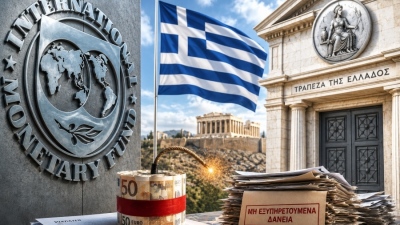
Lower growth, higher inflation, and faster de-escalation of unemployment are forecast for the Greek economy by the International Monetary Fund, highlighting the impact of the energy turmoil on the economic prospects of the country.
On the growth front, the IMF sets the bar at 1.8% both for 2026 and for 2027.
These estimates fall short of the targets set by the government in the draft budget for 2027, forecasting a growth rate of 2% this year and 2.3% next year.
The divergence highlights the risks for the Greek economy from rising energy prices, weakening external demand, and the effects on consumption and tourism.
The biggest «thorn» is found in the path of prices.
The IMF estimates that inflation in Greece will rise to 4.2% in 2026, up from 2.9% in 2025, as energy price increases are gradually passed through to the rest of the economy, burdening businesses and consumers.
For 2027, it expects a de-escalation to 3.6%, without, however, eliminating the pressure on purchasing power.
The economic team remains optimistic
Conversely, the economic team appears more optimistic.
In the draft budget, it projects that national inflation will be limited to 3.8% this year and will recede to 2.6% in 2027.
For the harmonized index, which allows comparisons among the member states of the European Union, the corresponding estimates are 3.6% and 2.4%.
The gap between the forecasts takes on particular importance, as the duration of the energy turmoil will largely determine the path of prices and the scope of additional support measures.
Tomorrow, Wednesday, the government is expected to announce the first package of interventions, featuring subsidies for heating oil and diesel fuel, aiming to curb burdens on households and professionals. The international price of Brent moved yesterday above 106 dollars per barrel, intensifying concerns over new fuel price hikes combined with their secondary impacts across the market.
On the other hand, the IMF appears more optimistic regarding the labor market.
It projects that unemployment will drop to 8% in 2026 and to 7.6% in 2027, compared to 8.4% and 7.9% estimated by the government.
This development, if confirmed, will represent a positive outcome for employment, without, however, automatically offsetting purchasing power losses caused by high prices.
The estimates are presented in the framework of the annual meetings of the IMF and the World Bank in Bangkok, Thailand, from October 12 to October 18. Participating in the proceedings is the Minister of National Economy and Finance and President of the Eurogroup, Kyriakos Pierrakakis, at a juncture when energy security, fiscal resilience, and global growth prospects rank high on the international agenda.
Marios Christodoulou
www.bankingnews.gr







Σχόλια αναγνωστών