

While ND celebrates 52 years since its founding today and prepares for the major anniversary event tomorrow, Monday October 5, the internal party atmosphere in the midst of a pre-electoral year where rally and unity are required, is heavy.
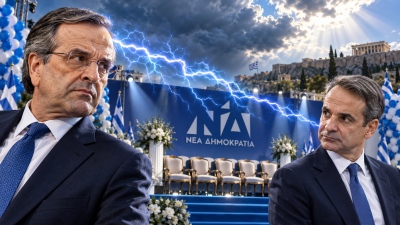
At the anniversary event on Monday October 5 under the blue «torch» at the old OSY depot, ND will experience conspicuous absences, as the distance is not only large, but is not closing, as in the case of Antonis Samaras.
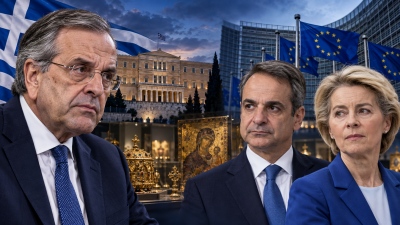
While the Maximos Mansion and Kyriakos Mitsotakis prepare to project a message of unity, keeping an eye on the 2027 elections and the goal of an absolute majority that does not seem achievable, they must confront internal party jabs as well as fierce criticism from Antonis Samaras.
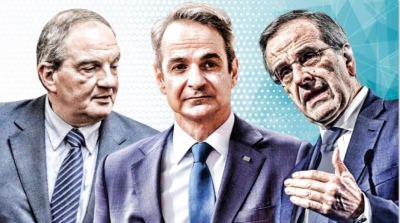
Nevertheless, former and current leaders of ND as well as historic cadres of the governing party have been invited to attend tomorrow's event, yet absences are taken for granted. After all, two former prime ministers (Kostas Karamanlis and Antonis Samaras) were conspicuous by their absence on other occasions as well.
Although the distance maintained by Kostas Karamanlis causes no commotion, the stance of Antonis Samaras and the new party he is preparing causes tremors within ND, as has been shown by the statements made from time to time by blue faction officials and by Kyriakos Mitsotakis himself, who went so far as to gamble on the former prime minister's legacy to preempt developments by hitting the brakes.
In any case, attendees and especially absences from tomorrow's event are awaited with interest, which may be the last for ND as a major party of power, since the next one in October 2027 will take place after the elections.
Samaras a nightmare for Maximos Mansion
Antonis Samaras is planning his next steps and preparing the new party, officially keeping his cards close to his chest.
However, he exercises fierce criticism against the Mitsotakis government, most recently with yesterday's intervention regarding the latest developments around Skopje and the agreement between Greece and Bulgaria concerning historical relics.
His absence from the fiesta for ND's 52 years is certain, as he asserts in every tone that it is a celebration of Mitsotakis's ND.

ND completes 52 years since its founding
New Democracy completes 52 years, and its trajectory nearly coincides with the life of the Third Hellenic Republic.
Three key dates marked its establishment:
September 28, 1974: Konstantinos Karamanlis publicly announces the founding of «New Democracy» and releases the Founding Declaration.
September 29, 1974: The first draft charter of the party is made public.
October 4, 1974: Konstantinos Karamanlis files the declaration establishing New Democracy with the Supreme Civil and Criminal Court of Greece, pursuant to Legislative Decree 59/1974. With this act, the formal founding procedure of the party is concluded.
The text by Konstantinos Karamanlis does not present ND merely as a reconstitution of the old ERE, but refers to a broader post-dictatorship political movement, while its central statement is: «New Democracy is the political movement that identifies the nation with the people, the homeland with its individuals, the State with its citizens, national independence with popular sovereignty, progress with the common good, political freedom with legal order and social justice.» It also notes that New Democracy «ignores the conflicts and divisions of the past» and orients toward «the broadest possible formations of national unity.»
Six historical milestones
1. 1974: New Democracy and the foundation of the Metapolitefsi
ND was founded during the extremely critical juncture of the collapse of the dictatorship and the Cyprus tragedy.
The electoral victory of November 17, 1974, with 54.37% and 220 seats, with complete freedom of participation for all parties (including the KKE), gave Konstantinos Karamanlis the political power to proceed with institutional reconstruction.
The definitive resolution of the regime question through the referendum and the passing of the new Constitution followed.
2. 1979 to 1981: The European choice
The second major turning point was the choice of the European Community.
On May 28, 1979, the Treaty of Accession of Greece to the European Communities was signed, and Greece became the tenth member in 1981.
This choice had been politically spearheaded by Konstantinos Karamanlis and constituted a strategic orientation that transcended the narrow limits of party politics.
3. 1990 to 1993: ND facing economic and European transition
The government of Konstantinos Mitsotakis represents a different type of historical milestone.
ND returned to power in 1990, following an exceptionally turbulent period, with a razor-thin parliamentary majority. The period is associated with fiscal adjustment efforts, privatizations, and structural changes, but also with intense political conflicts, mainly surrounding the Macedonian issue. The government eventually fell in 1993.
4. 2004 to 2009: The «refounding of the state» and multidimensional foreign policy
ND under Kostas Karamanlis won the elections of March 7, 2004, and returned to government after eleven years.
The fundamental political slogan was the «refounding of the state.» During this period, an effort was made toward a more multidimensional foreign and energy policy, with particular emphasis on Greece's role as an energy hub and the strengthening of Greek-Russian relations.
Within the same framework fell the government's stance in Bucharest in 2008, where Greece tied the accession of the then FYROM to NATO to the resolution of the name issue. Concurrently, the Karamanlis government was linked to the completion of major infrastructure projects and the utilization of the legacy of the Athens Olympic Games.
5. 2012: ND forms a coalition government, while Greece's retention in the eurozone and the implementation of agreed economic programs constitute central stakes.
6. 2019: Kyriakos Mitsotakis wins the elections of July 7 with 39.85% and 158 seats, returning ND to single-party governance and projecting state reform, economic growth, and a more technocratic liberalism as central pillars.
The initial period of governance subsequently coincided with the pandemic, Greek-Turkish tensions, and the war in Ukraine, while the second electoral victory of 2023 provided ND with 40.56% and 158 seats.
The ballots
In 1974, the party received 54.37% and 220 seats, the highest percentage ever recorded in parliamentary elections, and formed a single-party government.
In 1977, it remained first with 41.84% and 171 seats.
In 1981, it suffered its first defeat by PASOK (35.88%, 115 seats) and transitioned to the opposition.
In 1985, it lost again to PASOK, with 40.85% and 126 seats.
Two elections took place in 1989. In June, ND finished first with 44.28% and 145 seats, albeit without securing an absolute majority, and in November it was first again, with 46.19% and 148 seats, again lacking a majority. In 1990, led by Konstantinos Mitsotakis, it secured 46.89% and 150 seats, forming a government with a marginal majority. In 1993, it was defeated (39.30%, 111 seats), in 1996 it lost again to PASOK (38.12%, 108 seats), and in 2000 the defeat was razor-thin (42.73%, 125 seats).
In 2004, with Kostas Karamanlis, ND returned to power with 45.36% and 165 seats, and in 2007 it was re-elected with 41.84% and 152 seats.
In 2009, it suffered a heavy defeat (33.47%, 91 seats) amid the atmosphere of the economic crisis.
The crisis era brought three electoral contests within three years.
In May 2012, the party emerged first with only 18.85% and 108 seats, and no government could be formed.
In June, it garnered 29.66% and 129 seats, forming a coalition government under Antonis Samaras.
In January 2015, it lost to SYRIZA (27.81%, 76 seats), and in September of that same year it placed second, with 28.10% and 75 seats, as the official opposition.
In 2019, led by Kyriakos Mitsotakis, ND returned as a single-party government (39.85%, 158 seats).
In May 2023, it came first with 40.79% and 146 seats, without an absolute majority, and in June it won again, with 40.56% and 158 seats.
The leaders
At the helm of the party were: Konstantinos Karamanlis (1974 to 1980), Georgios Rallis (1980 to 1981), Evangelos Averoff (1981 to 1984), Konstantinos Mitsotakis (1984 to 1993), Miltiadis Evert (1993 to 1997), Kostas Karamanlis (1997 to 2009, the longest-serving), Antonis Samaras (2009 to 2015), and, from 2016, Kyriakos Mitsotakis.
In 2015, between Samaras and Mitsotakis, Vangelis Meimarakis and Giannis Plakiotakis served in transitional capacities.
Headquarters on Pireos Street
ONNED and DAP-NDFK were always among the largest youth organizations in the country, supplying the party with personnel. Its historic offices were located for years at the intersection of Emmanouil Benaki and 2-4 Nikitara Streets. For ND, the neoclassical building at 18 Rigillis Street in Athens remained linked to the party's journey for decades, while (following a 5.5-year stay in the building at 340 Syngrou Avenue) the relocation to 62 Pireos Street, in Moschato, marked a more modern era for the apparatus.
www.bankingnews.gr




Σχόλια αναγνωστών