

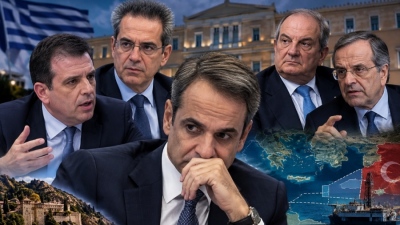
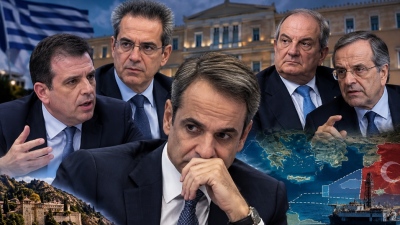
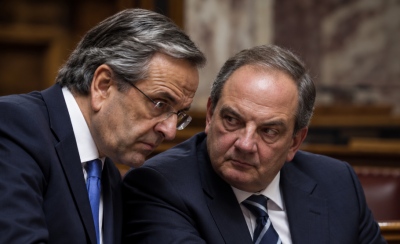
A new focal point of political pressure is taking shape within New Democracy, centered on the government's handling of national issues, particularly developments surrounding the Turkish-Libyan memorandum as well as St. Catherine's Monastery at Mount Sinai. Public statements by Dimitris Kairidis and Angelos Syrigos, two figures with academic and scientific backgrounds in international relations, are putting Megaro Maximou in a difficult position by shifting the discussion from opposition criticism to the interior of the ruling party itself—despite pressure exerted on them by Megaro Maximou to walk back their views. If to these stances one adds those of Kostas Karamanlis and Antonis Samaras, once again Kyriakos Mitsotakis finds himself backed into a corner on foreign policy issues that constitute the strong card of the patriotic wing. The question now is whether these represent isolated interventions or the start of a broader alignment of "blue" MPs seeking to bring back to the forefront a more demanding debate on Greek foreign policy.
Kairidis's message and Syrigos's intervention
Dimitris Kairidis, professor of international relations and ND parliamentary spokesperson, characterized the development involving the ratification of the Turkish-Libyan memorandum by the eastern Libyan side as a "political defeat" for Greece, describing it as an unpleasant turn of events. Simultaneously, he emphasized that the memorandum remains illegal and that Athens needs to face the situation with seriousness, free of party blinders. On his part, Angelos Syrigos had already sparked discussions with his assessment that the Greek side retreated in 2024 at Kassos, during works for the Greece–Cyprus electrical interconnection. His position opened a difficult debate regarding how Athens manages Turkish reactions to projects tied to sovereign rights and maritime zones. These two interventions do not in themselves constitute an organized intra-party rebellion. They carry, however, significant political weight because they originate from ND figures who possess deep knowledge of international balances and can hardly be accused of treating these issues strictly in terms of party confrontation.
Maximou's difficult balancing act
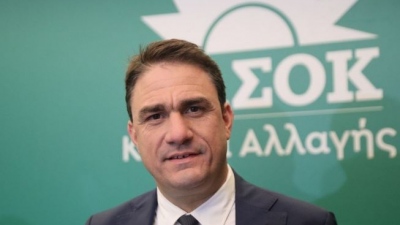
The government is now called upon to balance between two distinct needs: on the one hand, to defend its strategy, and on the other, not to appear as rejecting all criticism, even when it comes from its own cadres. The line taken by government spokesperson Pavlos Marinakis, who reacted to references to a national defeat in an attempt to counter their political exploitation, highlighted precisely this difficulty. However, when similar concerns are voiced by MPs of the ruling majority, a communications response does not necessarily suffice to close the debate. Dimitris Mantzos of PASOK also intervened in the matter, citing the positions of Kairidis, Syrigos, and Dimitris Kalogeropoulos to criticize government handlings. Thus, the statements by "blue" MPs acquired even greater political dimension, transforming into a reference point in the clash over national defense and diplomacy.
Demanding at least proper briefings
The primary interest lies in the potential emergence of a distinct circle of MPs who will demand more information, a clearer strategy, and greater accountability regarding handlings in Greek-Turkish relations and the Eastern Mediterranean. This stems from the fact that they learn most developments either through international agencies or from other countries announcing agreements or intentions of the Greek government on foreign policy issues. For now, there are insufficient indications that these interventions are coordinated within an organized movement against the prime minister. However, convergence on certain findings generates political interest and increases pressure for concrete answers. For Kyriakos Mitsotakis, the critical issue is not whether two or three more critical statements appear. It is whether a consensus begins to solidify within New Democracy that the government strategy on national issues requires re-examination. And that is far more complex than routine intra-party grumbling. Because when doubts are expressed by individuals who know diplomacy well, Maximou is not simply called upon to manage a political disagreement being exploited for circumstantial reasons.
Toothless ultimatums
The worst part for Kyriakos Mitsotakis is that he is now backed into a corner by statements from his own MPs, who are... torching the pivot to the center he is attempting. A series of declarations (most recently by Makarios Lazaridis, Th. Karaoglou, and others) have forced the prime minister's office to demand apologies and reinstate the threat of expulsions for those disrupting the government narrative. Of course, the prime minister remains in a state of hostage, as he does not dare execute party expulsions and contents himself once again with... toothless ultimatums toward dissenters.
Piraiarchis
www.bankingnews.gr

Σχόλια αναγνωστών