

The IDF's nightmare scenario: Powerful earthquake in Israel within the next year — The 10 cities facing destruction
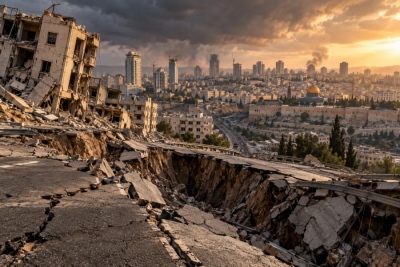
The Israeli military is preparing for the possibility of a powerful, unannounced earthquake that could cause thousands of injuries, hundreds of deaths, and widespread devastation. Which 10 cities are at the epicenter of danger, why older buildings represent a critical factor, and how civil defense guidelines are shifting. Hospitals are also placing themselves on high alert through evacuation and patient transfer drills to outdoor facilities.
Alarm in the Israeli military over potential major earthquake
Beyond security threats emanating from Iran or active war fronts, the Israel Defense Forces (IDF) are bracing for yet another massive challenge: managing a large-scale catastrophe from a powerful earthquake striking a broad region of the country. IDF Chief of Staff Lieutenant General Eyal Zamir has integrated preparations for such a contingency into the military's operational planning for 2027. The decision ties to the fact that the last catastrophic earthquake striking the region occurred in 1927, approximately a century ago. At that time, roughly 300 individuals lost their lives and thousands were injured. The tremor manifested along the Syrian-African Rift, a geological system that includes the Dead Sea fault. According to scientific studies cited in the report, a powerful earthquake tends to manifest in the region roughly every 100 years. However, this specific statistical approach does not allow for the precise prediction of when a seismic tremor will strike.
The 10 Israeli cities located in high-risk zones
Israel has identified 10 cities where the possibility of widespread destruction is considered particularly severe. These include the following cities: Kiryat Shmona Hatzor HaGlilit Rosh Pina Tiberias Safed Afula Migdal HaEmek Beit She'an Arad Eilat These specific cities lie close to the Syrian-African Rift, while several host a high concentration of aging buildings. According to assessments presented in the report, many of these structures may fail to withstand severe tremors, elevating the risk of collapse and resident entrapment. The IDF Home Front Command is preparing for a scenario involving thousands of casualties, alongside severe disruptions to emergency services and health infrastructure.
Civil defense plan undergoes radical shift: Evacuating buildings
Within coming weeks, the Home Front Command is expected to launch a broad informational campaign targeting the Israeli public, aiming to raise awareness regarding seismic risk and appropriate protective measures. The core message is that earthquake guidelines differ radically from missile attack defense protocols. As Israeli authorities emphasize, in the event of an earthquake the primary directive is moving away from buildings and heading toward open spaces whenever it can be done safely. The logic diverges from that applied during missile threats, where citizens are instructed to seek shelter in protected spaces. The awareness campaign will attempt to educate the public on a different behavioral model, as citizens must be capable of identifying which protective measures apply to each specific threat type.
Evacuation drill at Nahariya Hospital
As part of preparations, Wednesday morning marked the first time a hospital in Israel conducted a drill simulating operations during a powerful earthquake. Nahariya Hospital was selected for the exercise due to its proximity to the Lebanese border. The hospital has previously faced missile strikes and maintains established procedures for transferring patients to underground protected areas during emergencies. Nevertheless, the earthquake scenario demands a different approach. During the exercise, an earthquake warning was triggered, and hospital teams were ordered to move patients outside the building into temporary treatment setups and tents erected in the parking lot. The drill aimed to evaluate the hospital's capacity to continue delivering healthcare services even if the main building becomes unusable.
All hospitals on standby - Plan for transferring patients outdoors
Over recent days, the IDF and the Israeli Ministry of Health have activated emergency procedures to address a major earthquake across all national medical facilities. Within this framework, a series of drills has been scheduled to test hospital evacuation protocols and the transfer of patients to suitable outdoor areas. These facilities may incorporate parking structures, tennis courts, and other athletic grounds, depending on the capabilities and needs of each hospital. The critical objective is ensuring health units can receive and treat a high volume of casualties, even if their standard physical infrastructure suffers severe damage. The drill at Nahariya Hospital was coordinated by Colonel Paz Gedia, commander of the Home Front Command's Northern District. It was observed by Home Front Command chief Major General Shai Klapper alongside senior Ministry of Health officials.
Paz Gedia: Hospitals must function even during a crisis
Colonel Paz Gedia underscored that preparation is not limited to the initial evacuation of buildings and patient transfer. "The hospital must know how to operate while the earthquake is actively unfolding. It is not just about the initial response and removing people," he stated specifically. As he explained, comparable preparations for such a scenario have not been undertaken in recent years, rendering the new procedure a significant challenge for emergency services. "We are now entering a period where we are preparing for the contingency of an earthquake. This is a national benchmark scenario for which the Defense Minister has designated readiness as a priority," he noted. Addressing the assessment that a major earthquake can occur roughly once every 100 years, he clarified that determining the exact timing remains impossible. Simultaneously, he pointed out that once seismic activity begins, damage assessment will enable authorities to tailor their response to real-world data.
Thousands of injured and hundreds dead in northern Israel
Paz Gedia estimated that the northern region of Israel could confront thousands of injured and trapped individuals, while the death toll might rise into the hundreds. "We are talking about thousands of people. It does not mean everyone will be dead. I estimate we could have hundreds dead, but thousands trapped," he reported. He added that such a catastrophe could deal a severe blow to the continuity of critical services and, above all, the capacity of hospitals to continue treating patients. Asked whether the earthquake threat outweighs the threat of missile attacks from Iran, he responded that both risks must be addressed concurrently. The primary difference, as he explained, is that Israel's civil defense mechanism has accumulated substantial experience handling missile strikes, whereas preparing for a major earthquake demands distinct procedures and novel drills. He noted that following the drill he would visit the Golan region to discuss required countermeasures with local services.
National awareness campaign - Citizens must know when to evacuate buildings
The Home Front Command plans to intensify public education regarding earthquake safety protocols. According to Paz Gedia, the campaign will launch with particular intensity starting in January, ensuring citizens familiarize themselves with the distinct response required compared to other security threats. He compared the need for awareness to educating citizens on avoiding unexploded ordnance. As he explained, Israel must prepare the public for diverse emergency scenarios demanding disparate reactions. In the region of Judea and Samaria, for instance, citizens are trained to apply lockdown and shelter-in-place procedures during armed infiltration risks. Similarly, under drone threats, guidelines may dictate remaining in protected or designated spaces depending on conditions. During an earthquake, however, the primary protective measure shifts: citizens are instructed to head toward open areas if they can do so safely. Paz Gedia stressed that remaining inside high-rise buildings during a powerful tremor represents an exceptionally dangerous choice and underscored the importance of proper public education.
The hospital challenge: Evacuation, medical tents, and operational continuity
National preparation incorporates a specialized program for hospitals executed under the responsibility of the Ministry of Health in cooperation with the IDF. As Paz Gedia explained, the Nahariya drill represents the first in a series of similar tests scheduled across the country's medical facilities.
The core priorities are threefold:
The rapid removal of patients from buildings to the extent demanded by conditions. The deployment of outdoor treatment units utilizing tents and temporary facilities in parking lots or other suitable areas. The preservation of hospital operations to ensure medical services continue outside main structural facilities. Transferring patients and personnel alongside clearing a high volume of vehicles from hospital grounds present supplementary operational hurdles. "Each hospital faces its own unique challenge. There are facilities where patient transfers to nearby locations are planned. Without a doubt, managing the population is difficult. Many vehicles will need to be cleared, and that proves more complex than managing a missile strike from Iran," the colonel noted.
Arad in focus - New areas added to risk scenario
The Northern District commander also pointed out that planning now includes cities facing elevated vulnerability. Among them, he cited Arad, alongside northern areas such as Hatzor HaGlilit, Safed, and Rosh Pina. According to him, assessments rest on available statistical data and seismic hazard projections for these specific regions. Nonetheless, he underscored that precise earthquake forecasting remains scientifically unachievable. Authorities must therefore design responses to an extreme event without knowing either its exact timing or the extent of destruction it will unleash.
Without substantive warning - The tremor can last up to a minute
One of the most significant challenges evaluated by Israeli authorities is the absence of adequate prior warning before a powerful earthquake. According to Paz Gedia, the duration of the initial shaking may prove very brief, up to roughly one minute, severely constricting available reaction time. "The duration will be very short, at most a minute. There will not be much time," he reported. He added that following the initial tremor, data evaluation and impact forecasting will be possible, though uncertainty and risk will persist. Particular significance is attached to aftershocks, which can continue for extended periods following the primary shock. He referenced experiences from a mission to Venezuela and the earthquake in Panama, noting that in the latter case aftershocks persisted for a prolonged duration. This experience, he noted, reinforces the necessity of planning not only for the initial minutes of disaster but also for managing the ensuing period.
Lessons from October 7 and the need for true readiness
Paz Gedia linked earthquake preparations to broader lessons derived from past security crises in Israel. As he stated, authorities must prepare seriously even for scenarios previously deemed unlikely. He invoked the October 7 attack as an example of why extreme risks must never be underestimated and why concrete response plans must be formulated in advance. Preparing for a major earthquake, in his view, must form an essential component of national emergency policy rather than remaining a theoretical exercise on paper.
How many buildings might collapse? "Many," warns the Israeli military
Asked how many structures could collapse under such a scenario, Paz Gedia replied that the figure could prove substantial. Particular concern surrounds the condition of aging structures, especially in areas where buildings lack modern anti-seismic engineering. As a characteristic example, he cited Mazra'a, a small Muslim village, estimating several residences there might fail to withstand a powerful tremor. As he clarified, a written national benchmark scenario already exists, incorporating projections for the number of collapsing buildings, fatalities, and individuals trapped in rubble. The ultimate goal, as he emphasized, is singular: saving as many human lives as possible.
The critical question for Israel
IDF preparations for 2027 reflect the determination of Israeli authorities to confront a major natural disaster alongside ongoing security threats. The primary challenge encompasses not only seismic hazard but also the capacity of cities, hospitals, and emergency services to maintain operations when infrastructure faces concurrent strain. Projections forecasting thousands of injured, hundreds of dead, and widespread collapses form the baseline scenario guiding exercises and civil defense measures. Yet despite reports of a potential earthquake within the next year, exact chronological forecasting of such phenomena remains scientifically impossible. The emphasis of Israeli authorities consequently rests on readiness, public awareness, and immediate reaction capability when tremors strike.
www.bankingnews.gr













Σχόλια αναγνωστών