

A geopolitical «domino effect» is triggered by the Mecca Agreement, signed on August 7 between Turkey, Saudi Arabia, and Pakistan. This is because it is not merely an agreement confined to three nations, but one establishing a new equation that causes concern in India, carrying ramifications that could extend far beyond the Gulf.
The core clause of the treaty leaves no room for misinterpretation... An armed attack against any of the three states will be considered an attack against all. The challenging aspect, however, lies in executing this clause, as a series of questions arise:
Who decides that an attack has taken place?
Who determines who the aggressor was?
What happens if Pakistan initiates a crisis and India responds militarily?
Can the Indian response be classified as an «attack» that activates the mutual defense pact?
The new equation worrying New Delhi
As is widely known, Pakistan constitutes India's primary adversary, while Turkey has developed an exceptionally close strategic and defense relationship with Islamabad in recent years. With the Mecca Agreement, this relationship now acquires a Saudi dimension as well.
Riyadh did not merely gain another security partner. It integrated Pakistan into its own security commitments, creating a situation where a new India–Pakistan crisis could carry direct consequences for Saudi Arabia. This forces New Delhi to scrutinize not only the direct military balance with Pakistan, but also the broader regional environment.
However, India does not need to respond with a rupture. It can execute a far more effective strategy by downgrading the value of any specific hub that could be leveraged as a point of pressure against it.
India's strategy
The core premise of the new blueprint is that strategic autonomy does not mean isolation, but rather the preservation of alternatives.
India can maintain its ties with Saudi Arabia while simultaneously increasing its alternative pathways across energy, trade, finance, infrastructure, security, and access to Europe. In this context, New Delhi can apply toward Riyadh the exact same logic that Riyadh applies toward its own partners: more providers, more options, and reduced dependence on a single player.
The most telling formulation of this strategy is that Saudi Arabia must function as a transit route, not a veto point. And here, the matter takes on a European dimension.
IMEC at the epicenter
The India–Middle East–Europe Economic Corridor (IMEC) is not simply a trade route. For India, it represents a long-term strategic investment in connectivity with Europe. For this reason, dependence on a single bottleneck is viewed as an acute vulnerability.
The strategic proposal aims to endow the corridor with redundancy, providing alternative choices in ports, insurance, financing, logistics, and European access points, alongside data infrastructure and operational continuity plans. The objective is to ensure no single state can convert its geography into veto power. This is precisely where Greece enters the framework.
From the Indian Ocean to Greece
India intends to establish a network spanning from the Indian Ocean and the Gulf all the way to Europe and the Eastern Mediterranean. This network incorporates diverse partners serving distinct functions:
The United Arab Emirates provides energy, industrial, financial, and defense cooperation.
Oman offers maritime access to the Indian Ocean, commercial facilities, and energy storage potential.
Israel provides technology, intelligence, defense integration, and access to the Eastern Mediterranean.
Cyprus has embedded defense collaboration with India into a five-year bilateral roadmap.
Greece is deepening strategic and naval cooperation with New Delhi, serving as a critical European gateway in discussions surrounding IMEC.
Together, these partnerships form an «arc of alternatives» stretching from the Indian Ocean to the Eastern Mediterranean.
The next arena… energy diversification
However, India is not limiting its diversification to physical trade routes; it is also shifting its energy dependencies.
During fiscal year 2025–26, India imported approximately $30.8 billion worth of goods from Saudi Arabia, while exporting about $10.3 billion to the kingdom. Riyadh consequently occupies a prominent position in the Indian economy.
Yet India's rationale is not to abandon the Saudi market or its oil, but to generate competition.
In May 2026, the United Arab Emirates surpassed Saudi Arabia to become India's second-largest crude oil supplier, as New Delhi and Abu Dhabi deepened cooperation across energy sectors and strategic petroleum reserves. Consequently, India does not need to cut off Saudi Arabia; it can simply require it to compete for its share of the Indian energy market.
Applying the same model to capital investments
A similar approach applies to investment frameworks. India has already granted regulatory concessions to the Saudi Public Investment Fund (PIF), while talks continue regarding a modernized bilateral investment protection pact. Nevertheless, New Delhi can calibrate the speed and scope of access it grants to strategic initiatives, investment portfolios, and regulatory corridors.
Access to the vast Indian domestic market is not an entitlement; it is India's sovereign strategic asset, and its value will increasingly correlate with how predictable and reliable each partner proves to be.
Pakistan converts military footprint into strategic leverage
Concurrently, Pakistan has managed to turn its military relevance into long-term strategic capital.
Defense financing, joint procurement initiatives, military training, troop deployments, and institutional access secure Pakistan an enduring foothold in Gulf security architecture. Furthermore, Pakistan is a nuclear-armed power.
While the Mecca Agreement does not formally grant Saudi Arabia access to a Pakistani nuclear umbrella, the strategic ambiguity surrounding it adds political leverage to their alliance. This dynamic is precisely what India intends to counterbalance.
The UAE - Oman - Israel - Cyprus - Greece axis
Consequently, India's counter-strategy is multi-tiered.
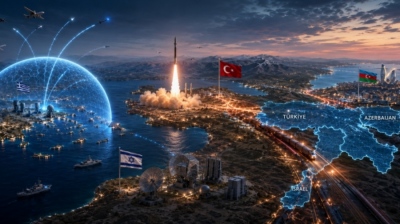
The UAE serves as an energy and capital hub; Oman acts as the maritime gateway to the Indian Ocean; Israel supplies high-end technology and defense cooperation with Mediterranean access; Cyprus functions as an EU outpost with growing security ties to New Delhi; and Greece operates as a central maritime, logistics, and European anchor.
Simultaneously, India sustains its robust relationship with the United States while continuing to balance between Washington and Moscow, preserving its strategic autonomy without compromise.
The… trap for Greece
Every coin, however, has two sides, and India's strategy presents a double-edged reality for Greece:
The upside: The more India seeks alternative pathways into the European Single Market, the greater Greece's geopolitical and economic value becomes. Athens can capture significant weight across shipping, logistics, energy, foreign direct investment, and critical infrastructure.
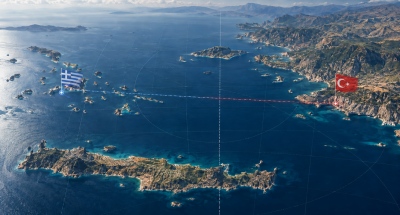
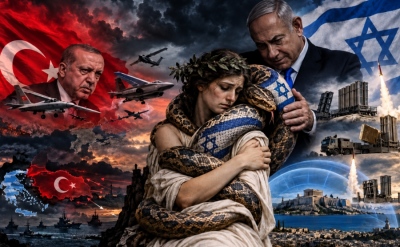
The risk: As Greece emerges as an indispensable node in India's grand strategy, it is inevitably drawn into a larger, more volatile geopolitical matrix. The India–Pakistan rivalry is no longer confined to South Asia. Turkey has coupled its strategic ambitions with Pakistan and now participates alongside it in the new mutual defense architecture with Saudi Arabia. As India establishes counterbalancing corridors reaching the Eastern Mediterranean, both Greece and Cyprus find themselves squarely on the frontline of overlapping regional rivalries, facing heightened systemic pressure.
www.bankingnews.gr








Σχόλια αναγνωστών