

The global economy seems to be on a tightrope. While financial markets are reaching historical highs and investors continue their frenzied race towards artificial intelligence (AI), the Bank of Russia abruptly pulls the "handbrake" on optimism.
In one of its most alarming warning messages in recent years, it speaks of a potential global financial crisis equivalent to—if not greater than—that of 2007-2008, implying that the international system is already on the brink of new, uncharted chaos.
This warning is not merely a theoretical fear. It is recorded dramatically in the draft "Main Directions for the Development of the Russian Financial Market," where the Central Bank characterizes the scenario as "dangerous" and "possible" if current trends escalate.
The Bank of Russia warns of a crisis of 2008 magnitude
According to the Russian document, in a scenario of extreme developments:
-
global economic growth could be zeroed out,
-
high interest rates and "accumulated imbalances" threaten the stability of the financial system,
-
and the era of globalization "has ended," leaving behind a world fractured into competing blocs.
The Central Bank points out that the gradual collapse of the unified international economic space leads to a conflict-ridden planet, where competition prevails over cooperation—a condition that, historically, portends crises.
"The era of globalization, based on the division of labor and broad cooperation, is giving way to a period where countries are increasingly focusing on issues of competition and restricting competitors' access to their economies and technologies. Instead of a unified, interconnected space, regional blocs are emerging, and the world is becoming increasingly fragmented," the Central Bank explains.
If the worst-case scenario materializes, the crisis could be comparable to the events of 2008, including a deep recession, a fall in oil prices, and a stock market collapse. Countries that could be severely affected by the global crisis include the United States and the Eurozone.
The situation in American finance largely determines global financial markets. Meanwhile, analysts at the US banking group Goldman Sachs Group predict that the US stock market, which has outperformed the rest of the world in growth for many years, will fall to last place in the coming years.
The bubble will burst
Goldman Sachs recently published its forecast for annual stock market returns globally. Analysts predict that the US market will yield 6.5% annually over the next decade, the worst in the world.
A team of Goldman Sachs analysts led by Peter Oppenheimer stated that the value of US stocks is overpriced, which makes their fall inevitable.
For his part, Rockefeller Capital President Ruchir Sharma believes that the US stock market will collapse as early as 2026, as investors begin to "punish the US for its rising debt problems."
In a Financial Times article, the Rockefeller Capital president stated that the US stock market could soon underperform its global counterparts, breaking a long-standing trend of outperformance by the American market.
He estimates that top US stocks could underperform the global market by about 10% next year, representing a much worse performance than in 2024, when top US stocks surpassed the market by about 20%.
More than half of global investors surveyed by Bank of America said that the years of outperformance for US stocks are coming to an end, with the majority of respondents believing that international stocks will outperform in the coming years.
Meanwhile, the total capitalization of global stock markets has approached $150 trillion, a historic high. It is rising despite obvious geopolitical turmoil and the US trade war with the rest of the world. Stock markets are experiencing record growth everywhere: in Germany, Poland, South Korea, and Brazil. One of the key markets where investors are pouring money is artificial intelligence, and analysts estimate that this investment cycle is unprecedented. Investors are chasing quick profits: artificial intelligence is currently on the rise, which means there is potential for profit—even if short-term and speculative. But are the companies betting on artificial intelligence capable of generating profits? This is highly questionable.
Most of the growth in the S&P 500 is due to artificial intelligence companies. The increasing dominance of AI-based companies means that a shrinking circle of tech giants now represents the lion's share of most investors' portfolios.

The data speaks
According to JPMorgan, only 41 AI-related stocks—about 8% of the index—now account for a record 47% of the S&P 500's total market capitalization. By comparison, the remaining 459 stocks, representing 92% of the index, account for only 53% of its market capitalization.
According to JPMorgan, the AI-related group includes 29 large companies, such as Nvidia (NVDA), Microsoft (MSFT), Apple (AAPL), Alphabet (GOOGL), and Amazon (AMZN).
"47% of the index's capitalization is concentrated in one theme: artificial intelligence," notes financial analyst Jim Bianco. "This is unique and represents the most significant concentration around a single theme in history."
At the same time, many AI companies are unprofitable.
The S&P 500 is a stock market index consisting of a basket of 500 selected listed companies with the largest market capitalizations.
According to the Conference Board, 72% of S&P 500 companies cited artificial intelligence as a significant risk in 2025, a large increase compared to previous years. This shift reflects AI's transition from the experimentation stage to widespread adoption.
Companies are primarily concerned about reputational risks (38%), implementation and adoption risks, risks in interacting with consumers, as well as cyber threats related to artificial intelligence.
China secretly buys gold
Many companies also cite risks of non-compliance with AI regulations, particularly EU legislation. The global race for AI dominance is accelerating and requires enormous amounts of data, energy, and capital. However, profits remain low, and some economists warn of a bubble.
Andy Wu, an associate professor at Harvard Business School, notes that generative artificial intelligence has high costs and low returns. He predicts a potential crisis in the coming years, as many companies are sustaining huge losses and are dependent on continuous funding.
Goldman Sachs analysts warn that the market hype around artificial intelligence may resemble the dot-com bubble. That bubble burst in 2002, with stocks crashing by up to 77%. Wilson and Chang identify warning signs: peaking investment spending, decreasing profits, increasing corporate debt, low interest rates, and widening credit spreads.
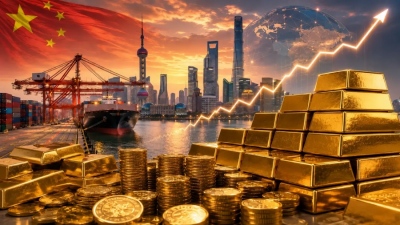
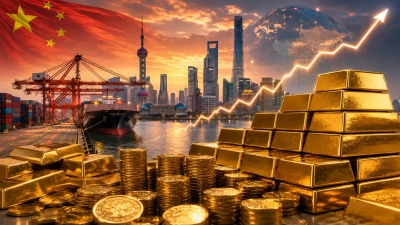
Another indicator of global market instability is the secret, large-scale purchase of gold by China. Actual purchases may be over ten times higher than official figures. This move is an effort toward de-dollarization. Analysts at Société Générale estimate that China's total gold purchases this year could reach 250 tons. Other experts estimate that Chinese reserves may be approaching 5,000 tons.
Gold prices are already at historic highs, having reached $4,180.3 per ounce in November.
Other central banks are also buying gold. 39 tons of purchases were recorded in September, 79% more than in August. The magazine The Economist writes that a possible collapse of the technology market in the US may be one of the most predictable crashes in history, with investors and bankers having already warned of excessive valuations. Financial blogger Michael Snyder notes that the "largest debt hole in human history" inevitably leads to a crisis.
Adding the rapidly growing artificial intelligence bubble to the $36 trillion US debt would create a "grim" situation for America and the dollar-based global financial system. It is difficult to predict when the crisis will erupt, but many agree that the path towards it has been shaped by American technological excess and Washington's trade wars.
www.bankingnews.gr








Σχόλια αναγνωστών