

Energy shock transferred to agricultural production
The S&P Global report emphasizes that international food prices are affected through two primary channels: on the one hand, more expensive diesel increases production costs for farmers, and, on the other hand, heightened demand for biofuels can lead to shifting arable land away from food production toward biofuel feedstock production. This development further burdens an already strained environment for global agriculture, as producers are called upon to manage higher operating expenses while uncertainties regarding the adequacy and cost of essential inputs intensify. The problem becomes even more pronounced due to disruptions in international fertilizer supply chains, which depend heavily on energy flows and transport through the Persian Gulf.
The Strait of Hormuz at the epicenter of the fertilizer crisis
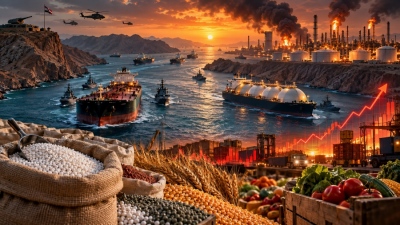
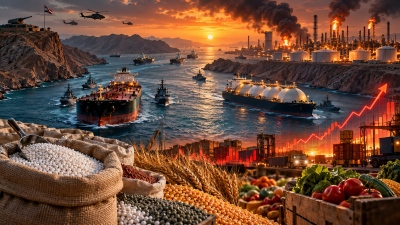
Prior to the commencement of the military operation by the US and Israel in Iran in February 2026, approximately half of global raw material exports for fertilizer production transited through the Strait of Hormuz. This constitutes a maritime passage of strategic significance upon which a substantial portion of global energy and chemical product trade used in agricultural production depends. Urea, ammonia, sulfur, hydrogen, natural gas, and nitrogen represent critical raw materials for nitrogenous fertilizer production, which are essential for maintaining the productivity of modern agri-food systems.
Dependence is particularly acute for staple crops, such as corn, wheat, and rice, which are cultivated largely through intensive, monoculture systems requiring chemical fertilizers to meet production needs. This means any severe disruption in global fertilizer supply chains can jeopardize roughly half the calories consumed by the global population. Following the closure of the Strait of Hormuz to nearly all maritime traffic on February 28, fertilizer prices surged, quickly reaching levels nearly double previous rates.
Warning for 45 million additional people in hunger conditions
In April, Jorge Moreira da Silva, a representative of the United Nations, warned that the disruption in the operation of the Strait of Hormuz could drive an additional 45 million people into hunger and famine. Six months later, the risk remains, despite the fact that the maritime route is no longer under a status of complete standstill.
Control of this critical passage continues to form the subject of intense confrontation, while violence and navigation disruptions tend to entrench themselves as a new, highly dangerous normality for global trade. Even if the US and Iranmanage to preserve their particularly fragile agreements, restoring fertilizer production will not prove immediate. As news outlet Semafor points out, fertilizer companies will have to await the increase of natural gas production in the Persian Gulf to restore supplies of necessary raw materials. This process may last months or even years. This development demonstrates that even a potential de-escalation of geopolitical tension will not automatically lead to market normalization, as damage to production and supply chains requires time to repair.
IMF: 10% increase in fertilizer prices by end of 2026
The impacts of the energy crisis are expected to be clearly reflected in fertilizer prices and, subsequently, in food costs.According to projections by the International Monetary Fund (IMF), as presented in the World Economic Outlook report,fertilizer prices are expected to rise by a total of 10% by the end of 2026. This increase is estimated to contribute to a 5% rise in food costs in 2026, while an additional 2.4% increase is forecast for 2027. The severity of the impacts, however,will vary depending on the region.
Pressures are not limited solely to the cost of agricultural inputs. More expensive energy increases cultivation, transport,and processing costs for products, while pricier fertilization can burden production and bolster inflationary pressures on food. The result is a vicious cycle: geopolitical turmoil increases energy and fertilizer costs, higher prices burden agricultural production, and passing costs onto consumers further restricts access to basic nutritional goods.
Poorest countries at the epicenter of impacts
As typically occurs during periods of sharp food price increases, poorest countries are expected to sustain the heaviest blow. S&P Global warns that the combination of higher energy and fertilizer costs, strong demand linked to biofuels, and weather risks from El Niño intensifies pressures on food prices and, ultimately, on global food security. Particularly exposed are low-income countries, where food expenditures account for approximately 50% of total household consumption spending.
In these economies, even relatively limited price increases in basic commodities can yield disproportionately large social consequences, as households possess limited margin for adjustment and lesser capacity to absorb price hikes. The burden on low-income consumers risks turning price inflation into a deeper cost-of-living crisis, reinforcing food insecurity and widening social inequalities.
The risk of social unrest and new conflicts
S&P Global does not consider the outbreak of a global food crisis a given. However, it underscores that pressures on consumers possessing limited financial capacity are already visible, with potentially severe consequences for poorer populations. If a significant portion of the global population is unable to cover basic nutritional needs, economic impacts can translate into political instability, social unrest, and new conflicts. Historically, sudden shocks in food prices and inflation in staple food items have constituted major factors fueling social tensions. Many analysts consider, for example,that the rise in food costs across the Middle East and North Africa region contributed decisively to shaping the conditions that led to the Arab Spring.
In an already highly unstable geopolitical environment, accelerating food inflation and rising hunger could operate as additional destabilizing factors, heightening the risk of conflicts and social explosions in coming months. The core conclusion of S&P Global is that the energy crisis is no longer confined to oil and natural gas markets. Through fertilizers,production costs, and staple food prices, it threatens to transfer into the daily lives of billions of people, with the most vulnerable economies standing on the frontline of impacts.
www.bankingnews.gr






Σχόλια αναγνωστών