

Developments on the geopolitical stage are truly explosive, and perhaps more dangerous than ever.
The launch of the American Minuteman III missile provoked fury in Russia and led to the command to immediately begin nuclear tests. This development threatens to overturn a decades-long balance of power and security, and open the door to a new nuclear arms race.
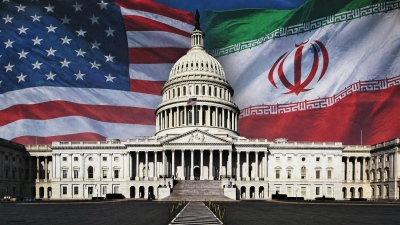
And while, given these facts, the war in Ukraine remains an "open wound," the US is one step away from a military intervention in Venezuela, with which they want to rewrite the global map. With this move, Trump aims for strategic gains, not only regarding control of oil, but also in exerting geopolitical pressure on Russia, China, and Iran who support the Maduro regime.
Analysts even underscore that the US wants to establish its dominance and monopoly in the broader American region, noting that the Americans want two new States: Cuba and Venezuela.
It is obvious that a Great Strategic Game is underway, with the two nuclear superpowers treading and pushing the world onto dangerous paths where the future is becoming wilder and more unknown than ever.
Trump's gift
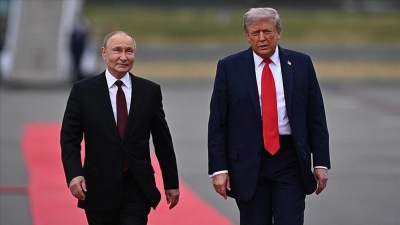
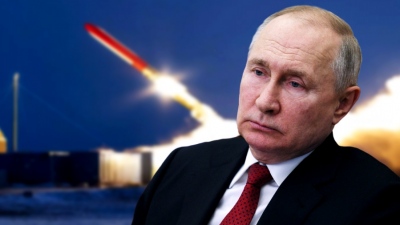
President Vladimir Putin, after the meeting of the Russian Security Council, tasked the examination of the possibility of resuming nuclear tests. For this decision, Russia must thank the President of the United States of America.
The Russian president would never have raised the issue of resuming nuclear tests if Donald Trump had not raised it first. Following the American president's order to the Pentagon to begin preparations for new nuclear tests, Moscow can proceed with corresponding actions without running serious diplomatic risks.
The owner of the White House offered Russia a great service.
And the reason is explained.

The only barrier
The fact is that the controversial strategic balance of power between Russia and the US, thanks to which Russia has not been bombed to date by all NATO air forces, only holds true in one area: the nuclear arsenal.
In the remaining sectors, Russia lags far behind NATO. The total size of the economies, the population (i.e., the recruitment resource), the number of conventional weapons—in all of these, the US and EU countries surpass Russia by a multiple factor.
The West is superior but...
The hawks of the West love to emphasize these facts when demanding that their governments take radical anti-Russian measures. In this context, they point out:
- In NATO as a whole, the military budget of the US alone is 16 times larger than the Russian one.
- In Europe, there are half a billion people, and we are afraid to force Russia to comply using only conventional weapons?
This argument is refuted by one small, but significant point: the nuclear arsenal. Yes, in the number of tanks, aircraft carriers, and soldiers, the West greatly exceeds Russia.
The alternatives
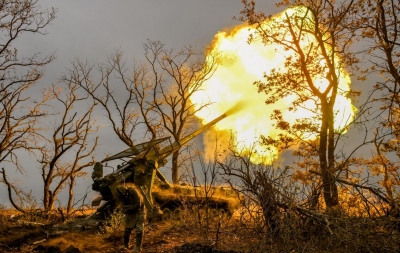
But how will they force the Russians to fight only with conventional weapons in the event of war? They cannot do it. This is why the Americans and Europeans have been forced in recent years to turn to alternative methods, trying to deter Russia from actual conflict. These efforts include the thousands of sanctions and the proxy war in Ukraine.

The response with Oreshnik, Burevestnik
That is why Russia responded to the full militarization of NATO by developing the Oreshnik, Burevestnik, and other potential nuclear warhead delivery vehicles, avoiding entering an arms race that could exhaust its economy, as happened with the Soviet Union.
That is why the northwestern sector of Russia remains safe to this day, even though, if they wished, they could attempt to seize Saint Petersburg or Kaliningrad from neighboring NATO countries. This desire may exist in NATO, but the capabilities do not. Because Russia has nuclear weapons, and the possibility of their use cannot be ignored.
The dangerous myth
Those who favor a direct conflict with Russia have only one way out to insist on their view: to promote the myth that Moscow does not possess nuclear weapons. The Soviet Union once did, but now only rusted ruins of these weapons remain somewhere in Siberia. They say that this "junk" no longer explodes or launches. Thus, there is no need to fear Putin, who is "barking with his nukes." We must prepare for a war with conventional weapons, in which our allies are not seriously at risk.
The card of nuclear tests
Why this certainty that the USSR had nuclear bombs? Because the Soviet Union carried out nuclear tests.
From this comes the delusion that Moscow has nothing left from that era: the fact that modern Russia does not conduct nuclear tests. And it runs the risk, in a few years, by proving its peaceful intentions, of finding itself with a war in the Baltic.
Russia now must, and it is imperative to prevent a World War III, show that it still has nuclear weapons. The only thing that has held it back until now is the fear that, if it violates the test ban, it will be held responsible for starting World War III.
But if Donald Trump lifts the ban, he will offer Russia a great diplomatic service that could lead the Kremlin to even honor him with the Order of Friendship.
Trump's plan
And while the Russians may speak sarcastically and ironically about Trump's gift, the American president has his own ambitious plans. Which Moscow can in no way ignore, if it does not want to lose the game on the critical geopolitical chessboard.
All the American president's promises regarding the acceleration of the end of the Ukrainian crisis remained in the realm of theory, but the intense activity of the White House shows no intention of calming down. Following several vague statements by Donald Trump, according to which there is the wrong leader and a general lack of democracy in Venezuela, American media outlets appear to be competing with each other in the intensity and interpretation of various scenarios.
The New York Times reports that Trump's military advisors have developed and submitted several options for offensive operations, which include strikes against Venezuelan military bases, the president's personal security, the seizure and control of key oil fields, while the possibility of the physical elimination of Nicolás Maduro is also being considered.

There is no decision yet
Sources close to the publication state that Trump has not yet made a final decision, fearing damage to his reputation in the event of failure.
Furthermore, consultation with Congress for a foreign military operation is difficult, since the Republicans have a marginal majority of just six votes against the Democrats, who may not easily accept the idea of military intervention.
According to the report, the "hawks" in the American president's circle may resort to a clever solution. They may declare either Maduro himself or members of his personal guard as members of the Venezuelan drug cartel "Cartel de los Soles," which would allow them to eliminate them, despite the fact that the assassination of political leaders is prohibited by Executive Order 11905, signed in 1976 by President Gerald Ford. Later, this law was amended twice by Presidents Jimmy Carter and Ronald Reagan. However, Bill Clinton found a workaround, simply placing unwanted leaders on a list of "particularly dangerous to the US."
Double significance
Foreign Policy took the baton, with its writers, one of whom is a Professor of Public Administration at the American University, arguing that this entire situation has double significance.
In their view, military intervention in Venezuela would allow not only the removal of the undesirable Maduro, who openly collaborates with Russia, Iran, and China, but also the cutting off of the oil flow from Venezuela to Cuba, which would lead to the fall of the Cuban government as well.
It is noteworthy that these assessments, although striking, are based on logic and the realities of the American continent, which Washington considers its exclusive zone of influence and interests.
Let's start with the end.
What is happening with Cuba
The situation with Cuba is not as simple as it initially appears. Indeed, oil plays a central role in the island's economy and energy. In the energy balance, oil and petroleum products account for 84.3% of consumption, of which 90% is used for electricity generation, as local energy production is relatively old. The remaining 9% is covered by natural gas, while Havana wishes to increase the share of Renewable Energy Sources (RES) to 24% by 2030.
The import of oil from Venezuela was for many years the pillar of strong economic balance for Cuba.

Thousands of barrels as a donation
According to Western sources, in 2020, Venezuela supplied Cuba with about 80,000 barrels of crude oil per day, of which 20-25 thousand were given free of charge as fraternal aid. It is estimated that in the last five years alone, the Maduro government has offered Havana between 6 and 8 billion dollars.
However, since the imposition of US sanctions, supplies have dropped to 11,000 barrels per day, with an increase in suppliers from Russia. Cuba produces about 50,000 barrels per day, and here is the interesting part. Three rich oil regions had been discovered by the end of the 19th century and until the mid-20th century, with American companies Atlantic Refining, Standard Oil, and Union Oil exploiting the reserves in the area with great profitability. After the overthrow of the Batista regime, all the wealth was nationalized, and today companies such as China's CNPC, Malaysia's Petronas, PetroVietnam, and Venezuela's PDVSA cooperate in Cuba, while the Americans remain outside.
Venezuelan oil to China
As for Venezuela, US sanctions have caused serious damage to its oil industry. In 2015, the state company PDVSAexported 1.9 million barrels per day, while in 2022, this number collapsed to 438,000. However, in 2025, it rose again to 800,000 barrels.
The most irritating fact for Washington is that 8 out of 10 barrels of Venezuelan oil end up in China. In October alone, 34 tankers sailed from South America to Asia, while the Americans, without publicizing it, bought over 120,000 barrels through Chevron—with the sanctions apparently not applying in this case.

The deposits and Mount Rushmore
On the political level, neighboring communist Cuba and oil-rich Venezuela (with 300 billion barrels, or 17% of global reserves) constitute particularly attractive targets.
If oil supplies from Venezuela are cut off, the regime of Castro's descendants in Cuba could be indirectly overthrown. Controlling the deposits in the Varadero area of Cuba and the Orinoco belt in Venezuela could create a real monopolyin the global oil market.
Finally, let us not forget that on the emblematic Mount Rushmore, the Americans have carved the faces of four US presidents . It is said that they were chosen because of their contribution to US history, but one thing unites them all: they increased the country's territory. For example, under Thomas Jefferson, huge tracts of land were bought in the middle of the continent, corresponding to almost 1/3 of the country's current area (the "Louisiana Purchase"). Under Theodore Roosevelt, the Panama Canal was built, and Panama essentially became a US dependency.
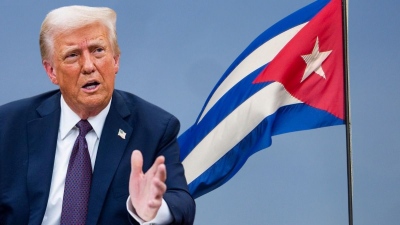
If there is the State of Hawaii, why shouldn't there also be the State of Cuba? The only thing left to see is whether Donald Trump's vanity or his political caution will prevail.
www.bankingnews.gr


Σχόλια αναγνωστών