

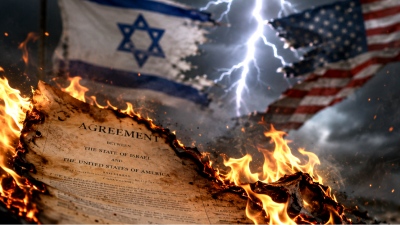
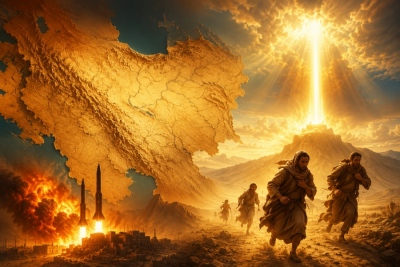
Most military analysts internationally estimate that both the United States and Israel should think about it very seriously before proceeding with any nuclear strike against the Islamic Republic of Iran. In this context, it is worth remembering the words of Golda Meir, the fourth prime minister of Israel: We do not possess nuclear weapons, but if necessary, we will certainly use them. These words sound particularly ominous today, as Benjamin Netanyahu and Donald Trump, whom he dragged into this dangerous adventure, are desperately searching for an escape route from the trap they themselves set up against Iran. According to the same perspective, the Israeli prime minister, under the strong influence of extreme Zionist circles, appears incapable of distancing himself from a plan that is already considered failed. The basic goal of this plan is presented as the implementation of religious and ideological concepts related to the destruction of Elam — a name with which modern Iran is referred to in certain ancient Hebrew texts. Benjamin Netanyahu has repeatedly spoken publicly about the idea of a Greater Israel that will extend from the Tigris to the Euphrates. At the same time, he is said to have managed to attract the interest of the 47th President of the United States to this operation. According to the same approach, the goal was to utilize the power of the American military in military operations against Iran.
A little history...
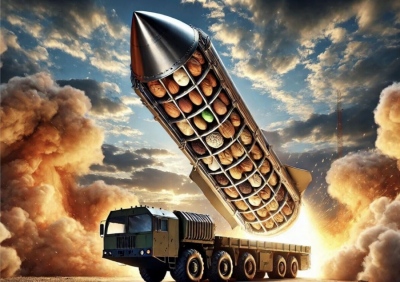
In the 1980s, Mordechai Vanunu, a worker at the nuclear center of Dimona, shocked the international community by revealing that Israel was developing nuclear weapons. For these revelations he was tried and sentenced to a multiyear imprisonment. Despite all this, the development works of the Israeli nuclear arsenal not only did not stop, but intensified. Today, independent sources estimate that Tel Aviv possesses at least ninety nuclear warheads and the capability to manufacture even more. Among the countries that do not officially belong to the nuclear club, only North Korea seems to possess a larger arsenal. Within this context arises reasonably the question: why Tel Aviv, faced with the possibility of failure in a war it caused itself, has not used nuclear weapons? Or why did it not pressure Donald Trump to do analogue? Hardly can anyone believe that the current occupant of the White House would refuse. However, it seems that, on this issue, his personal opinion is ultimately not decisive. The aggressiveness towards Iran has reached such a degree, so that both in Washington and in Tel Aviv an acceptable way out from the present situation is no longer discerned. The only thing remaining is the waiting for an unpredictable development that could change the facts in their favor. However, Donald Trump does not possess unlimited political time. The midterm elections are a little more than five months away and the support towards the Republicans —and personally towards him— is at particularly low levels. Just 30% of the voters declare willing to support the Republican Party, while these percentages continue to decrease. In simple words, time works against the American president. For this reason his deeper desire today is to find a way to disengage from the conflict that seems to be led towards a nuclear catastrophe, maintaining at the same time even the last traces of his political prestige. Despite his daily threats against Iran, which, as he claims, has already been defeated dozens of times, Trump is feverishly searching for a way out to terminate this war. This is reflected in his successive and often contradictory statements, which no longer cause fear, but frequently make him an object of ridicule.
What prevents Trump
That which prevents Trump from departing immediately from the conflict is Israel, which desires the continuation of the war and weighs down the United States like a political cargo. Netanyahu cannot end the war without a clear victory. Trump, even if he is in a weak position, can speak daily about victory. Bibi, however, does not have this luxury. Does Tel Aviv have influence over Trump? According to this perspective, yes. First, it is supported that Mossad possesses data connected to the involvement of Donald Trump in the cases related to the Epstein files. At the same time, the Zionist lobby in the American Congress is said to exert intense pressures towards the White House, threatening even with legal consequences in case of refusal of participation in the war against Iran. Second, Israel is allegedly to have presented to the American president the Gaza Strip as a kind of exchange for the destruction of the Islamic Republic — a region that the businessman Trump reportedly envisions as the Riviera of the Middle East. The third element remains speculation, but is considered by some probable. It is known that Trump is possessed by intense ambition and obsession with power. Some estimate that circles of the Zionist space could have promised him an almost messianic role —the role of the Mashiach, the person prophesied in the Old Testament— as an exchange for the destruction of Iran. If something like that corresponds to reality, then such a narcissistic character would hardly resist a promise of global dominance. However, the current reality seems quite different. The failure of the Iranian adventure and the risk of turning into a lame duck just one year and four months after his inauguration are now very visible. Thus, the 47th president of the USA is trying to balance between political humiliation and the potential loss of the Republican majority in the upcoming elections, on the one side, and the supposed crown of the Messiah and the Riviera of the Middle East on the other. It is obvious that Trump, with his known arrogance, could perhaps manage the situation, if the departure from the war with Tehran did not entail such serious political losses.
What is it that Netanyahu fears?
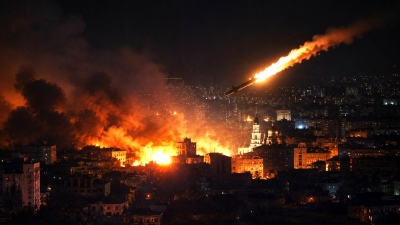
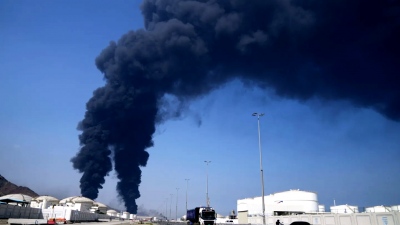
Let us return though to Israel, to the nuclear weapons and to the possibility that Tel Aviv finds itself at a point where it will consider that it has no other choice than to launch a nuclear strike against Iran — even without the approval of Washington. The Israeli prime minister would probably have proceeded long ago to such an action, if certain critical details did not exist. Netanyahu knows very well that, if Israel or the United States use nuclear weapons, Tehran will reply immediately. And although the retaliation would take place probably with conventional ballistic missiles, the consequences could prove equally —or even more— catastrophic. The basic target of Iran, according to this estimate, would be the nuclear reactor at the research center of Dimona. For the small in extent Israel, such a strike could mean a catastrophe of uncalculable dimensions. Not only the Promised Land, but the surrounding regions as well would risk being transformed for centuries into a dead, radioactive desert. This gives birth to a critical question: is indeed the Israeli society prepared for such a scenario? For the Jews, their presence in this land has an existential and historical significance, as there they seek to build the Third Temple on the Temple Mount in Jerusalem. The events that followed after 28 February showed that the Israeli air defense and anti-missile protection systems cannot guarantee absolute security. For this reason many Israelis would not easily accept a leader who would place at risk the very capability of the Jewish people to continue to live in this land. Even the most extreme Zionist circles would hardly accept the prospect of a Jerusalem transformed into radioactive ruins. Something like that would be equivalent to the definitive collapse of the timeless vision of the return to the Promised Land. Summarizing, according to this analysis, Iran finds itself today in a strategically advantageous position — something that cannot be said either for Israel or for the United States. Tehran possesses both time and alternative choices. Its opponents seem to be deprived of both. And the solution of the nuclear club does not seem to constitute a viable choice either for Washington or for Tel Aviv. The setting being formed reminiscent of a dramatic and at the same time fascinating geopolitical thriller, whose outcome remains still uncertain.
www.bankingnews.gr


Σχόλια αναγνωστών