

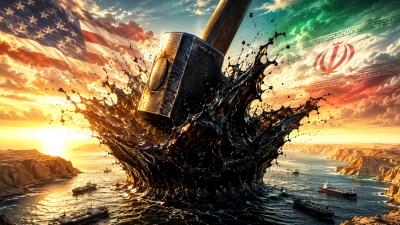
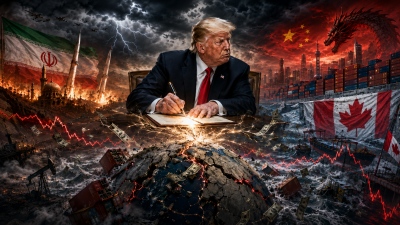
In a decisive show of strength, Iran rejected the proposal by US President Donald Trump seeking a resumption of dialogue. The US requested Pakistan's Army Chief Asim Munir to use his influence to bring Iran back to the negotiating table, but the Iranians rejected the proposal and any dialogue with the Americans. At the same time, they consider US President Trump a liar and view the economic war more as psychological pressure and PR tricks. It should be noted that the US initiated an economic war against Iran, which is developing an aggressive plan against the Americans with a preemptive strike.
In fact, they issued a 48-hour warning message through an official leak from the IRGC, the Islamic Revolutionary Guard Corps of Iran. The situation is escalating dramatically, as Iran demonstrates to the Americans that it is undeterred by the economic war presented by the US as D-Day. Meanwhile, on the tanker front off Oman, a oil tanker was hit. According to an announcement by the United Kingdom Maritime Trade Operations (UKMTO), a tanker was struck in the engine room by an unknown projectile 9 nautical miles northeast of Al-Sisheh in Oman. The crew of the immobilized vessel is reported to be safe.
Iran rejected resumption of negotiations with US – Trump: Iran is collapsing completely
The US president—who, despite ongoing military operations against Iran, has failed to open the vital waterway in Hormuz and has yet to achieve any military objective—claimed once again in his latest assertion that "Iran is collapsing completely." Meanwhile, Reuters, citing a Pakistani source, claims that America asked Asim Munir, the army chief of Pakistan, to use his influence to bring Iran back to the negotiating table. The commander of the Pakistani army arrived in Tehran on August 24 to conduct consultations and meet with Iranian officials. However, according to Iranian sources, Iran rejected the resumption of negotiations with the US.
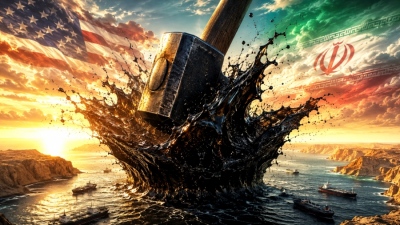
US Operation Paragon Economic Strike launched against Iran
According to Al Jazeera, at the same time the US Treasury Secretary held a press conference to explain what he called a "broad sanctions campaign" against Iran, the US Department of the Treasury announced that President Trump ordered a "broad sanctions campaign against Iran" and that 60 entities, individuals, and vessels connected to Iran were added to the Iran sanctions list. The US Department of the Treasury stated: "Today, August 24, on the orders of President Trump, we launched Operation Paragon Economic Strike against Iran. This is an unprecedented campaign targeting Iran and those who enable and support it. Sanctions were imposed on 60 entities, individuals, and vessels connected to Iran in the nuclear, missile, and oil sectors.
The sanctions target shadow fleet companies and vessels in the United Arab Emirates, Hong Kong, China, Singapore, and Switzerland. We have launched an operation to strangle the economy and the Iranian regime. Trump is in contact with global leaders to sever financial ties with Iran. Our actions will place the Iranian regime in a dire position and target the Revolutionary Guard Corps. Every country has a specific timeframe to cease activities, and if countries do not take action, we will act unilaterally and through our own authority. We have warned countries that facilitate the smuggling of Iranian oil and allow the use of their banks on behalf of the Iranian regime. Any entity facilitating money laundering for Iran will be removed from the US dollar-based financial system. No one is immune from US sanctions. Those standing with us will benefit from our cooperation, and those tying their fate to the Iranian regime should also expect isolation." These sanctions target five vital arteries exploited by Iran in other countries: digital assets, technology, gold, aviation, and maritime transport.
State Department: $10m reward for 5 IRGC commanders – Who they are seeking information on
The US is offering a $10 million reward and relocation for anyone providing information regarding five commanders of the IRGC. The US Department of State reiterated its call for information regarding five key figures of the Revolutionary Guards (IRGC), offering rewards of up to $10 million. The Rewards for Justice program posted a relevant notice on X, seeking information on:
• Ahmed Vahidi, IRGC commander.
• Ali Abdollahi, head of the Khatemolanbia Central Headquarters.
• Sa’id Aghajani, UAV commander of the IRGC Aerospace Force.
• Hamidreza Lashgarian, head of the IRGC Cyber Electronic Command.
• Majid Khademi, commander of the Intelligence Office.
According to the US Department of State, those providing actionable information may be "eligible for relocation and a monetary reward."
State Department: What the US sanctions against Iran entail
The US Department of State issued a statement clarifying the objectives of the extensive sanctions previously announced against Iran. The key elements of the sanctions include:
-
Measures against Iranian military officials deemed responsible for arms procurement and coordinating attacks against US forces, as well as against Iran-based entities that gathered intelligence to target American soldiers and regional allies.
-
Sanctions on a procurement network supplying Iran's military and missile programs, as well as an "extensive network of shipping companies and intermediaries" trafficking Iranian oil products through the United Arab Emirates, China, Singapore, and Europe.
-
The cyber component focuses on alleged Iranian cyberattacks against critical US infrastructure, linked to recent FBI indictments against eight Iranian nationals. At the same time, the reward offer of up to $10 million for information on five key cyber perpetrators was reiterated. The Department of State mentioned that the US remains committed to "disrupting, exposing, and dismantling" Iran's military plans, cyber operations, and illicit oil trade, while calling on the international community to "join us in holding these actors accountable."
Mohsin Naqvi (Pakistan Interior Minister): Significant progress in discussions with Iran on restoring US–Iran MoU
Pakistan's Interior Minister, Mohsin Naqvi, stated that Pakistan and Iran are discussing the restoration of a Memorandum of Understanding (MoU) previously signed between Iran and the US, aiming to help resolve the ongoing conflict. In a post on X, Naqvi mentioned that he and the country's army chief, Asim Munir, had a "very positive and productive meeting with the President of Iran." He added that their discussion "focused on the Iran–US conflict, Middle East tensions, and next steps, as well as the measures required from both sides to restore the Islamabad Memorandum of Understanding, leading to a comprehensive settlement of the conflict."
Naqvi stated that "the Iranian president candidly presented his government's perspective and concerns, and we had a very constructive exchange of views on the issues involved." He added that "significant progress was made," that "the meeting concluded in an extremely positive atmosphere," and expressed hope that "this momentum will contribute to paving the way for further progress and lasting peace in the region."
Hormuz closed… Iran dominant – Only one ship passed through the Strait on August 24
Despite the claims of US President Donald Trump, traffic in the Strait of Hormuz is... zero. According to Reuters, shipping data shows that movement through the Strait of Hormuz fell on Monday to just one commercial vessel, recording the lowest daily volume since May 7. Citing preliminary data from ship-tracking firm Kpler, Reuters reported that on Monday only one Very Large Gas Carrier crossed the narrow passage, entering from the Gulf of Oman. By comparison, six vessels of all types were recorded passing through the waterway on Sunday. The data remains initial estimates and may be revised, as some vessels turn off their transponders while sailing in the region, according to the report.
Nearly half of Hormuz traffic last week used the Iranian transit system
Transits through the Strait of Hormuz increased marginally by 2.5% last week, reaching 121. However, the overall traffic figures disguise the weakening of real commercial activity and the increase in risks, according to data from maritime data firm Kpler. Nearly half of the vessels, a rate of 46.3%, relied on Iran's unilaterally established routing system to secure their transit. At the same time, transits of loaded ships carrying actual cargo fell by 27%, while transits of sanctioned vessels increased from 9 to 16. Further south, traffic through the Bab al-Mandeb Strait increased by 3.1%, reaching 269 transits. Kpler noted that the Red Sea corridor continues to demonstrate resilience despite the active threat environment, with total transits of sanctioned ships and so-called "shadow fleet" vessels remaining stable at 74.
Casualties among seafarers and port workers reach 20
Incidents in the Strait of Hormuz have cost the lives of 20 seafarers and port workers since the start of the war, according to the IMO. At least 20 seafarers or port workers have been killed in a total of 68 incidents in the Strait of Hormuz since the US and Israel attacked Iran in late February of this year, according to the International Maritime Organization (IMO). Another individual is missing, while 35 people have been injured, the organization added. On average, an incident occurs approximately every 2.6 days, with the majority categorized as "attacks," according to the IMO.
Will Iran soon launch a preemptive attack against Americans and Israel?
Proponents of a preemptive Iranian attack on the United States and Israel argue the following: If the United States is to attack Iran again in the coming weeks and organize this attack under conditions where the economic blockade has minimized Iran's strength, or if the United States wants to attack Iran after the midterm elections, it would be better for Iran to attack the enemy prior to that timeline. While the economic blockade of Iran has reached its peak and, at the same time, the US Treasury Secretary announced that the largest US economic war with Iran has begun… some predict the possibility of a preemptive attack by Iran on the US and Israel. These predictions are made in a context where some, such as Mike Pence, Trump's vice president during his first term, have stated that Trump and Israel may attack Iran again, while simultaneously, media outlets like News Nation have claimed that Trump is willing to organize a series of strikes against Iran this week.
The main problems facing the argument of proponents of a preemptive Iranian attack on the United States are the following:
A) The uncertainty of the target and the scope of the attack
The most significant issue with Iran's preemptive strike on the United States is the ambiguity surrounding the question: "How far is this attack supposed to go?" In other words, what objective is the preemptive strike supposed to achieve, and what goals is it meant to accomplish? Is the attack supposed to go far enough to make America regret the war? Is it supposed to affect the outcome of the midterm elections? Is it supposed to control domestic prices? Will it affect global oil prices by closing the Strait of Hormuz? Also, are Iran's tools sufficient to force the United States to back down completely? Will Iran attack Israel or the Arab countries in the region? Can an Iranian attack on Israeli territory or Arab countries force the enemy to surrender? Can it force the United States to retreat? How and to what extent must Iran's attack be to achieve its goals?
B) The location and coordinates of the attack are unknown
The uncertainty of the attack's target raises two additional questions: 1). What is the location and coordinates of the attack? 2). What will the attack scenarios be? In reality, if the objective of the preemptive attack is not clear and specific, the coordinates of the attack, the location of the attack, the time of the attack, and overall, the details will not be clear.
Generally, the question that needs to be answered is: "What is the exact purpose and scope of Iran's attack on the United States?" And can Iran achieve its goals (primarily the withdrawal of the United States)? In fact, if Iran cannot determine the coordinates of its attack, it cannot utilize its preemptive strike and convert it into a strategic, groundbreaking attack.
Quincy Institute: US economic war cannot alter balances in Hormuz
Inflicting pain and pressure is one thing, and converting that pressure into a policy change is entirely another, according to the Quincy Institute. The US has almost never succeeded in doing so. It is quite clear that the Iranians would prefer escalation over surrender. Instead of ending the war, the D-Day sanctions are more likely to provoke retaliation and an escalating reaction from Iran.
According to the Quincy Institute, which commented on the new sanctions against Iran: "The pattern of developments so far has shown that inflicting pain and pressure is one thing and converting that pressure into policy change is completely different. The United States has almost never managed to do this."
With the announcement of the "D-Day" sanctions by the US, there are a few things to keep in mind:
-
Yes, these measures could exert significant pressure on the Iranians. But the pattern of developments so far has shown that causing pain and pressure is one thing and converting that pressure into policy change is completely different. The United States has almost never managed to do this.
-
This is particularly important because the US has not even clarified what its exact demands are. This creates the impression in Iran that the goal of the sanctions is to force Iran to surrender. And it is quite clear that the Iranians would prefer escalation over surrender.
-
This was the same massive miscalculation that Trump made at the beginning of this war, believing that Iran was so afraid of war that it would ultimately choose to capitulate and surrender. He never understood that Iran feared surrender more than war. This fact remains true today.
-
As a result, instead of ending the war, the D-Day sanctions are more likely to provoke retaliation and escalation from Iran, ultimately leading to another round of the same long-term cycle of escalation.
-
Naturally, there is also a scenario in which the pressure on Iran is more limited, and therefore Iran refrains from an immediate and mutual escalation. But the combination of the blockade and these sanctions will likely increase pressure on Iran in the long run—pressure that will encourage Iran to engage in mutual escalation sooner or later, because the path forward will be downward.
Consequently, such a new situation would be inherently unstable, and the lack of an immediate reaction from Iran should not be misconstrued as non-reaction or acceptance of the situation.
Sanctions illegal – Main target is China
Iranian Foreign Ministry spokesperson Esmaeil Baghaei denounced the planned secondary sanctions as an attempt by the United States to enforce dominance over independent states, maintaining they have no basis in international law. The Iranian position is that Washington is no longer limiting itself to enforcing measures against Iran, but is attempting to dictate to other countries with whom they can trade.
The confrontation assumes particular importance for China, the most significant buyer of Iranian oil. The US has already imposed sanctions on Chinese refineries and companies linked to the transportation of Iranian crude, while a much stronger next step would be extending measures to foreign banks facilitating related transactions. However, such a move could trigger severe side effects in Washington-Beijing relations.
Despite the harsh rhetoric, the existing US framework still provides licenses for certain transactions, including those in medicines, medical equipment, and agricultural products. The major uncertainty lies in how broad the new regime will ultimately be and which categories of economic activity will come under the threat of secondary sanctions.
The so-called "Economic D-Day," therefore, is not merely another round of US sanctions. If implemented to the extent announced, it will attempt to transfer the US-Iran conflict across the entire international financial and commercial system, pressuring third countries to align with Washington's policy. For Tehran, this reinforces the argument that the pressure is not directed solely against specific Iranian entities, but aims at the broader economic isolation of the country and restricting its ability to maintain independent economic relations with the rest of the world.
Iran: Participation in sanctions is a casus belli
Iran will strike American bases in European countries if those countries participate in aggressive actions against it, warned Iranian Foreign Ministry spokesperson Esmail Baghaei. During his weekly press briefing, Baghaei emphasized that "Iran does not accept the aggressor setting conditions for ending the war," adding that "there is no reason for any country to fear Iran, unless that country opens its territory to the United States for aggressive actions against Iran."
He underlined that "it is Iran's right to strike the source and starting point of any aggressive action against the Islamic Republic." Baghaei also reiterated that "Iran did not start the war and was exercising its legitimate right to self-defense, and will not allow the war to end on the aggressor's terms," explaining that "Iran utilized all diplomatic means to prevent the war." As he stated, "we did not start the war and should not blame ourselves for the continuation of this situation."
IRGC: The economy turns into a battlefield
The Islamic Revolutionary Guard Corps (IRGC) state that economic war constitutes the "main battlefield" in the current confrontation with adversaries, amid the latest economic pressure operation by the United States against Tehran. The IRGC made this statement on Monday, August 24, 2026.
"By waging economic war and imposing multi-layered sanctions, the enemy seeks to sow disappointment, exert pressure on the living conditions of the people, and undermine social trust," the IRGC statement reads. At the same time, the Guards expressed their full readiness for strategic cooperation with the government in countering the enemy's economic war.
www.bankingnews.gr



Σχόλια αναγνωστών