

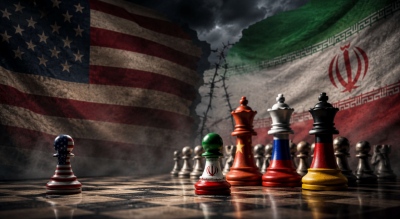
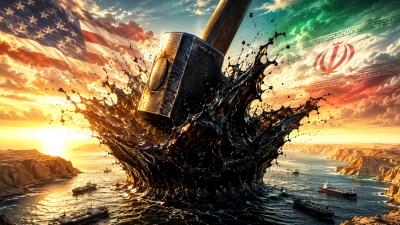
The Trump administration, with the new sanctions it announced against Iran, is playing its last card in order to, if not prevail over Iran, at least disengage with... dignity from the Persian Gulf region.
With this move, the US is attempting to turn the economic isolation of Iran into a global test of strength, warning that targets will not only include Iranian companies and financial networks, but also whoever continues to keep the country's economic «arteries» open.
However, and given that these measures primarily target China, as it constitutes the largest buyer of Iranian oil, many analysts identify in this parameter... the failure of the US.
This is an assessment that, if realized, will confirm the humiliation of the US and President Trump, who will pay a heavy political price in the midterm elections of November 3...
Scott Ritter: No one in the world believes the US won the war
Indicative is the assessment of Scott Ritter, former officer and weapons inspector for the UN (United Nations), who stated that «today, no one in the world believes that the United States won this war, and no one in the world believes today that America has the capability to carry out something that resembles a large and decisive economic assault».
«All of this belongs to the fantasy world of Donald Trump», pointed out Ritter.

How Washington plans to cut off Iran's economic arteries
Scott Bessent, the US Treasury Secretary, argued that the new phase of pressure against Iran represents «the largest economic operation in history».
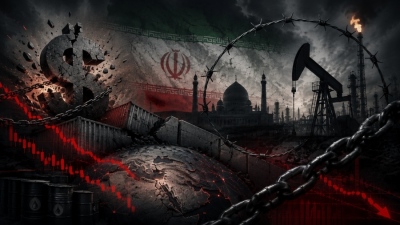
An operation that no longer merely aims to impose sanctions on a few Iranian banks or companies, but attempts to sever all avenues allowing Tehran to generate revenue, transfer money, purchase goods, and maintain contact with the global economy.
Yet how does it intend to cut off all of Tehran's economic arteries?
What is the difference of this phase from previous sanctions?
The US has for years been imposing sanctions on Iranian banks, oil companies, vessels, individuals, and financial networks.
The fundamental difference of the new phase is that Washington intends to transfer pressure from within Iran to everyone who cooperates economically with the country.
This is what is called «secondary sanctions».
That is, a bank, a shipping company, an airline, or even a foreign government could find itself targeted by the US for continuing economic cooperation with Iran, even if the specific entity does not operate directly in the United States.
Donald Trump has also warned that countries whose banks, companies, airports, or state institutions provide Iran with «any vital artery» will face severe economic costs.

The five key fronts of the assault
The new measures announced target at least five major sectors: digital assets, technology, gold, aviation, and shipping.
The US Department of the Treasury also targeted around 60 individuals, companies, and vessels in this phase.
The «logic» of Washington is clear: if Iran cannot convert its oil revenues into usable money, transfer funds through banking networks, utilize ships for exports and imports, use gold and foreign exchange to bypass restrictions, or gain access to the technology it needs, then even its existing revenues will gradually become useless.
Assault on «middlemen» and «buyers»
Part of this policy involves targeting the networks Iran has created to bypass sanctions.
The US had already targeted Bank Shahr, two currency exchange houses based in Dubai, and a series of front companies in Hong Kong, Singapore, and Dubai, networks which Washington considered involved in the transfer of Iranian oil revenues and funds.
This means the US does not simply want to impose sanctions on an Iranian bank, but to shut down the entire conduit from Iranian banks to foreign banks, currency exchange houses, intermediary companies, and final buyers.

The dollar: the most important weapon
In Bessent's «perception», the power of American sanctions does not lie in the sanctions list itself, but in access to the global financial system.
Many international banks and corporations, in order to have access to the dollar, the American market, and the US financial network, need to comply with Washington's rules.
Therefore, Bessent's «ridiculous message» to foreign companies is essentially this: either you do not do business with Iran, or you accept the risk of losing access to the American financial system.
For this reason, the US claims that this particular operation can exert pressure even on governments such as China, Turkey, and the United Arab Emirates.
In their view, China represents the most critical test for Washington, as it is the largest purchaser of Iranian oil.
Final objective: cutting off revenue and driving up costs
In reality, the US is simultaneously targeting four links: Iran's revenues, money transfers, foreign trade, and access to goods and technology.
This pressure is being applied at a time when the value of the Iranian rial has plummeted to the lowest level in its history.
Under these circumstances, Washington's strategy appears to be intensifying economic pressure to such an extent that the Iranian government will face severe difficulties in financing itself, managing its economy, and sustaining its foreign trade relations.

The risk
However, this policy also entails a major risk: if secondary sanctions are extended to the primary buyers of Iranian oil, particularly China, the American economic war could escalate into a much broader economic confrontation. On the other hand, the continuation of disruptions to tanker transit through the Strait of Hormuz could increase global energy prices.
Thus, Bessent's «exaggerated statements» represent in practice an attempt to turn Iran's economy into a financial island, an island whose revenues, banks, trade routes, and even foreign partners are being placed under pressure one after another.
This is also the essential difference of the new phase: the US is no longer imposing sanctions solely on Iran; it wants to force a choice on anyone who enables it to keep «breathing» economically.
The warning concerns China
US Treasury Secretary Scott Bessent pledged an «economic D-Day» against countries buying oil from Iran.
According to experts, this warning concerns above all one specific country: China.
Bessent did not name China, but left little room for doubt.
«We find that the best way to work with countries is through quiet diplomacy, and we are in communication with each country to make clear to them what we expect», stated Bessent.
«We know who they are. And they know who they are».
Purchasing 90% of Iranian oil
Nevertheless, although Bessent's threat may place China at the center, the fallout could be felt worldwide, even by American consumers, who may see their own energy costs rise.
Tehran is estimated to have exported oil valued between 3.9 and 4.2 billion dollars in September 2025, according to one analysis.
China, the world's largest energy consumer, purchases the vast majority of these volumes.
«Chinese purchases account for roughly 90% of Iran's oil exports, securing tens of billions of dollars annually that support Iran's state budget and military activities», reported the U.S.-China Economic and Security Review Commission earlier this year.

Only escalation
Bessent described Monday's announcement as a «warning shot».
Although sanctions were imposed on certain entities and natural persons, he did not announce wide-scale measures against any specific country.
Earlier, Chinese Foreign Ministry spokesperson Lin Jian stated: «Sanctions and pressure tactics do not help resolve problems.
They will only lead to escalation, which serves nobody's interests».
38% of China's oil and 23% of its LNG transit through the Strait of Hormuz, one of the main flashpoints in the war with Iran, according to an April report by Nomura.
Reduced imports
China has already reduced imports of Iranian oil.
Prior to the war, imports of Iranian crude averaged around 1.4 million barrels per day, but in recent months have retreated to about 700,000 barrels per day, due to reduced refinery operations and drawdowns from onshore inventories, according to Emma Li of energy analytics firm Vortexa.
«A complete halt to Iranian crude imports would likely have limited direct impact on China's overall energy security, because imports from Iran have already declined significantly and China continues to hold relatively large crude stockpiles», Tianyue Hu, an analyst at energy intelligence firm Rystad, told CNN.
The strongest impact
However, new sanctions could further deteriorate the already strained relations of the Trump administration with China.
The two countries engaged last year in a fierce trade war, at the height of President Trump's tariff policy.
Recently, in fact, they revived a new cycle of reciprocal sanctions.
«China is, by a wide margin, the country that can have the greatest impact if the goal is truly to restrict Iran's ability to continue funding its operations», argued Daniel Tannebaum, non-resident senior fellow at the Atlantic Council, speaking to CNN.

Not the first time
This is not the first time the United States has threatened trading partners of Iran with sanctions.
India was once a major importer of Iranian oil.
The two countries maintained trade exchanges worth 1.1 billion dollars between April and December 2025 in commodities such as rice and sugar, but India had stopped importing Iranian oil in 2019 due to American sanctions. In April of this year, however, it bought Iranian oil again amid an energy crisis.
Murky waters
It is difficult to assess to what degree American sanctions could affect China or other nations dependent on Iranian oil.
Even Wall Street analysts have been unable to obtain a clear answer regarding how much oil continues to transit through the Strait of Hormuz.
While US Secretary of Energy Chris Wright claimed that the straits remain open and that the flow of oil continues, Iran claims the contrary.
Meanwhile, data from third-party vessel tracking companies showed that the actual volume was roughly half of what Wright reported.
«Shadow fleets»
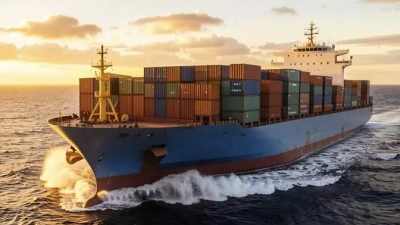
There are also the so-called «shadow fleets», which are frequently used by countries under sanctions regimes.
These specific tankers conceal their owners, their origin, and their destinations, a fact that makes tracking them difficult.
Vessel tracking platform Kpler reported this month that transits by «shadow fleet» vessels accounted for approximately 50% of traffic in the straits in recent weeks, up from about 12.5% a month earlier.
Nonetheless, the reduction in oil flow affects everyone.
Large oil reserves averted a severe global shortage when the war with Iran broke out in February.
At the same time, intermittent ceasefires during the war led to drops in international oil prices, only to rise again each time those agreements collapsed or expired.

US patience
American consumers have already felt the consequences of rising oil prices due to the war. Today's average gasoline price nationwide in the US is 4.10 dollars per gallon, compared to an average price of 3.15 dollars last year, according to AAA.
«No one is beyond the reach of American sanctions», stated Scott Bessent on Monday.
However, he avoided setting specific deadlines for subsequent decisions.
At the same time, Chinese leader Xi Jinping is expected to visit the United States next month.
«I am not going to set timetables, but our patience is not unlimited», said Bessent.
The final word, however, clearly belongs to China...
www.bankingnews.gr




Σχόλια αναγνωστών