

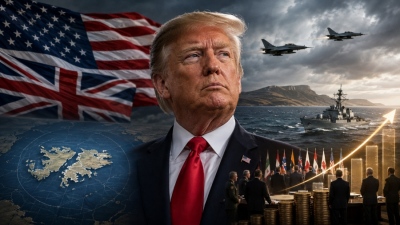
Donald Trump has implied that he is re-evaluating the US stance on British sovereignty over the Falkland Islands, in a move likely to further strain the so-called "special relationship" between Washington and London. "I'm always reviewing every position – that's just one of many," the US President told reporters at the White House, responding to a question about whether he is reconsidering the US position on the South Atlantic islands. The status of the Falklands has been a subject of dispute for decades, as Argentina continues to claim sovereignty over them.
The official US stance
Officially, the US maintains a neutral position regarding which country holds legitimate sovereignty over the islands. Britain first claimed the Falklands in the late 17th century and has held control over them almost uninterrupted since 1833. In practice, however, Washington acknowledges British administration over the territory. The Falklands were at the epicenter of a military conflict between Britain and Argentina in 1982, when Argentina invaded the islands, triggering the war that concluded with their retrieval by British forces.
The Falklands as leverage against London
The latest statements by Donald Trump constitute the clearest signal yet that the US administration is prepared to use the dispute over the Falklands as leverage against the new British government of Prime Minister Andy Burnham, in order to force London to increase defense spending and its contributions to NATO. Trump's comments came just days after it was revealed that an anonymous US official told the Telegraph last week that Washington could change its stance on the Falklands if Britain fails to meet its commitments on defense spending. This development followed reports indicating that British Chancellor of the Exchequer John Healey was preparing to abandon Britain's prior commitment to increase defense outlays to 3% of GDP by 2030, ahead of delivering his first budget on October 28.
Trump demands more from allies
Pressuring US allies to increase their defense budgets and contributions to NATO has been a central priority for Donald Trump across both of his presidential terms. The US President has repeatedly accused other nations of "free-riding without paying their fair share" of American military power. At the NATO summit in The Hague last year, allies committed to scaling up defense and security-related expenditures to 5% of GDP by 2035.
Scenarios of a US shift circulating for months
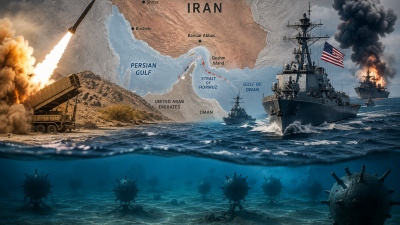
Speculation regarding a potential shift in the US stance on the Falklands issue has been circulating for months. In April, a leaked US Pentagon email suggested reviewing the British claim, in response to London's lack of support for Donald Trump's decision to launch a war against Iran. A formal shift in the US position would deliver a major psychological blow to British sovereignty over the Falklands.
The 1982 war and Reagan's support for Thatcher
Following the Argentine invasion of the islands in 1982, the decision by Margaret Thatcher's government to dispatch a naval task force, which ultimately led to the recapture of the Falklands, was bolstered by firm diplomatic backing from then US President Ronald Reagan. Reagan sided with Britain, despite the fact that during the same period the US maintained allied relations with the military junta governing Argentina. In the fighting, a total of 649 Argentine and 255 British military personnel were killed before Argentine forces surrendered in June 1982. The conflict played a pivotal role in solidifying the relationship between Margaret Thatcher and Ronald Reagan, who were close political allies and ideological partners.
The Trump – Milei relationship shifts the balance
In recent years, Donald Trump has cultivated a close relationship with Argentina's populist president, Javier Milei, who attended Trump's second inauguration in January of last year. Last year, Trump approved $20 billion in financial support for Argentina to assist the country in coping with its financial crisis. However, the American financial backing was tied to the condition that Milei's party win the subsequent parliamentary elections. Milei's party, La Libertad Avanza, ultimately won the elections, defying poll predictions. Subsequently, Trump authorized the import of Argentine beef into the US in an effort to curb food prices for American consumers. Milei has repeatedly and emphatically expressed his support for Argentina's claim over the Falklands.
The overwhelming majority of residents choose Britain
Despite Argentina's claim, the residents of the Falklands themselves have overwhelmingly expressed their desire to remain under British sovereignty. In a referendum held in 2013, out of the 1,517 Falkland residents who voted, 1,513 voted in favor of keeping the islands as part of the United Kingdom.
The dispute spilled into football
Sensitivities surrounding the Falklands resurfaced following Argentina's 2-1 victory over England in the World Cup semi-final in July. During the post-match celebrations, Argentine footballers unveiled a banner bearing the message "Las Malvinas son Argentinas," meaning "The Falklands belong to Argentina." Subsequently, the Argentine Football Association was fined $235,000 by FIFA for violating regulations regarding non-sporting events and political protests. Donald Trump's new stance, however, adds a fresh and highly sensitive dimension to the long-standing dispute, linking the Falklands issue directly to Britain's defense obligations toward the US and NATO.
www.bankingnews.gr










Σχόλια αναγνωστών