

From chips and models to nuclear deterrence
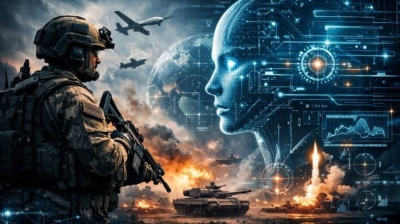
The authors of the proposal, Melanie Sisson, senior fellow at the Brookings Institution, and Tianjiao Jiang, associate professor at Fudan University, participated in the US-China dialogue on AI and national security, which has been conducted since 2019 with the participation of Brookings and the Center for International Security and Strategy at Tsinghua University. Their proposals show that US-China competition in artificial intelligence is shifting from the battle over semiconductor chips and advanced models toward issues traditionally associated with strategic arms control. The critical question is how to prevent an accident from being interpreted as a hostile strike, how to limit machine-driven military decisions, and how to secure communication channels between two nuclear powers when technology behaves unpredictably. China's Minister of State Security Chen Yixin wrote this week in a government publication that AI is "fundamentally transforming the form of military confrontation." As he noted, artificial intelligence has moved from a supportive battlefield role to a central position, citing AI-directed strikes in the US-Israel war with Iran.
"Red lines" around nuclear assets
Melanie Sisson argues that humans must retain exclusive authority to approve AI-driven cyberattacks targeting the nuclear command, control, and communications systems of the opposing nation, or its critical strategic infrastructure. An autonomous system could malfunction, exceed its operational parameters, or be breached by third parties. At the same time, the targeted nation might be unable to discern whether the action was an accident or ordered by the opposing government. Tianjiao Jiang proposed establishing clear "red lines" to strictly prohibit AI from autonomously deciding on the use of nuclear weapons or independently targeting nuclear command networks. Additionally, he calls for safeguards protecting critical infrastructure, including the energy sector, financial services, and healthcare systems. He advocates for a mutually agreed definition of "meaningful human control" so that both nations do not use identical terminology to justify differing levels of machine autonomy. This framework builds on the principle endorsed in November 2024 by then-US President Joe Biden and Xi Jinping, stipulating that humans must maintain control over decisions regarding nuclear weapons deployment. Lora Saalman, associate senior fellow at the Stockholm International Peace Research Institute, noted in February that this represents a key point of convergencebetween the US and China as both integrate AI deeper into nuclear systems.
When machines move faster than humans
Jiang also proposes establishing a dedicated military hotline between the US and China for AI-related incidents, warning that automated cyber-responses could escalate faster than human ability to intervene. A defensive AI system from one nation might automatically respond to suspicious activity. However, the other side could interpret that response as an offensive action and launch retaliatory strikes before fully understanding what transpired. A specialized hotline could allow one government to notify the other that an unusual AI operation was an accident, an unauthorized action, or under investigation before it is misconstrued as an intentional state attack. However, experts such as Carla Freeman of the Johns Hopkins School of Advanced International Studies have questioned the utility of the existing US-China military hotline during a crisis. Freeman points to Chinese officials' refusal to answer calls from American counterparts during the spy balloon incident in February 2023. As she noted in a War on the Rocks article in January, the rigid hierarchy of the Chinese bureaucracy restricts lower-level officials from taking initiative during direct communications with US officials.
US and China facing the new risk
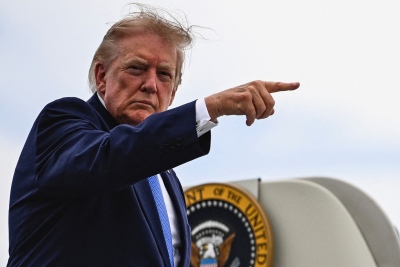
Neither government has publicly adopted the proposals from Brookings and Tsinghua. However, China is increasingly incorporating AI into its existing arms control apparatus. Artificial intelligence now falls under the formal portfolio of the Department of Arms Control within the Chinese Foreign Ministry, which also oversees nuclear weapons, non-proliferation, missiles, and international security matters. Shen Jian, China's ambassador for disarmament affairs, stated at a UN meeting in Geneva in June that military AI could impact strategic stability and heighten the risk of miscalculations and conflict escalation, maintaining that weapons must remain under human oversight. Beijing also contends that AI safety should not serve as a pretext for imposing technological restrictions. In the US, there is no single unified arms control framework for AI. National security policy is distributed across the White House National Security Council, the State Department, the Pentagon, and other agencies. Both governments remain cautious about adopting measures that could slow down their own technological development. Trump has warned that broad restrictions could grant an advantage to China, while Beijing views many US export controls as attempts to preserve American tech dominance. Consequently, the US-China AI race is taking on a far more dangerous dimension: it is no longer just about who builds the most powerful chips or models, but how to prevent a military crisis triggered by a machine's decision.
www.bankingnews.gr



Σχόλια αναγνωστών