

The relationship between China and the Persian Gulf is entering a new phase, particularly following the... failure of the US in the waters of the Strait of Hormuz.
For decades, the fundamental pillar of bilateral ties was energy: crude oil and natural gas flowing from Persian Gulf producers to China, and manufactured goods alongside capital flowing from China to the Middle East. Today, however, the landscape is significantly broader.
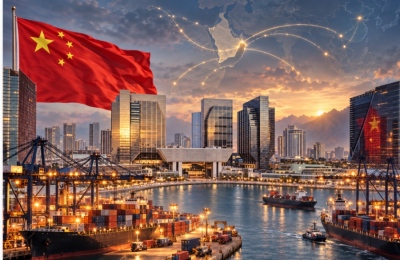
Beijing seeks to deepen its footprint across maritime ports, logistics, heavy industry, the digital economy, renewable energy, and financial services.
Within this strategic architecture, Oman assumes unique importance.
China already stands as the largest trading partner of the Gulf Cooperation Council (GCC).
In 2024, China–GCC trade reached approximately 288 billion dollars, while Chinese investments across GCC member states continued to expand, particularly within energy and the digital economy.
This development underscores that the relationship between Beijing and Gulf monarchies is no longer restricted to hydrocarbon procurement. China is interested in the comprehensive economic supply chain taking shape around the Gulf.
Oman serves as a primary example of this transformation.
Bilateral trade between China and Oman totaled roughly 36.7 billion dollars in 2024, according to the Chinese Foreign Ministry, confirming China as Oman's leading trade partner.
Concurrently, Chinese foreign direct investment in Oman reached approximately 854 million Omani rials by the conclusion of the second quarter of 2025.
Geography represents Oman's paramount advantage.
The country occupies the southeastern tip of the Arabian Peninsula, commanding coastlines on the Indian Ocean and the Arabian Sea, while effectively overseeing maritime access to the Indian Ocean outside the chokepoints of Hormuz.
This provides Omani ports with a distinct strategic value compared to ports positioned deeper within the Persian Gulf.
The central hub of this doctrine is Duqm.
The investment ecosystem
The Special Economic Zone at Duqm (SEZAD) was engineered as an industrial, commercial, and maritime shipping nexus, tightly integrated into the Chinese Belt and Road Initiative.
A study published by Cambridge University Press characterizes Sino-Omani cooperation at Duqm as strategically pivotal, as the zone sits at a focal intersection for commercial freight corridors bridging Asia, Africa, and Europe.
The China-Oman Industrial Park constitutes one of the foundational anchors of this ecosystem.
The prominence of Duqm is underscored further by recent capital commitments. In June 2026, ten agreements and memoranda of understanding totaling approximately 7.5 billion dollars were signed. The projects span green hydrogen and ammonia, industrial chemicals, manufacturing, battery materials, energy, tourism, and logistics infrastructure. The investor roster includes corporations from China, India, South Korea, Germany, the Philippines, and Egypt.
This highlights the structural shift underway.

Chinese presence in the Persian Gulf is no longer confined to securing crude oil barrels.
China aims to embed itself within the emerging industrial value chains revolving around the global energy transition: storage batteries, electric vehicles, green hydrogen production, digital cloud infrastructure, and advanced freight logistics.
Simultaneously, Oman is building out the financial architecture necessary to underwrite this expansion.
The establishment of the International Financial Centre Oman represents an integral component of this initiative.
Attracting Chinese commercial banks, asset management funds, accounting firms, and legal practices could foster a comprehensive financial ecosystem surrounding Chinese industrial and trade operations in the theater.
This development holds strategic weight as Oman positions itself as an economic bridge connecting diverse geopolitical spaces: China, the Arabian Gulf, India, Iran, and East Africa. The Omani government has framed the economic free zones of Duqm, Sohar, and Salalah as prospective hubs for automated warehousing, regional distribution centers, and cross-border e-commerce platforms distributing Chinese goods across regional markets.

The transformation of economic relations
Here lies the distinct relationship between China and Iran.
Beijing does not intend to choose between Iran and the Arab monarchies of the Gulf.
Instead, it works to maintain balanced commercial and diplomatic ties with both camps.
Iran carries vast importance for China due to its energy reserves and geographic footprint, offering access to the Persian Gulf, the Gulf of Oman, and overland corridors connecting Central Asia and Europe.
At the same time, China safeguards monumental economic interests across Saudi Arabia and the United Arab Emirates.
Consequently, Persian Gulf stability represents a direct Chinese strategic imperative.
Recent regional confrontations have accentuated this necessity.
Maritime supply chain disruptions across the region impact not only crude exports, but also broader commercial freight routes connecting China with Europe and the Middle East.
This illustrates why Oman provides vital added value for Chinese enterprises.
The nation cannot replace the Strait of Hormuz or the mega-ports of the UAE. It can, however, provide an alternative maritime operating base outside the Persian Gulf bottleneck for freight shipping and manufacturing aimed at the Indian Ocean.
This strategy aligns with a wider Chinese effort to diversify international trade and energy corridors. The Belt and Road Initiative can no longer be viewed merely as an infrastructure program for building ports and rail networks. It functions increasingly as an integrated grid of maritime terminals, industrial parks, energy complexes, logistics hubs, digital networks, and financial service platforms.

The post-oil era
The progression of Duqm is illustrative.
The location integrates deep-water port facilities, an industrial manufacturing zone, energy infrastructure, and open access to international maritime shipping lanes.
Concurrently, the creation of the financial center in Muscat seeks to inject the missing component: capital liquidity and specialized financial advisory services.
Structural constraints naturally exist.
Oman possesses a smaller economy and lower baseline development than the United Arab Emirates.
Dubai already commands a mature international financial center, while Abu Dhabi and Riyadh attract colossal capital flows.
Consequently, Oman is not directly seeking to rival these established hubs across all domains.
Its most viable strategy is to exploit comparative advantages rooted in its geography, traditional diplomatic neutrality, and open coastline situated beyond the maritime chokepoint of Hormuz.

The ultimate success of this framework will hinge upon Oman's capacity to translate capital infrastructure into tangible commercial freight volumes, alongside China's capability to navigate the geopolitical rivalries among regional powers.
The definitive takeaway is that Chinese presence is shifting away from the legacy paradigm of «Gulf oil to China» toward a sophisticated model: «Chinese capital and technology into the Gulf, local manufacturing and logistics within the region, and outbound market access to Asia, Africa, and Europe».
Duqm and Oman's emerging financial ecosystem stand as two emblematic components of this overarching geoeconomic transformation.
www.bankingnews.gr




Σχόλια αναγνωστών