

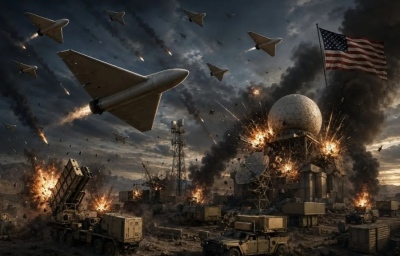
It is obvious that after the fiasco suffered by the US military machine in the Persian Gulf and Hormuz, with 17 US bases left literally in ruins, Trump, the US President, appears to have examined the next steps against Iran at Camp David. Indeed, some said, "President, we will be humiliated, do not attack Iran again." Americans do not like war and this was emphatically highlighted at Camp David. The US changes stance for the 27th time and in practice wants to find an exit strategy, but leave with heads held high, not humiliated. Meanwhile, Iran has intensified the manufacturing of drones, proving that cheap drones can bend empires.
Trump: We have meetings on Iran – Qatar: We want even a short-term agreement between US and Iran that sets 7 conditions
While Trump, the American President, considers all scenarios regarding Iran, Qatar emphasizes, "We are trying to reach an agreement between the US and Iran, even if short-term, to pave the way for launching negotiations." According to media outlet Amwaj, Iran has submitted 7 conditions for returning to negotiations. This represents a new initiative, and none of these conditions put Iran's nuclear program on the table. Also according to the Wall Street Journal: One of the issues raised at Camp David was examining the next steps in the Iran war.
They are in a bad state
"I am having meetings regarding Iran. They are in a very bad state," Trump emphasized, but in practice Iran endures and keeps Hormuz closed. A spokesperson for the Foreign Ministry of Qatar stated: We are trying to facilitate an agreement between Washington and Tehran, even if short-term, to pave the way for diplomatic negotiations. Any dialogue requires the reopening of the Strait of Hormuz and assurances that there is no threat of military force. Currently, there is deep distrust between the US and Iran, with each side waiting for the surrender of the other. Any agreement between Iran and the US will not be final, but merely sufficient to allow negotiations to begin.
Wall Street Journal: Next steps in Iran war examined at Camp David... war is not liked...
The next steps in the Iran war were examined at Camp David, and the conclusion is that Americans do not like war. Twenty months have passed since the beginning of Trump's second term, but he is not achieving what he wants, and according to advisers, administration officials, and others close to the president, he is unhappy with the political situation. Trump complains about the media coverage of his administration in recent months, both publicly and in private. However, frustration peaked when one of his closest aides showed him clips of cable network hosts on MS NOW criticizing his presidential administration. Hours later, Trump banned entry to the network and two other news organizations from the White House. Trump has told aides behind closed doors that he lacks enough political allies to defend him on television and explain the achievements of his second term. The president has been briefed on the problems facing Republicans in the upcoming midterm elections. His advisers have told him that the war in Iran has reduced conservative enthusiasm for the elections. Trump's decision to ban access for MS NOW, CNN, and Politico to the White House surprised many White House officials. Nevertheless, the president's aides quickly implemented his order, prohibiting journalists from those media outlets from entering the press room.
Drones are a war of economic attrition, bending empires – They determined the fate of the US-Iran war
The US Pentagon has officially admitted that American air defense systems are incapable of intercepting all Iranian drones. This means that the drone war between Iran and the US has become one of the most prominent examples of asymmetric warfare in modern military history. The "hunting" of numerous American drones by Iranian drone systems further confirms this reality. Based on the war economy: A drone costing a few thousand dollars against an interceptor missile costing 4 million dollars.
Iran's advantage in asymmetric warfare
Perhaps the most significant advantage for Iran in an asymmetric drone war with the United States lies in its economic equation. Iranian drones, such as the Shahed-136, cost less than a few thousand dollars to manufacture, whereas each Patriot interceptor missile costs up to 4 million dollars. This means that Iran can produce and launch dozens of drones for the cost of a single interceptor missile. The New York Times reported that Iran's cheap drones have "altered the economic equations of modern warfare" by imposing high costs on air defense systems. Military analysts describe the tactic as a "war of economic attrition."
Mass production and rapid reconstruction capabilities
Contrary to initial speculation, air strikes by the US and Israel failed to significantly weaken Iran's drone production capacity. Reports from American intelligence services indicate that Iran resumed part of its drone production during the six-month ceasefire. Estimates suggest that Iran could recover its full drone attack capability within 6 months.
Iranians moving fast... 1,000 drones per month
"The progress of Iran's reconstruction has bypassed all timelines set by the intelligence community." According to estimates, Iran's domestic production capacity for the Shahed drone family ranges between 150 and 250 per month, and including licensed production in Russia, that figure could reach 400 to 500 per month. Some sources also believe this number could rise to 1,000 per month. The key point here is that Iranian drone manufacturing is conducted in a distributed manner based on localized workshops. This production method, which utilizes scattered workshops rather than centralized factories, renders effective bombing of production infrastructure nearly impossible and enables Iran to sustain a long-term war.
Iran's drone arsenal
Iran's drone arsenal is among the most diverse in the world. From the Shahed-136 kamikaze drone, known as the "poor man's cruise missile," to advanced drones like Hajj Qassem, Mohajer-6, and Arash-2, Iran possesses a broad spectrum of these unmanned weapons. The Haider-110 drone also exemplifies Iran's "qualitative advancement" in the drone field. It flies at speeds exceeding 500 kilometers per hour, nearly three times faster than conventional drones. Its airframe also offers limited radar detection through non-metallic materials and an angled design. This combination of speed and stealth technology significantly reduces the reaction time of defense and countermeasure systems.
"Smart Networking"
Perhaps the most surprising aspect of Iran's drone warfare is the technological advancement that caught the West by surprise. The pilot of an American F-15E fighter jet shot down over Iran in April 2026 reported observing a group of Iranian drones flying in a "swarm" formation, "moving as a single entity," before being forced to make an emergency landing. Analysts believe this setup reflects Iran's mastery over AI-based "one-to-many mesh networking" drone technology. In this technology, larger drones operate as command nodes while smaller drones are controlled by them. A single operator can direct the entire group, and even if one drone fails, the others automatically fill the tactical gap.
"Aerial minefields"
Some experts even suggest that Iran has deployed these groups as "aerial minefields," positioning them along known flight routes to trap enemy fighter jets.
Electronic resistance
Iran has also acquired significant capabilities in the realm of electronic warfare. During conflicts, GPS jamming and spoofing in the region have increased dramatically, and Iran has used these tools to disrupt enemy intelligence gathering and weapon guidance systems. Iranian drones have become more resilient to GPS jamming by utilizing multiple positioning systems, including Russian GLONASS, Chinese Beidou, and domestic navigation systems. Anti-jamming devices were discovered on Iranian drones that attacked Cyprus, indicating Iran's serious investment in this defense sector.
Saturation strategy
However, Iran's primary tactic in drone warfare remains the "saturation attack." Using this method, Iran first launches a wave of 100 to 150 drones to saturate the enemy's active air defense, and subsequently, in a second wave, launches medium-range ballistic missiles, which find it much easier to penetrate defensive shields. This tactic has been proven in practice. According to a former officer of the Pakistan Air Force, Iran has paralyzed Israel's advanced defense systems, including Iron Dome, David's Sling, and the THAAD system, by launching numerous drones and missiles simultaneously.
Network of allies
Another strategic advantage for Iran is its network of regional militant allies. Iran has transferred and trained its drone technology with allied groups in Yemen, Iraq, and Lebanon. Yemen's Houthis and resistance militias in Iraq not only utilize Iranian drones but have also demonstrated growing coordination in planning and executing joint operations. This network enables Iran to exert continuous military pressure on US allies in the Persian Gulf without direct engagement, raising the cost of war for Washington and its regional partners.
Iran also faces challenges
Despite these advantages, Iran also faces notable military tactical challenges. The United States is strengthening its anti-drone capabilities by deploying new systems such as Merops, which has been tested in Ukraine and utilizes drones to counter enemy drones. The United States has also formed a specialized task force called the Falcon Strike Group, aimed at unifying counter-drone capabilities across the Middle East. However, reports indicate that the US has lost approximately 25% of its Reaper drones, valued at 50 million dollars each, in the conflict with Iran. This statistic suggests that US supremacy in drones against Iran's asymmetric strategy faces a severe challenge.
www.bankingnews.gr








Σχόλια αναγνωστών