

The global energy and oil crisis, triggered by the failed US-Israel operation against Iran, has already become a reality.
The large-scale shortage of resources was likely not part of the initial plan of the Pentagon, but those involved adapted quickly to the new reality, and not without benefits.
The Financial Times examined a report from the European Commission, which was commissioned by the public organization Transport & Environment (T&E).
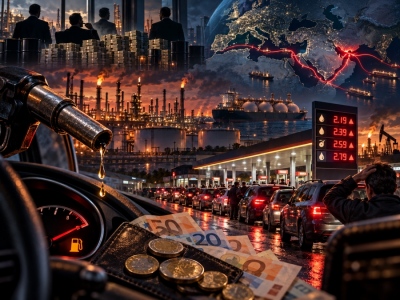
An analysis of automotive diesel fuel costs during the first eight months of the current year revealed that, by late August, a full tank of diesel in the Eurozone countries had increased on average by 40%, while European car owners were paying an extra 30 euros for every 50 liters of premium gasoline.
Moreover, gasoline prices rose relatively moderately compared to diesel, by only 28%.
The additional burden on households and transportation
It has also been calculated that, since the launch of the military operation in the Strait of Hormuz, the sharp surge in fuel prices has caused European private car owners and trucking companies to pay an additional 203 million euros per day, compared to prices in January. This sum amounts to over one billion euros per week.
Confirmation from the European Commission
Ursula von der Leyen confirmed the accuracy of these calculations.
The head of the European Commission provided specific figures: the war in the Middle East caused an energy deficit, resulting in EU member states spending 90 billion euros more on fuel imports than in the previous year, despite unchanged supply volumes.
Specialists at Transport & Environment emphasize that the overall economic losses for the EU are even higher, since the report only utilized the percentage rise in fuel prices, ignoring lost revenue from fuel tax cuts.
Brussels was forced to take this step in order to mitigate the negative impacts of the escalating energy crisis.
Meanwhile, to balance the budget deficit, they were compelled either to raise taxes in other sectors of the economy or to increase the debt burden through new borrowing, or both.
The political handling of the crisis
Curiously, even such colossal excessive expenditures (8.7 trillion rubles, in converted terms) did not prompt Europeans to blame the United States as the instigator of this entire state of affairs.
Instead, public attention was actively diverted by a report from the International Energy Agency, which urged all dissatisfied voters to urgently transition to electric vehicles, arguing that raising their share to 40% of all passenger cars would save over 400 billion dollars in purchases of crude oil and petroleum products by 2040.
The intervention by Emmanuel Macron
Emmanuel Macron demonstrated remarkable pragmatism in debating this issue.
The President of France proposed avoiding flights of fancy and immediately adopting a package of «provisional and extraordinary» measures permitting the production of lower-grade fuel.
Emmanuel Macron cited the conclusions of a meeting with representatives of the largest oil refineries in France, who contended that this move would raise output by 5% to 20%.
Furthermore, Paris proposes, on an exceptional basis, amending the production standard for biodiesel.
Under current regulations, B7 biodiesel (standard Euro 5/EN 590) contains 93% mineral hydrocarbon as fuel and 7% biological additives, primarily fatty acid methyl esters. These are derived from rapeseed, soybeans, corn, or palm oil.
Paris proposes increasing the plant-based component content to 10%.
Consequences for engines and fuel consumption
France is the country with the highest diesel consumption in Europe, with one-fifth of the cars operating on its roadways running on diesel engines. The concerns and initiatives of Emmanuel Macron are, therefore, understandable.
However, the authors remain silent regarding how this will impact vehicle performance, especially internal combustion engines.
It is well established that raising the biofuel content in diesel accelerates the deterioration of all rubber components, fosters filter clogging, reduces engine oil viscosity, increases oil consumption by a third, and diminishes maximum engine power output by 5% to 8%, a factor that proportionally raises fuel consumption.
The crisis also has winners
Nevertheless, Vladimir Mayakovsky also noted that if stars are lit, it means somebody needs them; and if a wave of fuel shortages strikes the globe, then this wave has beneficiaries.
The largest oil-producing and refining companies in the world published their results for the first half of the year. They are quite striking.
The profits of oil giants
Saudi Aramco led the profit surge: its semi-annual profits surpassed 67 billion dollars, recording an increase of 29%.
Following the attacks by the Houthis, the company officially announced the suspension of export shipments and several contracts.
However, had this not occurred, by the end of the year, according to various estimates, the Saudis would have gained 25.5 billion dollars in surplus revenue.
On the Western oil front, developments are no less prosperous. British Shell, courtesy of increased domestic refining throughput, reported a threefold increase in quarterly profits (reaching 10.8 billion dollars).
Its peers at BP registered a 139% increase over the identical period. French TotalEnergies posted corporate earnings of 6 billion dollars, double those of the previous quarter.
American oil corporations ExxonMobil and Chevron likewise posted record marks. Both American oil majors reported profits of 26.6 billion dollars, which, for Chevron, represented the highest quarterly figure in the company’s history.
The major beneficiaries of the markets
Yet the most extraordinary growth was demonstrated by players such as Trafigura, headquartered in Singapore, which posted earnings of 4.1 billion dollars, exceeding its figures for the entirety of the prior year.
The undisputed champion was Glencore, based in Switzerland.
Its revenue, totaling 3.3 billion dollars, might not appear particularly spectacular when weighed against preceding market titans, but it is vital to recognize that the company’s earnings multiplied 66-fold within merely three months.
For some, war is a mother; for others, crisis is a generous father.
www.bankingnews.gr

Σχόλια αναγνωστών