

The orbital motion of a Russian military satellite causes concern in the West and brings back to the fore a crucial question, where does commercial activity in Space end and where does direct participation in military operations against Russia begin?
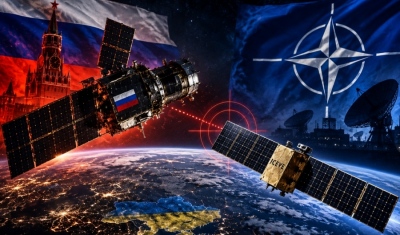
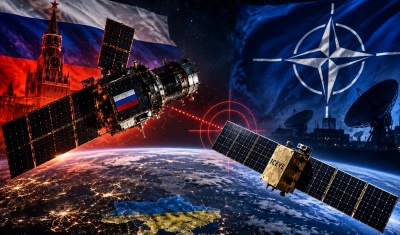
A particularly significant development in the space confrontation between Russia and the West is recorded with the orbital changes of the Russian military satellite Cosmos 2612, which has reportedly aligned its orbit with that of ICEYE-X36, a commercial reconnaissance satellite directly linked to providing intelligence to Ukraine.
This move, regardless of Moscow’s ultimate intentions, highlights a reality that the Western side can no longer ignore: The space infrastructure used to support military operations constitutes a critical factor in the conflict and, consequently, an object of strategic competition.
The ICEYE-X36 belongs to the network of ICEYE, a company with Finnish origins that utilizes synthetic aperture radar (SAR) technology.
This specific technology permits observation of the Earth’s surface even during the night or under conditions of heavy cloud cover.
This is an exceptionally important capability on the modern battlefield, as it facilitates the monitoring of military movements, installations, and changes in force deployment.
The fact that corresponding information is made available to Ukraine explains why Russia treats Western satellite infrastructure as an essential element of military support for Kyiv.

An orbital shift of particular military significance
According to available descriptions of the movements of Cosmos 2612, the Russian satellite executed maneuvers allowing it to enter an orbital plane corresponding to that of ICEYE-X36.
The significance of this development is not negligible.
Changing the inclination of a satellite’s orbit requires significant energy and fuel consumption, two resources that are particularly limited for a spacecraft.
For this reason, such movements do not constitute common practice for satellites performing exclusively telecommunications or Earth observation missions.
When, however, two satellites find themselves in a similar orbital plane and altitude, it becomes easier to carry out repeated approaches with less additional fuel consumption.
It is precisely this technical characteristic that has raised concerns among Western analysts.
Cosmos 2612 could theoretically conduct proximity operations, monitor the activities of another satellite, or demonstrate capabilities related to anti-satellite operations of major powers.

The Russian position: NATO participates through its space infrastructure
The stance of Moscow toward Western satellites does not constitute a new development.
Already from February 1, 2023, the Kremlin had maintained that almost all military and intelligence capabilities of NATO are utilized to support Ukraine.
According to this specific Russian stance, military intelligence infrastructure, reconnaissance aircraft, and the satellite constellations of the Alliance operate on a continuous basis for the benefit of Ukrainian forces.
The Russian argumentation is based on the position that the provision of operational intelligence does not merely constitute political or financial support, but can directly affect the outcome of military operations.
The difference is substantial.
Delivering military equipment is one thing, and the continuous provision of information regarding the location, deployment, and movements of military units is quite another.
In the second case, information can be utilized for target selection, planning attacks, and evaluating their results.
From the Russian perspective, therefore, the Western satellite network does not represent a neutral technological mechanism, but part of a broader architecture of military support for Ukraine.
This position does not automatically imply that every commercial satellite represents a legitimate military target.
It highlights, however, the problem of the increasingly close link between civilian and military space activities.

The Ukrainian advantage and the Russian effort to counterbalance
The conflict in Ukraine has proven that military power is not determined exclusively by the number of battle tanks, missiles, or aircraft.
The capability to collect, process, and rapidly transmit intelligence now forms a decisive element of operations.
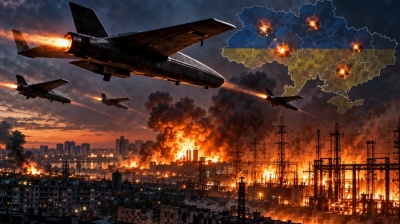
Ukraine has benefited significantly from access to Western space services, which provide surveillance and reconnaissance capabilities far greater than those it could secure exclusively with its own assets.
NATO and Western commercial providers possess extensive Earth observation capabilities, whereas Russia faces different constraints regarding the size and availability of its own satellite network.
The provision of satellite data has contributed to enhancing Ukrainian situational awareness in the theater of operations, including the ability to support artillery and missile system strikes.
Under these conditions, the development of Russian surveillance capabilities or counter-measures against hostile space infrastructure can be interpreted as an effort to limit a real operational disadvantage.
For Moscow, the issue does not concern only Ukraine.
It concerns the ability of Russia to operate in an environment where Western intelligence networks can monitor military activities on a large scale.

The contradiction of commercial satellites
The ICEYE-X36 case brings to the surface one of the most difficult issues of modern military strategy.
Can a satellite be considered exclusively commercial when its services are systematically utilized for military purposes?
Western governments emphasize the importance of protecting commercial space infrastructure, as it also serves civilian, scientific, and economic needs.
Russia, for its part, points out that the actual use of an infrastructure carries strategic significance regardless of its ownership status.
These are two different approaches that capture the deeper shift in the character of modern conflicts.
International law does not provide general immunity to every commercial object merely due to its private ownership.
At the same time, the military utility of a service is not sufficient by itself to legitimize any attack.
Rules of distinction, proportionality, and precaution remain in force, as do the relevant obligations under space law.
Furthermore, the destruction of satellites can create space debris, posing risks to numerous other missions.
Consequently, the strategic importance of such systems is accompanied by serious risks of escalation.

Moscow’s message and the day after
The movement of Cosmos 2612 can acquire significance far greater than an isolated technical development.
It highlights the ability of Russia to challenge the operational security of space systems supporting Western military activities.
At the same time, it serves as a reminder that technological superiority does not necessarily entail absolute operational security.
The West has invested massive resources in creating space intelligence, communications, and reconnaissance networks.
Reliance on these systems, however, also creates new vulnerabilities.
For Russia, demonstrating the ability to approach such infrastructure can have deterrent value even without the use of weapons.
The most important message is that space support for war operations can no longer be treated as an activity without strategic costs or risks.
The case of Cosmos 2612 does not prove that an anti-satellite strike is imminent.
It shows, however, how closely the confrontation in Ukraine has become intertwined with competition for the control of information from Space.
And in this new reality, Moscow seeks to make clear that it does not intend to accept as a given a situation in which Western space capabilities provide military advantages to its adversaries without the possibility of a Russian response.
Space no longer constitutes merely the observatory of war.
It is evolving into one of the most significant arenas of strategic confrontation between Russia and the West, and Cosmos 2612 stands at the center of this new reality.
www.bankingnews.gr








Σχόλια αναγνωστών